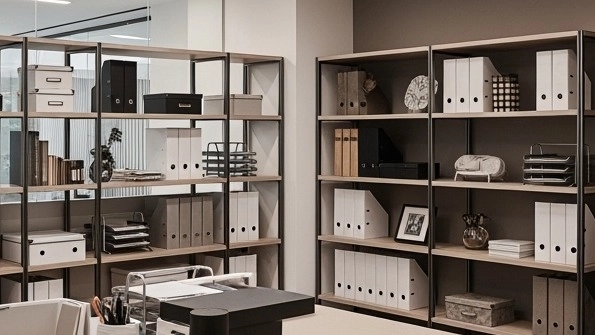
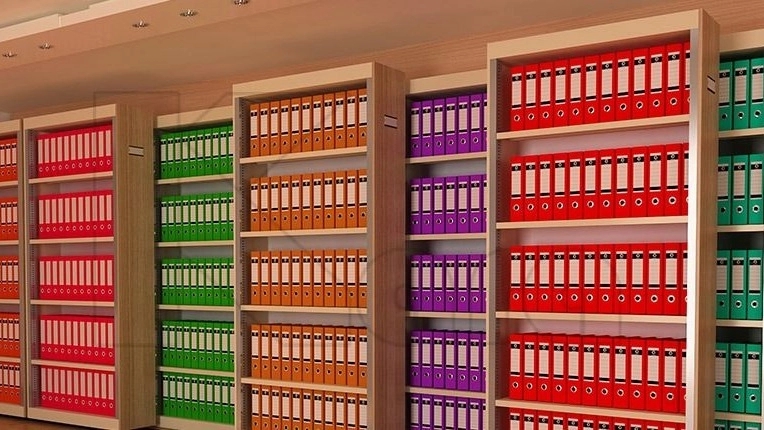
Office shelving is systems used to organize and maintain documents, files, office supplies and equipment in workplaces and offices. These shelves are usually designed to give the office space a regular and professional appearance. At first glance, the shelf may seem just a device to prevent irregularities, but in reality, a smart and proper shelf system is the spine of an efficient, dynamic and inspirational office. In a world where the physical space of the offices is precious and the productivity of employees is the key to success, investing in the right shelving is a strategic decision.
Key advantages of office shelving: Return of capital through order
Your initial text properly mentioned the main benefits. Here are some more detail:
Main Types of Office Shelving: An option for any need and space
The office shelving market is very diverse. Choosing the right option depends on the type of use, the volume of the equipment, the budget and the style of your office decoration.
1. Rail Archive Shelves (Mobile Shelving Systems)
This system, also known as the "rail archive wardrobe", is an ideal solution to optimize space in large archives. The shelves are mounted on the rails and move them with a corridor in the required location.
- Application: Large archives of government departments, insurance companies, banks, hospitals and any place where a large volume of paper documents is kept.
- Benefits: Increased storage capacity up to twice as high, high security, and high security (often large). Modern.
- Tips: Higher initial cost than fixed shelves, need to be resistant to system weight tolerance.
2. Library shelves or open shelves (Open Shelving / Bookcases)
This model is the most classic and common type of shelf in offices. It is easy to access the items in these shelves and can also be used to display decorative elements.
- Application: Book maintenance, zonak, catalogs as well as displaying awards, plants and decorative objects.
- Benefits: Easy and fast access, reasonable price, high variety in design and gender (wood, metal, MDF) Space.
- Tips: The equipment is exposed to dust, they are not suitable for confidential documents.
1. Cabinet file or sliding wardrobe (Fling Cabinets)
These cabinets are professionally designed for the archive of documents and files in the standard disconnection. Are usually supplied as vertical or horizontal drawer.
- Application: Organizing personnel files, contracts, financial documents and any type of paper document that requires accurate categorization.
- Benefits: Excellent organization for documents, locking capability to increase security, protect documents and dust. They are not suitable for holding bulk items.
1. Model shelving (Modular Shelving)
These systems are made up of separate units that can be arranged as a puzzle and created different combinations based on the need. This flexibility makes them ideal for growing offices.
- Application: Startup offices, joint work spaces and companies whose needs change rapidly.
- Benefits: Extraordinary flexibility and scalability, high customization capability, modern and creative design. Not integrated systems.
1. Wall shelves (Wall-Mount Shelves)
These shelves are mounted directly to the wall and do not occupy the surface, so they are a great option for small offices.
- Application: Small offices, top of the desk, corridors.
- Benefits: Maximum savings in floor space, minimal and modern appearance, installation at custom altitude.
- tips: Has.
1. Creadenzas & Low Cabinets)
Dischools are low -profile wardrobes that are usually behind or by the management desk. These multipurpose devices provide both storage space and provide an extra work level for printers, scanners or other items.
- Application: Management offices, conference rooms, reception spaces.
- Benefits: Multi -use (storage and work level), a stylish and formal look, help define space. They are
Step -by -step guide to select the right office shelving
Supplementary tips for organizing and maintaining
- Labeling: Tagging everything! Use clear labels for drawers, zones and boxes. This simple task greatly reduces search time.
- Regular cleansing: devote time (for example every three months) to clean and discard unnecessary documents and equipment. This prevents unnecessary accumulation.
- Use divisions: Use the separators in the drawer and class divisions to order smaller items.
Conclusion: Shelving as a strategic tool
Finally, office shelving is far beyond a few boards. It is a strategic tool for managing space, time and energy in the workplace. The right choice can increase productivity, create a positive organizational culture, and show a professional picture of your business. By spending time evaluating the needs and choosing a system that is both practical and beautiful, you are investing in one of your most important assets: a regular, efficient and inspiring work environment.