

First part: Getting to know the concept of 3D laser scanning
Second part: The role of 3D laser scanning in the protection of historical monuments
1. Millimeter accuracy in recording details
2. Reducing the risk of physical harm
3. Comprehensive and fast registration of information
The third part: practical applications of laser scanning in historical projects
Digital reconstruction and 3D modeling
Video and archival documentation
Assessing the degree of destruction or deformation
Part 4: Understanding the importance of laser scanning for researchers
The fifth part: Iran's experience in using this technology
In recent years, large projects in Iran have also been carried out using 3D laser scanning in the documentation of historical works. Collections such as Isfahan Jame Mosque, Takht Jamshid and Soltanieh Dome are among the buildings that have been documented by 3D laser scanning method.
As one of the pioneers in this field, Iran Laser Scanning has successfully completed many projects using advanced equipment and expert operators. In addition to rental of 3D laser scanning in Tehran, this company also offers post-scanning services including modeling, processing and extraction of 2D maps.
The sixth part: the implementation process of 3D laser scanning in historical works
Executing a 3D scanning project has certain technical steps:
First step: Initial visit and scan planning
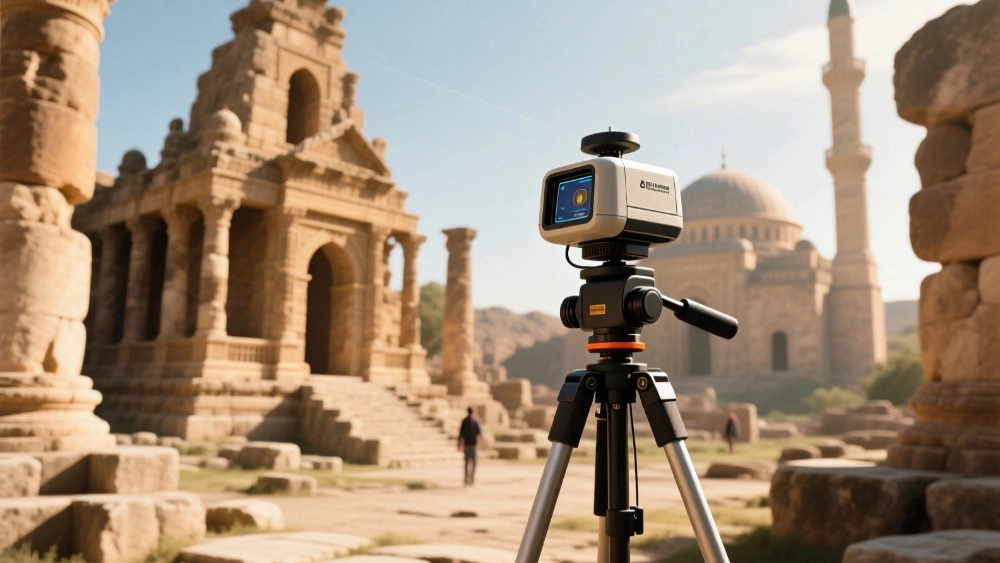
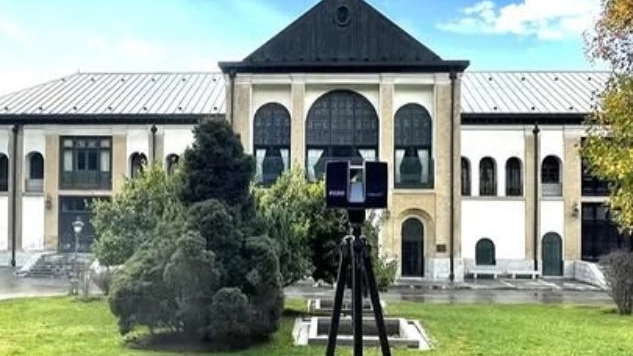
Experts laser scanning of Iran visit the project site and determine the scanner installation points, radiation angle and the number of necessary positions. In historical works, the goal is the least physical contact and the most precision.
Second step: scanning on site
At this stage, the 3D scanner records millions of spatial data by rotating 360 degrees at each point. The time of each scan is usually between 5 and 10 minutes.
Third step: data processing
The collected information is processed and combined in specialized software and a coherent 3D model is obtained. The data is then saved in common formats such as E57 or RCP.
Fourth step: analysis and production of output
Finally, the 3D model can be used for documentation, geometric analysis or production of architectural drawings.
Section Seven: Economic and research benefits
Although at first glance 3D laser scanning in documenting historical monuments seems expensive, in the long run it is very cost-effective in terms of time and money. This method increases the speed of documentation several times and almost eliminates the possibility of human error.
On the other hand, the created digital archive can be studied for future generations without the need for physical presence. Such an archive creates new opportunities not only for conservation but also for virtual tourism.
Section 8: The relationship between laser scanning and BIM technology
One of the important points in 3D laser scanning in the documentation of historical monuments is matching the scan data with building information modeling (BIM).
By entering the data into the BIM environment, the restoration process can be simulated with high accuracy. This feature is especially useful in the reconstruction projects of complex historical works.
Laser Scanning Iran has provided architects and engineers with the possibility of complete integration of historical and technical data by providing models that can be used in BIM software.
Section 9: Challenges and limitations
Besides the advantages, the implementation of 3D laser scanning in the documentation of historical works is also associated with some challenges. For example:
- Need for advanced equipment and professional operator
- Effect of light and weather conditions on data quality
- High volume of raw data and need for high processing power
Nevertheless, the experience of Laser Scanning Iran has shown that with proper management and the use of modern error correction technologies, very accurate and stable results can be obtained.
Part 10: The future of digital documentation of historical works
Technological developments in the field of laser scanning are expanding day by day. The arrival of portable 3D laser scanning and drone-based systems has revolutionized the future of documentation. The combination of ground and aerial data provides the possibility of complete modeling of the works with all the details.
In the not too distant future, all historical monuments can have digital versions always available. The role of Laser Scanning Iran in realizing this vision is to provide technical infrastructure and local experts in the country.
Summary: 3D laser scanning, a bridge between past and future
3D laser scanning in documenting historical monuments is not only an advanced technology, but also a tool to preserve human cultural memory. With millimeter accuracy, high speed and complete safety, this method can provide researchers with a set of irreplaceable data for the reconstruction, analysis and protection of historical monuments.
The Iran Laser Scanning company, as a specialized center in this field, provides full 3D laser scanning rental services, data processing, modeling and consulting for historical documentation projects in Tehran and across the country.
If you have a project related to historical monuments, traditional architecture or the restoration of old buildings, contact Laser Scanning Iran to receive expert advice and accurate cost estimates and benefit from modern technology in the service of history.