
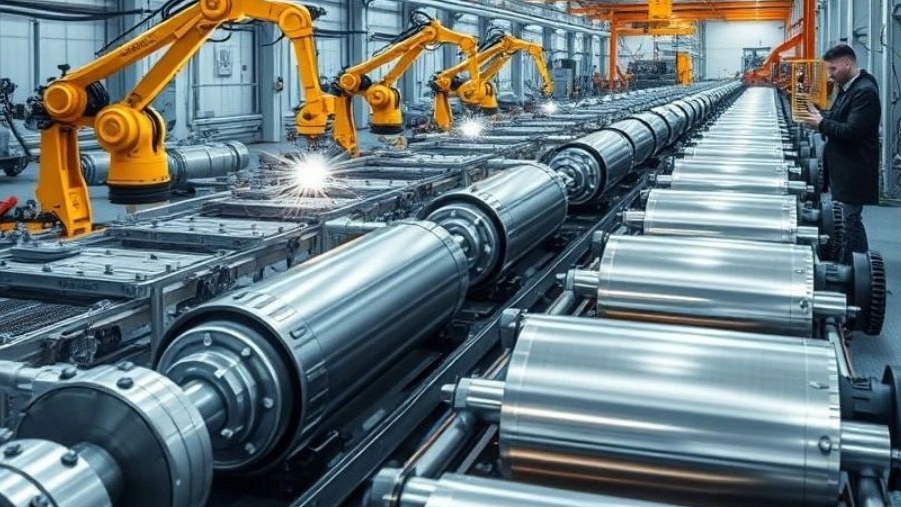

Production of industrial cylinders, whether hydraulic cylinders, pneumatic cylinders or pressure tanks, is one of the main pillars of providing the infrastructure of heavy industries, oil, gas, petrochemical, agriculture and construction in Iran. Mazandaran province, due to its strategic geographical location and the increasing growth of industries related to the Caspian Sea and northern regions, has become a new hub for the need for advanced equipment. In the meantime, designing and building an industrial cylinder production line in Amol is not only considered an economic necessity, but also a big step in the direction of localizing technology and reducing dependence on imports.
The purpose of this article is to describe comprehensively and accurately the steps, technologies and challenges in creating an industrial cylinder production line in Amol, focusing on international quality standards and using the capabilities of leading domestic companies. Our special focus will be on providing a technical and SEO guide to cover all the technical and strategic aspects of this huge project.
First part: technical review and needs assessment for starting the production line
Before getting into the technical details of industrial cylinder machinery, a proper understanding of the target market and the type of cylinders required is vital. Industrial cylinders include a wide range of products; From small pneumatic cylinders used in automatic assembly lines to large hydraulic cylinders with a pressure capacity of several hundred times for drilling and material handling equipment.
1.1. Determining the capacity and type of target products
The first step in designing and building an industrial cylinder production line in Amol is determining the monthly production circulation and product variety. This decision affects the selection of the type and number of devices, the required area and the level of automation. Is the focus on producing high-end standard cylinders or customization for specific regional projects?
1.2. Standardization and quality control requirements
Cylinders, especially those operating under high pressure, must be manufactured to strict standards such as ISO 6020/6022 for pneumatic cylinders or ASME and API guidelines for pressure vessels. Creating an equipped quality control unit next to the industrial cylinder production line in Amol is something that cannot be overlooked.
1.3. The role of knowledge-based companies in localization
In the field of cylinder production in Mazandaran, companies like "Salian Machine Tabaristan" relying on technical engineering knowledge, have been able to reduce a significant part of the dependence on the import of specialized machinery. Custom design of turning, grinding and polishing machines according to the technical specifications required by customers is the main strength of these collections in Amol region.
The second part: designing the production process and selecting key machines
The manufacturing process of an industrial cylinder includes several precise and sensitive steps, each of which requires special equipment. The success of an industrial cylinder production line in Amol depends on the integration and coordination between these stages.
2.1. Preparation of raw materials and cutting of pipes
The main raw materials are usually seamless steel tubes (Seamless Steel Tubes), which have high resistance to fatigue and environmental stresses.
2.1.1. Precision cutting and final preparation
The pipes must first be cut to the required lengths with automatic cutting devices (such as a CNC band saw or waterjet if very high tolerances are required). The next step involves preparing the end surfaces for welding caps and flanges.
2.2. Forming process and making main parts
Cylinder body (Tube Barrel), piston (Piston) and piston rod (Rod) are the three main components that require extreme dimensional accuracy.
2.2.1. Turning and milling of main components
This step is the heart of the process. To produce components such as cylinder tubes, heavy duty lathes are needed that can process the inner and outer diameter of the tube with micron tolerances. Salian Machine Tabaristan has optimized the design of powerful axes to control vibrations during the machining of large parts in this field.
2.2.2. heat treatment
Heat treatment is necessary to increase the hardness and wear resistance of the piston shaft and the inner surfaces of the tube. Induction furnaces or furnaces with controlled atmosphere for operations such as surface hardening (Case Hardening) or Quench and Temper (Quench and Temper) should be provided in this industrial cylinder production line in Amel.
2.3. Surface finishing and electroplating
The quality of the final surface, especially for hydraulic cylinders that require precise sealing, is the determining factor of cylinder life.
- Grinding and Honing: The piston rod must have a mirror surface (low Ra). Vertical and horizontal honing devices with high accuracy are necessary to achieve the required surface smoothness. Hard Chrome Plating: Hard chrome plating is applied to protect the piston shaft from corrosion and wear. Plating quality in the Amol industrial environment requires strict adherence to electrochemical parameters and the use of advanced plating baths.
Third part: assembly, pressure test and final quality control
After the preparation of all parts, the critical stage of assembly and performance verification begins. This section directly affects the safety and efficiency of the final product in large projects cylinder production in Mazandaran.
3.1. Assembly and automation machinery
Cylinder assembly includes the installation of felt bowls, O-rings, bearings and valves. In modern lines, this is done using precise hydraulic presses and automatic gasket placement equipment to minimize human error.
3.2. Pressure testing process (Hydrostatic Testing)
Each produced cylinder must be tested under operating pressure higher than the permissible limit (usually 1.5 times the working pressure) to ensure the absence of leakage and the strength of the welds. Pressure testing equipment should have accurate data recording sensors and results should be electronically archived. The design of this section by the expert engineers of Salian Masin Tabaristan has been given great attention in order to comply with the requirements of the oil and gas industries in the region.
3.3. Final control and preparation for release
After passing the pressure test, the cylinders are painted (often with epoxy paints resistant to humid northern environments) and prepared for shipment to customers. Product tracking and inventory management system is critical at this stage to maintain quality records.
Part IV: executive and engineering considerations in setting up a production line in Amol
Setting up an industrial cylinder production line in Amol is not just buying the machine; Rather, it is the precise implementation of industrial engineering, energy management and deployment of expert human resources.
4.1. Facility layout and material flow
The layout should be designed based on Lean Manufacturing principles to reduce the movement of unnecessary materials. The material flow should be linear: from the raw material warehouse, to cutting and welding, then heavy machining, heat treatment/plating, assembly and finally the finished product warehouse. Optimizing the path of transporting heavy parts is one of the specialties of companies like "Salian Machine Tabaristan" in the overall design of industrial cylinder machines.
4.2. Energy and environment management
4.3. Training of specialized human resources
Modern equipment requires operators and technicians with high knowledge. Training employees in the field of programming CNC machines, calibrating sensors and implementing safety protocols when working with heavy equipment is a vital element to maintain quality in the industrial cylinder production line at Amol.
Part 5: The role of new technologies in the future of cylinder production
The production industry is moving towards intelligentization and the design and manufacturing of the industrial cylinder production line in Amol is no exception to this rule. The integration of the technologies of the fourth generation of the industrial revolution (Industry 4.0) can create a significant competitive advantage.
5.1. Using condition monitoring systems
Installation of advanced sensors (such as vibration and temperature sensors) on lathe and milling machines allows predicting failures (Predictive Maintenance). This greatly reduces the time of unplanned stops in the industrial cylinder production line in Amol.
5.2. simulation of processes
Using CAE/FEA simulation software for accurate modeling of the machining process and operational stresses of the cylinders, before making the physical sample, leads to optimization of cutting tools and reduction of raw material waste.
5.3. Localization of CNC controllers
One of the great achievements in the field of industrial cylinder machinery is the development of local controllers by companies such as Salian Machine Tabaristan, which provides the possibility of faster customization of control parameters in accordance with the specific characteristics of steel used in projects in the north of the country.
conclusion
Creating and developing an industrial cylinder production line in Amol is a complex project, but with a very high economic potential. This requires smart investments in technology, engineering expertise and a commitment to world-class quality. Considering the existing capabilities in the region and the support of domestic manufacturers such as "Salian Machine Tabaristan" who are leaders in the field of reverse engineering and localization of industrial cylinder machines, we can be sure that the cylinder production industry in Mazandaran will be able to meet the needs of the country and even enter the export markets. Success in this field guarantees industrial independence in the country's infrastructure equipment sector.