
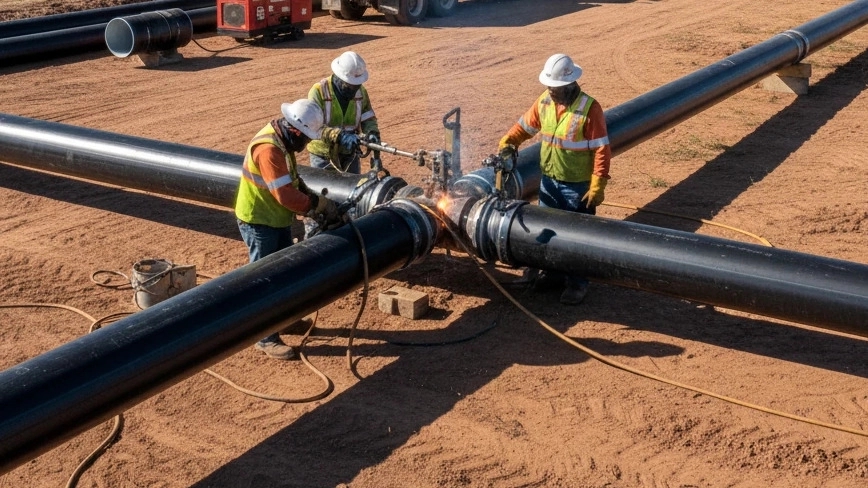


Polyethylene welding is one of the specialized and widely used methods in connecting polymer pipes, especially in water supply, gas supply and agricultural projects. This type of welding has become a reliable alternative to traditional joints due to its high strength, durability and resistance to leakage. In fact, polyethylene welding creates the point of connection of two pieces of the same material in such a way that the final result is a unified structure and the same as the main pipe.
In this article, we comprehensively examine what polyethylene welding is, what types it has, what applications it has in industry and agriculture, and why a group like Rad Sanat uses this method in the implementation of water supply projects.
What is polyethylene and why is it used for pipes?
Polyethylene is a type of resistant thermoplastic that is obtained from the polymerization of ethylene. Due to its light weight, high resistance to corrosion and flexibility, this material has quickly opened its place in various industries.
Polyethylene pipes are especially used in water, sewage, gas and even agricultural irrigation systems projects. The flexibility and weldability of this material allows the implementation of large water supply networks with completely sealed and leak-free connections.
In the projects implemented by Rad Sanat Industrial Facilities, the use of polyethylene pipes has brought very favorable results due to their high quality and the possibility of precise welding.
Definition of polyethylene welding
Polyethylene welding is a process in which two surfaces of polyethylene pipes or joints are connected to each other with specific heat and pressure. In this method, heat melts the contact surface and by applying pressure, two parts are permanently and seamlessly welded together.
The result of this process is a joint of the same type as the pipe body, which mechanically and chemically acts like the pipe itself, and there are no weak points or leakage points.
In fact, the purpose of polyethylene welding is to create a connection that is even stronger than the pipe itself.
Types of polyethylene welding methods
In the implementation of industrial projects, depending on the type of pipe, working pressure, diameter and environmental conditions, different methods are used for polyethylene welding. Rad Sanat, having advanced welding devices, uses world standard methods in its projects.
Butt Fusion
In this method, the two ends of the polyethylene pipe are placed in the butt-welding device and heated to a certain temperature with a thermal plate. After the surfaces are melted, the pipes are pressed together to form a seamless joint after cooling.
This type of welding is the most common method in water supply projects with large diameter pipes.
Electrofusion welding
In the electrofusion method, special connections are used that have resistance wires inside them. With the passage of electric current, the necessary heat is generated to melt the polyethylene layers and a completely watertight connection is created.
This method is mostly used in lines with a lower diameter or in places where there is not enough space to install a butt welding machine.
Extrusion Welding
In this type of welding, a device similar to a heat gun is used, which injects melted polyethylene in the joint. This method is usually used to repair pipes or connect polyethylene sheets.
Advantages of polyethylene welding
The correct implementation of polyethylene welding has many advantages in water transfer projects and piping systems. The most important features of this method are:
- Completely sealed and leak-free connection
- High durability and strength against pressure and impact
- Excellent resistance to corrosion, rust and chemicals
- Reducing the need for mechanical and metal connections
- Useful life of more than 50 years under standard conditions
These features have made polyethylene welding become the first choice of professional contractors including Rad Sanat in water supply projects in Yazd and desert areas.
Applications of polyethylene welding in industry and agriculture
The application of polyethylene welding is not limited to a specific industry. This method is widely used in the following fields:
1. Urban and rural water supply projects
In the implementation of drinking water transmission networks, the use of polyethylene welding ensures the safety of water and prevents the penetration of pollutants.
2. Pressure irrigation and agriculture
In drip and rain irrigation systems, polyethylene joints with precise welding ensure pressure stability and reduce water loss. Rad Sanat has used this technology in many agricultural projects in Ashkazar, Yazd.
3. Transfer of sewage and industrial effluent
Due to its high resistance to chemicals, welded polyethylene pipes are the best option for conveying sewage and sewage.
4. Gas supply lines
In gas transmission lines, safety is the first word. Polyethylene welding is also an ideal option in this sector due to the high assurance of no leakage.
Polyethylene welding steps
Preparation of pipes
First, the connection surfaces are cleaned of any pollution, moisture or foreign particles so that the welding is done uniformly.
Temperature and pressure adjustment
In the welding machine, temperature and pressure are adjusted based on the type and thickness of the pipe. Usually, the required temperature is around 200 to 220 degrees Celsius.
Melting and joining stage
The two ends of the pipes are heated and then connected with a certain pressure so that the polyethylene particles are completely combined.
Cooling and inspection
After welding, the part must be cooled in sufficient time for the joint to achieve its final strength. Then the pressure test is done to ensure the health of the connection. In the Rad Sanat collection, all these steps are done with fully automatic devices and trained operators so that the final result is completely standard.
The importance of skill in polyethylene welding
Polyethylene welding, if done by non-specialists, can lead to leakage, breakage or pressure drop in the network. Unauthorized temperature or incorrect pressure is one of the main causes of defects in welding.
For this reason, Rad Sanat Industrial Facilities uses trained and certified polyethylene welding technicians in all its projects. Experience and precision in this work make the difference between a successful project and a costly and flawed system.
Equipment required for polyethylene welding
Special tools and machines are needed to perform polyethylene welding. Some of the main equipment are:
- Butt welding or electrofusion device
- Heat plate with digital temperature control
- Pipe holding clamps
- Pressure and temperature measuring instruments
All the equipment used in Rad Sanat projects are from reputable brands and have standard approval to ensure the final welding quality.
Why choose Rod Sanat for polyethylene welding?
Rad Sanat is known as one of the leading operators of polyethylene welding with years of experience in implementing water supply and industrial piping projects in Yazd province, especially in Ashkazar region.
The reasons for choosing Rad Sanat include the following:
- Using advanced polyethylene welding devices
- Full compliance with international ISO and DIN standards
- Supervision by experienced engineers in all stages of implementation
- Providing quality guarantee for connections and pipes
Relying on quality and precision in execution, Rad Sanat has been able to win the trust of farmers, contractors and industries in the region.
The future of polyethylene welding and new technologies
With the advancement of technology, polyethylene welding methods are also evolving. New digital devices allow for more precise control of temperature, pressure, and boiling time. Also, data recording systems automatically provide the possibility of evaluating and documenting the quality of each connection. Rad Sanat has prioritized the updating of equipment and training of technical forces in its development path so that it always works in accordance with global standards.
summary
Now that we know what polyethylene welding is and what it is used for, we can see that this method plays an essential role in the implementation of water supply, gas supply and agricultural projects. Resistant connections, high durability and eliminating the possibility of leakage are the most important reasons for its use.