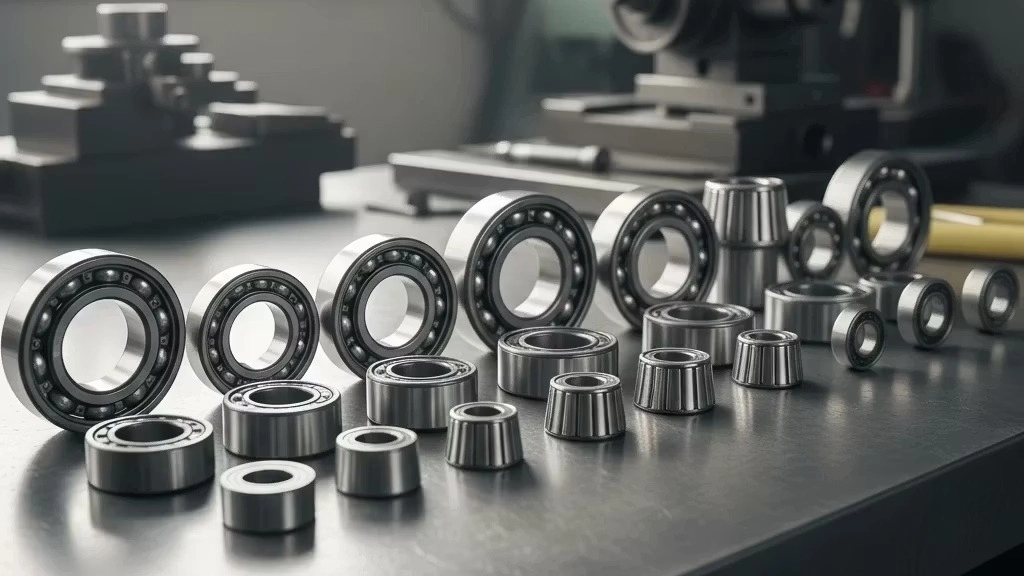

Bearings, the unsung heroes of the mechanical world, play a vital role in almost every moving device, from the smallest household appliances to the largest industrial turbines. By reducing friction, they enable smooth, accurate and efficient movement. However, this small and vital piece, if chosen incorrectly, can become the Achilles heel of a system and cause irreparable damage. The process of choosing and purchasing suitable bearings is a specialized knowledge that requires a deep understanding of numerous technical parameters. A wrong buying a bearing not only leads to the premature failure of the part itself, but can disrupt the performance of the entire machine and bring heavy repair costs and stop production.
In this comprehensive guide, Pars Store, as a specialized reference for sales and advice, intends to introduce you step by step to all the key aspects in choosing bearings. Our goal is that after reading this article, you will be able to purchase the best bearing for your application with an open mind and complete knowledge, and understand why a reliable bearing purchase from a reputable source is a smart investment.
Why choosing the right bearing is a strategic decision?
Many people consider the process of purchasing bearings to be a simple task, but experienced professionals and craftsmen know that it is a technical and strategic decision with far-reaching implications. Ignoring the importance of this issue brings serious risks:
- Decreased life span and frequent failures: Choosing a bearing inappropriate to the amount of load or speed, leads to premature metal fatigue, excessive wear, and ultimately the complete destruction of the part in a much shorter time than its standard life.
- Damage to adjacent parts: The failure of a bearing is rarely limited to the part itself. The resulting vibrations can cause serious damage to the shafts, axles, gears and housing of the device and multiply the cost of repairs.
- Increasing energy costs: An improper bearing requires more power from the engine or drive source by creating additional friction. This means an increase in energy consumption and a decrease in the overall efficiency of the system. Safety risks: In sensitive applications such as car wheels, medical equipment or heavy industrial machinery, the sudden failure of a bearing can lead to catastrophic accidents. Production line stoppage: For a factory, an unplanned stoppage of the production line due to the failure of a bearing means direct financial loss. The cost of a high-quality bearing against this loss is very small.
Therefore, spending time to choose the right bearing and buy original bearing from a center like Pars Store is a preventive measure to preserve your capital, time and safety.
The first step: understanding the key parameters in the selection of bearings
For a scientific and accurate bearing selection, you must master the language of these parts. This language contains the technical parameters that determine the performance characteristics of bearings.
1. Type and Direction of Load
The load on the bearing can be applied in different ways:
- Radial Load (Radial Load): A load that is applied perpendicular to the axis of the shaft (such as the weight of a coin on the shaft). Deep groove bearings and cylindrical roller bearings are ideal for this type of load.
- Axial Load (Axial/Thrust Load): Load that is applied along the axis of the shaft (such as the force applied to a drill when drilling). Deep groove ball bearings are designed exclusively for this load. Combined Load: When radial and axial loads exist simultaneously. Angular contact bearings and tapered roller bearings are the best options for these conditions.
2. Magnitude of Load
Bearing selection should be proportional to the weight of the load. In general, ball bearings are suitable for light to medium loads, while for heavy and very heavy loads, you should go to the family of roller bearings, which have a much higher load bearing capacity due to the linear contact surface.
3. Rotational Speed
Each bearing has a "speed limit" that should not be exceeded. In general, ball bearings are capable of operating at higher speeds than roller bearings. The type of lubrication (grease or oil) also has a direct effect on the maximum speed that can be achieved. The process of purchasing bearings for high speed applications requires special attention to this parameter.
4. Environmental and working conditions
The environment in which the bearing works plays an important role in its selection.
- Temperature: For very high or low temperatures, a bearing with suitable internal clearance (Internal Clearance) and special grease should be used.
- Pollution: In environments full of dust, moisture or chemicals, it is necessary to buy a bearing with a plastic felt bowl (such as 2RS extension) or metal (ZZ extension) to prevent contamination. to prevent inside it.
5. Precision and Rigidity
In applications such as the spindle of CNC machines or precision tools, the bearing must have very high rotational accuracy. This accuracy is specified by standard classes (such as ABEC or ISO). Choosing a bearing with a higher accuracy class is essential to achieve accurate performance.
Getting to know the big family of bearings: which one is right for you?
Considering the above parameters, we can now introduce the main types of bearings that are fully available in Pars store.
Pars Store: Why are we your best consultants in buying bearings?
Knowing the theory of choosing bearings is one part of the adventure, and another part is making sure to buy original and high quality bearings. Pars Store combines technical knowledge and commitment to product authenticity, making this process simple and safe for you.