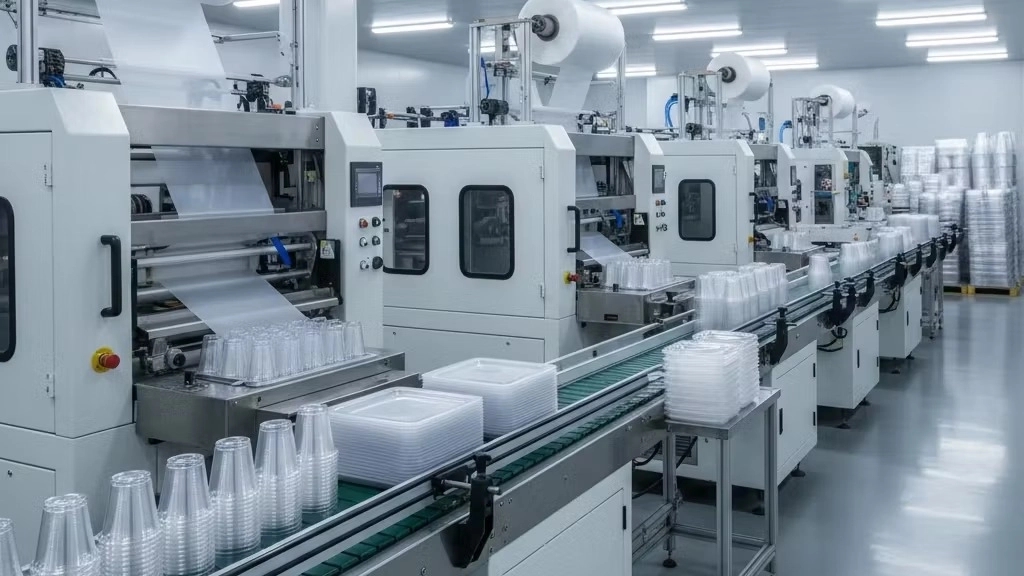

Why is raw material selection the most critical decision in your production line?
- Final product quality: transparency, brittleness, heat resistance, flexibility and appearance of your product directly depends on the type of polymer chosen.
- Final cost and profitability: The price of raw materials constitutes a significant part of the production cost. Choosing a material that strikes the right balance between quality and price is the key to your profitability.
- Machine performance and depreciation: Each machine is optimized to work with a specific range of raw materials. The use of inappropriate materials can increase depreciation, reduce the useful life of parts and frequent stops of the production line.
- Safety and health (Food Grade): To produce containers in contact with food, using food grade raw materials is a legal and ethical requirement. Failure to pay attention to this issue can lead to serious problems for the health of consumers and the sealing of your production unit.
Introduction of polymer giants: getting to know the most common raw materials
1. Polypropylene (PP): versatile champion
- Key features:
- High heat resistance: PP can withstand high temperatures and therefore is an excellent choice for microwaveable containers and hot food packaging.
- Chemical resistance: It is resistant to acids and bases and is suitable for packaging all kinds of food.
- Flexibility: It has little brittleness and is resistant to impact.
- Appearance: Naturally, it does not have complete transparency and is slightly cloudy or milky, although its transparency can be improved with additives. Applications: hot drink cups, dairy packaging containers (yogurt, cheese), take-out food containers, medical parts. Technical note from Akko: thermoforming devices manufactured by Akko are designed in such a way that they have the highest compatibility with PP sheets and a product produce with high quality and minimal waste.
2. Polystyrene (Polystyrene - PS): The king of transparency and fragility
Polystyrene or PS is another popular raw material, which is divided into two main categories:
- General Purpose Polystyrene (GPPS):
- Features: very high transparency (glass-like), hard and brittle, low heat resistance.
- Applications: cold water glasses, dessert containers, transparent lids, disposable spoons and forks.
- Resistant Polystyrene (HIPS - High Impact Polystyrene):
- Features: higher impact resistance, More flexible than GPPS, opaque appearance.
- Applications: plates, appetizers, packaging containers that do not require transparency.
- Technical note from Ako: The guide for choosing the right raw materials for the production of disposable containers tells you that if your target market is cafes and restaurants for cold drinks, GPPS is the best choice. Ako semi-forming machines are fully optimized for the mass production of HIPS containers.
3. Polyethylene Terephthalate (PET): first choice for beverage packaging
PET is mostly known for making soda and mineral water bottles, but it is also used in the production of disposable containers.
- Key features:
- Excellent transparency and shine: it gives the product a very attractive and stylish appearance.
- High resistance: it is very resistant to impact and pressure.
- Good permeability: it is a good barrier against the passage of gases and moisture.
- Applications: salad packaging containers, chopped fruits, beverage bottles, cake containers and Sweetness.
- Technical note: The production process with PET requires special conditions and equipment. Before choosing this material, be sure to consult with Ako's technical experts to ensure the compatibility of your device.
How to choose the best raw material for your product? (applicable checklist)
Now that you are familiar with the main players in this field, using this checklist you can systematically carry out the process of choosing the right raw materials for the production of disposable containers:
1. What is the final use of the product?
- For hot liquids (tea, coffee, soup): be sure to use polypropylene (PP). PS softens at high temperature and releases chemicals.
- For cold liquids (water, soft drinks): Polystyrene (GPPS) due to transparency and reasonable price, and PET due to strength, are excellent choices.
- For foods that can be heated in the microwave: Polypropylene (PP) only and only.
- For packaging (salad, fruit, sweets): PET and GPPS are the best choices due to transparency and beautiful presentation of the product. are.
2. How much transparency is important to you?
- Crystal transparency (glass): GPPS and PET are the best options.
- Medium transparency (slightly cloudy): PP is a good choice.
- Matte and colored: HIPS and colored PP are the best options for producing opaque or colored containers.
3. What is the budget and the final price?
In general, the price of polymers fluctuates in the market, but usually the price of polystyrene (PS) is slightly lower than that of polypropylene (PP). PET is also usually more expensive. The guide for choosing the right raw materials for the production of disposable dishes advises you to never sacrifice quality for price, but to look for the best "quality-to-price ratio".
4. Which material is more compatible with your production machine (thermoforming or semi-forming)?
This is a key technical question. Thermoforming machines are designed to work with PP and PS sheets and can produce very delicate and precise products. Semi-forming devices are also compatible with HIPS and PP. Consultation with the manufacturer of the device, i.e. ACO, is necessary at this stage.
5. What are the health requirements and national standards (food grade)?
Make sure that the raw material purchased has a "Food Grade" certificate from a reputable manufacturer. This certificate guarantees that the raw material is safe for food contact.
Ako's role in your raw material supply chain
At Ako, we believe that our responsibility does not end with the sale of the device, but rather the beginning of a long-term partnership. As a technical consultant based in Rasht (Gilan), we provide comprehensive services in the field of choosing the right raw materials for the production of disposable containers:
- Expert consultation before purchase: our experts analyze your business plan and target market first. Then, based on the type of product you intend to produce, they will offer you the best and most economical raw material.
- Introduction of reliable suppliers: We are in contact with a wide network of reliable manufacturers and importers of polymer sheets and granules, and we can guide you to a safe purchase at a competitive price. The installation calibrates your machine precisely to work with the same material (with respect to thickness, temperature and speed) to achieve maximum productivity.
- Operator training for working with different materials: We train your personnel how to change machine settings for different raw materials and how to solve common problems related to each material.
Conclusion: The raw material is the DNA of your final product
As you have seen in this comprehensive guide, choosing the right raw materials for the production of disposable containers is a multifaceted and specialized process that requires a balance between quality, cost, application and technical requirements of the device. This decision will have a direct effect on the success or failure of your business.
Investing in this industry, without having an expert advisor and guide by your side, can be risky. Akko Company is proudly ready to play this role for you. We not only produce the best and most modern devices for you, but by providing detailed technical advice, we help you choose the best raw materials and produce a product that has something to say in today's competitive market.
To receive free and specialized advice on setting up a production line and selecting raw materials, contact our experts at Ako today.