
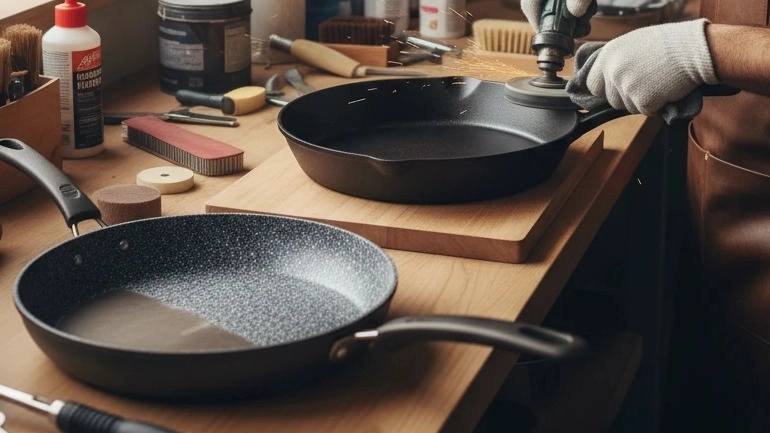
Non-stick dishes are one of the most popular and widely used cooking tools in every kitchen. These dishes have a special place among families due to their non-stick properties, easier cooking and faster washing. Over time and continuous use, the non-stick coating may become damaged, scratched, or lose its properties. In such a situation, many people use non-stick cookware restoration services, instead of buying a new cookware, to increase the useful life of their cookware.
But one thing that is often overlooked is the care of non-stick cookware after restoration. Observing certain principles after restoration or reconstruction can have a direct effect on the durability and quality of the new coating. If you take proper care of your reconditioned pan, it can perform as well as it did on day one for years.
In this article, we will introduce in detail necessary care after non-stick cookware restoration to increase shelf life and at the end, we will introduce Marjan Teflon as one of the best non-stick cookware restoration and repair centers in Mashhad.
The importance of taking care of non-stick dishes after restoration
Reconstructed non-stick cookware regains its non-stick properties, but this property depends on the type of use and daily care. Even with the use of high-quality raw materials in the restoration process, the behavior of the user plays a decisive role in the durability of the coating.
The reasons for the importance of taking care of non-stick dishes are:
- Increasing the life of the non-stick coating: Correct care can multiply the useful life of the coating.
- Maintaining the quality of food cooking: A healthy and non-stick surface makes cooking more uniform and healthier.
- Preventing scratches and damage: Wrong behavior can quickly scratch the non-stick surface.
- Saving Economical: With proper maintenance, you will not need to renovate frequently or buy a new container.
- Maintain beautiful appearance: Containers that are properly maintained will maintain their shiny and new appearance.
Key tips for caring for non-stick cookware after restoration
1. First use after restoration
After delivery of the refurbished container, it is best to gently wash and dry it before first use. Then apply a small amount of vegetable oil (such as olive or sesame oil) on the non-stick surface and heat the pan for a few minutes on low heat. This helps to "fix the final coating" and increases the property of non-stickiness.
This method, which is also called inoculation or preparation of the non-stick surface, is one of the most important steps in the care of non-stick dishes after restoration.
2. Use the right tools for cooking
The biggest mistake that users make is using a metal spoon or spatula on a non-stick surface. Metal contact with the surface can cause scratches and destroy the non-stick properties.
To take care of non-stick dishes, it is better to always use the following tools:
Metal tools are the main enemy of non-stick coating and should be completely avoided.
3. Adjusting the temperature during cooking
One of the most important principles in taking care of non-stick dishes is temperature regulation. Non-stick dishes are designed for use in medium temperatures. Using high heat will burn or gradually separate the non-stick layer.
- Never place an empty container on a high flame.
- If you need high heat, first pour some oil or water into the container.
- Avoid placing a non-stick container in the oven or on a direct gas flame without food.
Reconstructed dishes are more sensitive to high temperatures, that's why temperature control is the main key to increase their shelf life.
4. Wash properly after each use
Improper washing is one of the main factors of destruction of non-stick coating. To maintain the quality of the dish, you should pay attention to several points when washing:
- Allow the container to cool completely, then wash it. Sudden contact with cold water can cause cracks in the cover.
- Use a soft sponge or soft cloth.
- Use a mild dishwashing liquid and avoid strong detergents or those containing abrasive substances.
- Never use a dishwashing wire or a coarse scourer.
By following these simple steps, you can use your reconditioned pan for years without losing quality. Many users leave the pan wet to air dry after washing. But long-term humidity can eventually cause discoloration or damage to the bottom layer of the non-stick coating. Therefore, to care for non-stick dishes, it is recommended to dry the dish with a soft cloth after washing and store it in a dry place.
6. Avoid thermal shock
Sudden temperature change is one of the destructive factors of non-stick coating. If you place a hot non-stick pan directly into cold water, the coating may crack.
To avoid this issue:
- Let the container cool naturally.
- Avoid pouring water on the hot container.
This simple point plays an important role in increasing the lifespan of reconditioned containers.
7. Correct use in the oven and microwave
Although some non-stick dishes can be used in the oven, it is better to avoid putting them in the oven for a few weeks after restoration. Concentrated and high heat can cause premature softening of the coating.
Non-stick dishes regenerated in Marjan Teflon are usually suitable for temperatures up to 250 degrees Celsius, but it is recommended to consult the experts of this collection before any specific use.
8. Proper storage in a cabinet or shelf
How to arrange dishes is also a part of taking care of non-stick dishes. If the dishes are placed on top of each other and there is a hard object like a metal door between them, there is a possibility of scratching the surface.
For better maintenance:
- Place a napkin or cloth pad between both containers.
- Avoid hanging non-stick containers on the wall or metal hooks.
- If you have enough space, store each container separately on the shelf.
9. Periodic lubrication of the non-stick surface
One of the effective methods to increase the shelf life of non-stick dishes is periodic oiling. Every few weeks, lightly grease the inner surface of the container and let it stand on low heat for a few minutes. This makes the regenerated non-stick coating softer and more resistant.
Periodic oiling is one of the main recommendations of Marjan Teflon company experts for maintaining non-stick dishes after restoration.
10. Attention to the type of cooked food
Some foods, such as acidic sauces (for example, containing a lot of vinegar or tomatoes) can reduce the stickiness over time. Therefore, it is better to cook such foods with mild heat and for a short time.
Common mistakes in keeping non-stick dishes
Many unwanted people reduce the life of their dishes by doing some things. Here are some common mistakes:
- Using industrial oil sprays that cause peeling of the coating.
- Putting non-stick dishes in the dishwasher.
- Stacking several dishes on top of each other without protection.
- Using dry salt inside a hot dish.
- Washing in hot mode or using bleach.
Avoidance of these simple mistakes is a guarantee to maintain the durability of the non-stick coating after restoration.
The role of Marjan Teflon company in the restoration and care of non-stick dishes
Morjan Teflon Company in Mashhad is one of the most well-known specialized centers in the field of renovating, repairing and covering non-stick dishes. With years of experience, this collection has been able to win the trust of thousands of customers.
Reasons for choosing Marjan Teflon for renovating non-stick dishes:
- Using the best and most resistant non-stick coatings in the world.
- Using advanced industrial equipment and ovens.
- Expert team in the field of domestic and industrial cookware restoration.
- Providing free advice on care of non-stick cookware after restoration.
- Fast, accurate and quality guaranteed delivery.
Morjan Teflon not only provides restoration services, but also guides its customers in terms of maintaining and increasing the shelf life of dishes, so that each renovated dish remains like the first day for years.
conclusion
Reconstructed non-stick dishes, although they look new and beautiful, but their durability depends on how they are used and maintained after restoration. Observing simple tips such as using gentle heat, basic washing, complete drying and using the right tools can have a significant effect on the durability of the non-stick coating.