
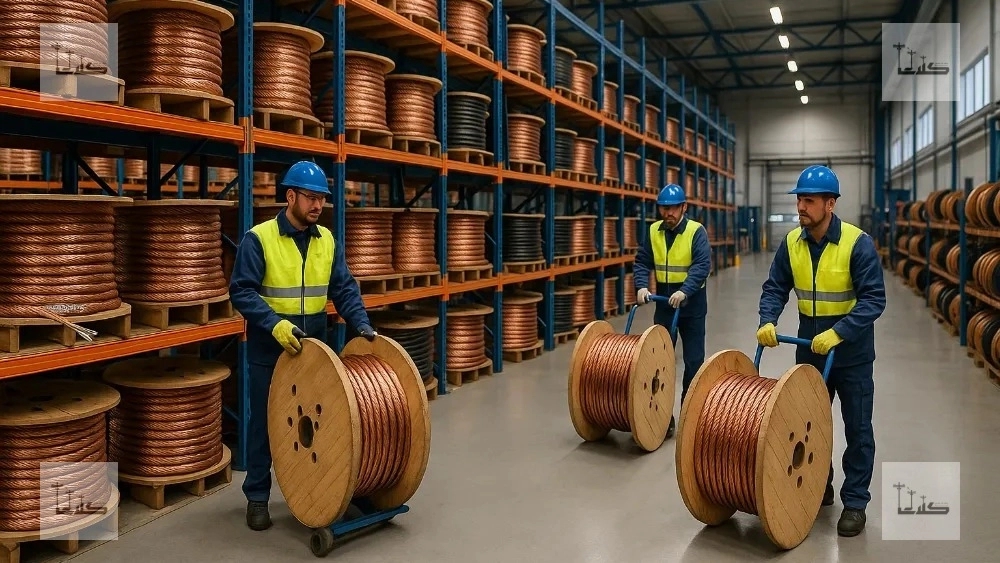




Supply and distribution of medium pressure copper cable Superior quality and fast service of Kelat Electricity
Introduction
In the complex and vital world of electrical engineering, infrastructures must be built according to the highest standards and with the highest quality equipment to ensure stable and safe energy transmission. Medium Voltage Aerial Copper Cables play an undeniable role as the backbone of electricity distribution networks in urban, rural and industrial areas. These cables must be designed in such a way that they can withstand both electrical stress (such as high voltage) and environmental stress (such as intense UV radiation, temperature fluctuations and mechanical load caused by wind).
What is medium pressure copper cable?
Aerial Medium Pressure Cables are three-phase power cables that are typically used for rated voltages between 11 kV (KV) and 33 kV (KV). At this voltage level, the quality of insulation and protection against environmental factors become vitally important, because any failure can lead to widespread power outages and safety hazards.
Key differences with terrestrial cables:
- Installation: These cables are installed directly on concrete or metal foundations and do not require channeling or direct burial.
- Mechanical: Due to aerial installation, they must be much more mechanically resistant to support their weight over long spans and remain stable against wind and vibration forces.
- Environmental Protection: Design They are based on extraordinary resistance to ultraviolet rays (UV), moisture, atmospheric pollution and extreme temperature changes.
Conductive material: annealed copper
The main conductor of these cables is made of Copper. Copper is the first choice due to its superior electrical conductivity (better than aluminum) and high ductility. The word "annealed" refers to the thermal process that copper is subjected to in order to reduce its hardness and greatly increase its ductility. This property is necessary for bending and installation in air routes.
Standard insulating materials
Insulation is critical in medium voltage cables. The most common and best materials used in electrical cables are:
- XLPE (Polyethylene Cross-linked): This insulation is the gold standard for medium voltage cables due to its very high thermal resistance, excellent moisture resistance and excellent dielectric properties. XLPE allows for higher current flow at the equivalent operating temperature (90^\circ C).
- PVC (Polyvinyl Chloride): Sometimes used, especially where greater flexibility and fire protection are required, but at medium atmospheric pressure, XLPE is preferred.
Detailed structure and components of air medium pressure copper cable
To ensure safe and long-term operation, the structure of these cables is multi-layered, each layer having a specific task.
Structural component row, common type, main function 1Main conductor (Conductor)Annealed copper (Stranded Copper), transmission of electric current with minimal heat loss. 2Semi-Conducting Shield - Inner Composite polymer, reduction of surface tension and uniformity of the electric field on the conductor. 3Main insulation (Insulation)XLPE (preferably) maintaining distance The necessary dielectric between the conductor and the outer sheath or other components. 4External Semi-Conducting Shield - Outer Composite polymer to create a flush connection with the protective shield and uniformize the field on the insulating surface. 5Metallic Shield/ScreenCopper tape or thin copper wire to collect leakage currents, protect against electromagnetic interference and provide a path For safe grounding of the cable. 6Outer SheathBlack PVC or UV-resistant PE, complete protection against atmospheric factors, moisture, chemicals and mechanical damage. The black color is due to anti-UV additives.
The basic formula of ohmic losses (to understand the importance of copper)
The heat loss of the cable is directly proportional to the conductor resistance and the square of the passing current:
[ P_{loss} = I^2 \cdot R ] where (P_{loss}) is the power loss (in watts), (I) is the current (amps) and (R) is the conductor resistance (ohms). Due to the lower intrinsic resistance of copper than aluminum (approximately (1.7 \times 10^{-8} \Omega \cdot m) at (20^\circ C) for copper), power losses in copper cables are significantly reduced, which is critical in long lines.
Technical characteristics of the cables supplied by Kelat electricity
Klat electricity supplies only according to international and national standards (such as IEC 60502-2 and ISIRI). The key features of our products are:
- Operating voltage range: Usually available for voltage levels (3.6/6 \text{kV}), (6/10 \text{kV}), (8.7/15 \text{kV}), (12/20 \text{kV}) and up to (26/44 \text{kV}).
- Rated current (Ampacity): based on cable cross section (from (35 \text{mm}^2) to (630 \text{mm}^2)) and aerial installation conditions (ambient temperature, wind speed), rated currents are calculated and guaranteed.
- Dielectric resistance: XLPE insulation ensures that the cable can withstand voltage stresses caused by lightning or transient switching.
- Flexibility and Bending: Due to the copper annealing, the Minimum Bending Radius is maintained at a standard level which facilitates the installation.
- Resistance against pollution: The external coating is designed to prevent "tracking" in severe pollution conditions.
Why cooperation with Kalat electricity is a smart choice?
A) guaranteeing the quality and authenticity of the product
We use a reliable supply chain and only work with manufacturers who have ISO 9001 certificates and approvals from Tawanir or the Ministry of Energy. All cables are provided with full technical certificate (Certificate of Conformance - CoC).
b) Logistical and financial benefits
- Wide distribution: Our distribution network is designed in such a way as to enable fast delivery of cables to the most remote parts of the country.
- Competitive pricing: By eliminating several layers of middlemen and purchasing in high volume, the final cable price is economical for employers and contractors. 20 kV) is kept ready for delivery until the waiting time is zero.
c) Technical services before and after sales
Klat electrical technical team consists of experienced power electrical experts who are ready to provide the following services:
- Section selection consultation: Helping design engineers to choose the most accurate cross-section based on the expected loads and environmental factors.
- Documentation: Providing all technical drawings and tables of permissible current (Derating Factors) to be presented to the client.
- Installation support: Providing the necessary guidance for cabling connections and proper earthing for cables. Air.
Accurate quality control and verification process (QC Process)
Quality in Kalat electricity is not a slogan, but a practical protocol that guarantees cables reach the project site with 100% safety.
1. Incoming Material Inspection
- Confirmation of the purity and annealing of conductive copper.
- Checking XLPE insulation certificates (checking density and hardness).
2. In-Process Testing
3. Final Product Testing
This step is the most critical part and often includes the following destructive and non-destructive tests that must be in accordance with IEC/IS standards:
- Ohmic resistance test (Resistance Test): Measure the resistance of the conductor at the reference temperature ((20^\circ C)) to ensure compliance with the standard table for the declared cross section. [ R = \frac{\rho \cdot L}{A} ] where ( \rho ) is specific resistance, ( L ) is length and ( A ) cross-sectional area. For example, for a 20 kV cable, a voltage of about (40 kV) may be applied for 5 minutes.
- Overload current endurance test (Thermal Cycle Test): Simulation of thermal working conditions and checking insulation stability in heating and cooling cycles.
Wide applications of air medium pressure copper cables
Aerial medium pressure cables supplied by Clat Electric are used for a wide range of critical infrastructures:
- Urban and rural distribution: Replacement of worn out lines or network development in areas where there are high earth excavation costs or physical barriers (such as rocky terrain).
- Feeders and main lines: Establish main feeders feeding distribution stations in factories and large complexes.
- Power plants and refineries: Supply energy to external equipment and Connecting units in open spaces and susceptible to variable weather conditions.
- Temporary infrastructures: Use in large construction sites that require high-capacity temporary energy transmission.
Expert tips on installing and running aerial cables
The correct installation of aerial cables has a direct effect on their useful life. In the projects where the cables are purchased from Kalat Electricity, the following points should be taken into account:
1. Tensile stress and support
The cable must be properly installed on the insulators of the distribution lines. The distance between two connection points (Span Length) must be calculated so that the tensile stress on the cable does not exceed the permissible limit, taking into account the safety factor. In cold regions, maximum cable sag at low temperature (which leads to increased tension) should be considered.
2. Protection against corrosion and erosion
Although the outer sheath is durable, it is recommended to use plastic shields or protective tapes in places where the cable is in contact with bases or supports to prevent long-term mechanical wear.
3. Electrical connections
Using connectors and medium pressure cables (Terminations) suitable with copper cable is necessary to prevent local heat (Hot Spot) and reduce the possibility of arcing in the long term. Connections must be pressed with special tools (crimping tools) and suitable conductive materials should be used.
Operational advantages of copper over aluminum at medium atmospheric pressure
Although aluminum cables are common in medium pressure ground to reduce cost, for long distance aerial installation, copper has significant competitive advantages:
Features of aluminum mesh cableSpecific conductivityVery high (better conduction) Lower (need larger cross-sectional area for the same current)Tensile resistanceVery high, suitable for longer spans Lower, need more supportCreepInsignificant, connections stay tighter Much, require the use of special washers and connections to prevent loose Becoming volume and weightsmaller and heavier, larger and lighter lifetime due to its high resistance to fatigue and corrosion, it has a longer life. Prone to oxidation at the joints.
Purchasing and ordering processes in Kelat Electricity
We have designed the purchasing process to facilitate the work of contractors and consulting engineers:
- Inquiry request: Send the required technical specifications (rated voltage, cross-sectional area, total length).
- Technical adaptation and pricing: The sales team, based on stock availability and market conditions, will offer the most competitive price by providing an official invoice and clear payment terms.
- Final approval and production/supply schedule: If custom production is required, the exact manufacturing schedule will be specified. (usually between 4 and 8 weeks depending on the size).
- Final quality control and shipping: Before loading, the cable is subjected to final tests and after the supervisor's approval, it is sent to the project site.
Final summary
Providing air medium pressure copper cable with guaranteed quality is the cornerstone of the stability of the electricity supply network. Relying on deep expertise in the field of medium pressure equipment, specialized warehousing and strict focus on compliance with technical standards, Klat Electric is committed to providing this strategic product for your projects across the country. Ensuring quality, speed in delivery and full technical support are the three basic pillars of cooperation with Kalat Electric.
To start your next project, contact our experts and benefit from free expert advice.
Keywords: medium pressure air copper cable, XLPE cable, distribution of power cable, supply of power cable, chelate power, 20 kV cable, power copper cable, XLPE insulation, medium pressure overhead lines, cable voltage test.