
Tea in Iran is not just a drink, but a part of the ritual of relaxation, conversation and family moments. Thousands of families across the country, especially in the western and northern regions, start their day with tea. But what many tea lovers don't know is that water and brewing temperature influence the taste, aroma and quality of tea more than any other factor. In this article, with a scientific and experimental analysis from the point of view of the prestigious brand Maghsoodi Chai Exchange in Baneh Kurdistan, we examine how choosing the right water and controlling the temperature can bring the experience of drinking authentic Iranian tea to a higher level and why these two factors are especially important for creating a balance between color, aroma and taste.
Authentic Iranian tea; A symbol of originality and natural flavor
The tea tree is native to the northern regions of Iran, where the mild climate and fertile soil provide the best conditions for the growth of tender tea leaves. Compared to foreign teas, Iranian tea has a more natural color, a milder taste, and a more earthy aroma. For this reason, Iranian tea always has a special place in the cafes, houses and traditional markets of Kurdistan.
In Maqsoodi Tea Exchange, only teas are offered that are prepared from the country's prestigious farms and with the natural drying process. But to fully experience the taste of authentic Iranian tea, it is necessary to pay attention to the brewing method; Because even the best tea will taste bitter or poor if it is brewed with the wrong water or the wrong temperature.
The role of water in brewing authentic Iranian tea
Water is one of the main elements of tea brewing and makes up about 95% of the final drink. In the science of tea making, the chemical composition of water and its amount of minerals have a direct effect on the extraction of flavor and color from tea leaves.
Water suitable for brewing tea should be fresh, light and have balanced solutes. Heavy water or water with a lot of chlorine will change the taste of tea and prevent the release of aromatic compounds inside the leaves. For example, in regions like Kurdistan where the spring water is natural and light, brewed tea has a clear color and a pleasant aroma.
At Maqsoodi Tea Exchange, when teaching brewing for sellers and major consumers, it is recommended to always use freshly boiled and chlorine-free water; Because this type of water allows the aroma of Iranian tea to be completely released and show its true taste.
brewing temperature; The determining factor in extracting the flavor and color of tea
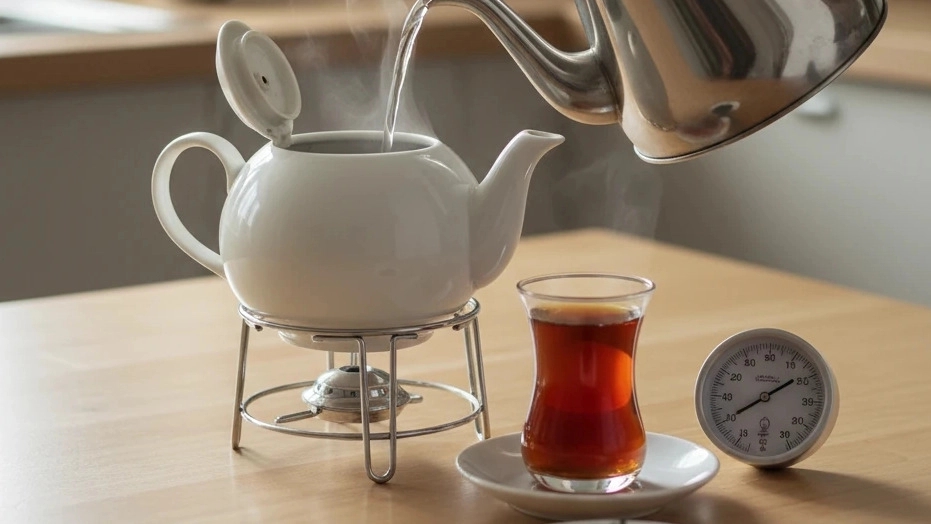
The temperature of the water at the moment of contact with the tea leaves is the most important factor for the formation of color and taste. Excessively high temperature will cause bitterness and loss of natural aroma, while low temperature will make the drink pale and tasteless.
For authentic Iranian tea, the best temperature is between 80 and 95 degrees Celsius. In this period, the compounds of tannin and polyphenols, which are the natural color and aroma of tea, are slowly released. Maqsoodi Tea Exchange always emphasizes to its major customers that tea should be brewed with controlled heat, not with boiling water. This method keeps the balanced taste, low bitterness and natural aroma.
The effect of hard and soft water on the final taste of Iranian tea
Hardness of water depends on the amount of minerals such as calcium and magnesium in it. The harder the water, the more difficult the process of extracting the aromatic substances from the tea leaves. Tea brewed with hard water usually has a dull color and a heavy taste. On the other hand, soft water preserves the transparency of the color and the delicacy of the taste.
In the western regions of the country, such as Kurdistan, especially Baneh, the water is relatively light and suitable for brewing pure tea. This natural feature has made the brand Magshoodi Chai Exchange become a standard for the real taste of Iranian tea in the region.
brewing time; Same as temperature and water quality
The right temperature without the right time does not have a good result. Tea must be brewed at a certain temperature and time so that the flavor and aroma compounds are released properly. It usually takes 7 to 10 minutes for Iranian tea. If the brewing time is too long, the tea will become bitter and heavy. Maqsoodhi Tea Exchange has determined the best time for various types of tea by scientifically examining the brewing process in its specialized workshops so that major customers can have the same high-quality experience.
Iranian tea and coordination with water temperature
High temperature causes the cells of the tea leaves to break quickly and tannin compounds are released, but if the temperature exceeds the balance, part of the natural aroma caused by the volatile oils of the tea leaves is lost. The controlled temperature, in the range of 85 to 90 degrees, causes the balanced extraction of flavor and aroma substances and preserves the clear color of the drink.
For this reason, a special brewing recipe is provided for each type of tea (black, green, aromatic) in Maqsoodi Tea Exchange, so that consumers, both at home and in major stores, can get the best results from each tea leaf.
Cold water or boiled water? The answer is from the Iranian experience
In the tradition of Iranian tea making, it is always emphasized that the water should be fresh and boiled, not heated several times. Because frequent boiling destroys the oxygen in the water and prevents the optimal brewing of tea. Freshly boiled water has more oxygen and when brewed it causes the leaves to fully open and release their natural aroma.
In Maqsoodi Tea Exchange, this principle is recognized as part of the brand's flavoring standard, and consumers are advised to use fresh water every time to brew tea so that the aroma of authentic Iranian tea remains intact.
Tea brewing standards in Kurdistan culture
In Kurdistan province, tea is a part of everyday culture and people are very careful in preparing it. In this region, brewing tea with spring water and controlled temperature is a long-standing tradition. Families usually brew tea in a china or copper teapot with a suitable lid and they believe that the uniform and mild heat causes the natural color and aroma to appear. With respect to this tea drinking culture, Maqsoodi Tea Exchange offers a series of teas compatible with the traditional Kurdistan brewing method, which have a luxurious and natural taste.
Effect of ambient temperature and type of teapot on Iranian tea brewing
The type of brewing vessel has a direct effect on quality. Chinese teapots are the best option for maintaining uniform heat. In contrast, a metal teapot transfers heat quickly and causes an inconsistent brew. In cold environments such as the mountainous regions of Kurdistan, it is recommended to wash the teapot with hot water for a few seconds before pouring tea to reduce the temperature difference between the wall of the teapot and the drinking water. By teaching these tips to major sellers, Maqsoodi Tea Exchange has standardized the experience of professional brewing in stores and cafes in the region.
Why is water and temperature control vital for Iranian tea?
Iranian tea has a natural structure and less processing, for this reason it is more sensitive to temperature and water compared to foreign teas. Foreign teas are often coated with essential oils or industrial compounds, but Iranian tea is made from pure leaves that any small change in temperature or water solutes can change its taste. Recognizing this feature, Maqsoodi Tea Exchange has detailed brewing instructions for each type of tea to preserve the authentic Iranian taste in each cup.
The secret of perfect tea from the eyes of Bors Maqsoodi tea masters
Tea masters at Maqsoodi Tea Exchange believe that the secret of a perfect cup of tea can be summed up in three factors: fresh water, precise temperature and balanced time. These three components work together to reveal the true taste of Iranian tea. In the brand's tasting workshops, samples of tea brewed at different temperatures are tested to identify the best blend for each type of tea. The result of these studies led to the presentation of a standard recipe that is now recognized as a reliable model in many parts of Kurdistan.
Effect of temperature on Iranian aromatic tea
Scented teas, such as rose or cinnamon tea, are more sensitive to temperature because their aroma is dependent on herbal ingredients. A temperature of more than 90 degrees causes the natural essence of plants to evaporate and reduces their aroma. For this reason, Maqsoodi Tea Exchange recommends a temperature range of 75 to 85 degrees for these teas so that the aroma of the plant and the color of the tea leaves remain harmonious. This scientific attention to details has made Maqsoodi aromatic teas have a distinct and pleasant taste in the market of Kurdistan.
The knowledge of tea brewing and the future of the Bors Chai Maqsoodi brand
In today's world where consumers are looking for quality and real experience, specialized brands such as Bors Chai Maqsoodi also play an educational role. In addition to selling all kinds of authentic Iranian tea, this center organizes professional brewing courses for major sellers in order to standardize the quality of Iranian tea throughout the country. The ultimate goal of this approach is to revive the culture of high-quality tea drinking and provide an experience that shows that Iranian tea can be even superior to international brands by observing the principles of water and temperature.
summary
The taste and aroma of authentic Iranian tea is the result of the delicate interaction between water, temperature and brewing time. If the water is fresh, light, and chlorine-free, and the temperature is maintained within the correct range, the result will be a cup that has a natural color, a balanced taste, and a delicate aroma. With the scientific and experimental knowledge of this process, Maqsoodi Tea Exchange is known as the main source of providing and teaching the brewing of authentic Iranian tea in Kurdistan.