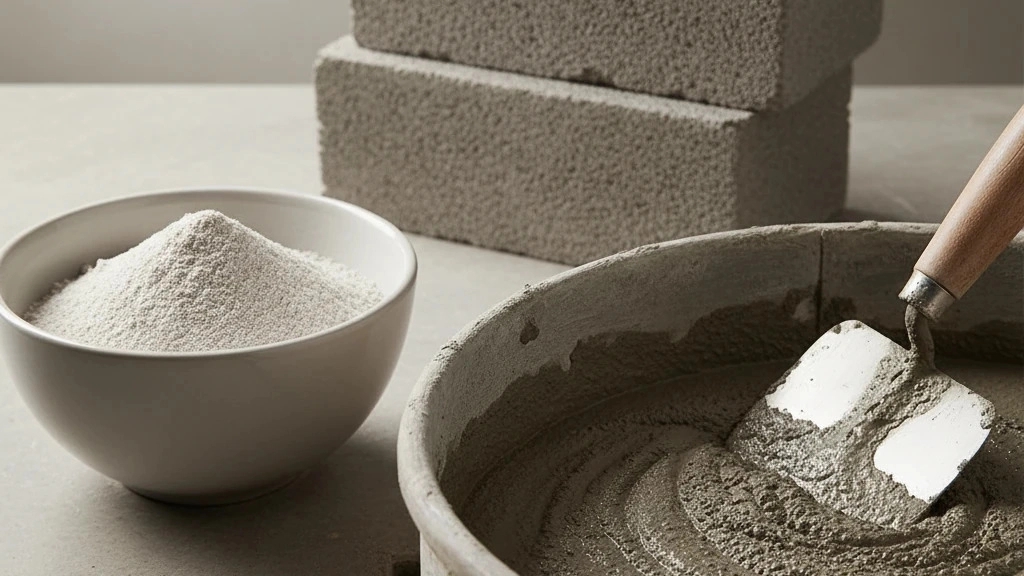



In today's advanced world, the construction industry is constantly looking for solutions to increase the quality, durability of structures, reduce costs and move towards sustainable construction. One of the materials that has received special attention in recent years as a strategic and efficient additive is stone powder. This material, which was once known as a by-product and waste in mines and stone-cutting factories, today, thanks to extensive research, has become a key component in optimizing the properties of mortar and concrete.
The intelligent use of stone powder is not only an economic choice, but also an engineering decision to achieve superior performance. In this comprehensive article, we examine the use of stone powder in mortar and concrete in a detailed and comprehensive manner and show how leading companies such as Shojaei Construction Company implement quality, cost-effective and environmentally friendly projects using this technical knowledge.
What is stone powder and how is it produced?
Stone powder (Stone Powder or Rock Flour) refers to very small particles that are obtained from crushing, wear and processing of all kinds of natural stones. These powders are mainly produced as by-products in the processes of mining, stone cutting in stone factories and sand production.
Common types of stone powder based on mother rock are:
- Limestone Powder: the most common and most widely used type.
- Marble Powder: has a bright color and high purity.
- Granite Powder: has high hardness and strength.
- Calcium Carbonate Stone Powder: which is produced with very high purity.
The production process of stone powder includes the following steps:
- Primary crushing: Large stones are converted into smaller pieces in jaw or hammer crushers.
- Grinding: Crushed pieces enter ball mills or vertical mills and are ground to micron size.
- Granulation and grinding: Finally, the stone powder produced is passed through special sieves to separate particles of a specific and uniform size (usually below 75 or 100 microns). The final quality of rock powder is highly dependent on the particle size distribution (PSD) and its chemical purity.
Specialized applications of stone powder in mortar
Stone powder as a key additive, significantly improves the performance of all types of construction mortars.
Bricklaying Mortar
In the mortar used for wall covering, adhesion and efficiency are of great importance. Adding stone powder to this mortar makes it more pasty and sticky, making it easier to work with for the building and creating a stronger bond between the bricks or blocks.
Plastering & Facade Mortar
To have a smooth, beautiful and crack-free facade, the quality of the coating mortar is vital.
- Creating a smooth surface: Stone powder provides a very smooth and uniform surface for the final finish due to its particles.
- Reduction of cracking: By reducing plastic shrinkage, it prevents the formation of hairline cracks on the facade surface.
- Colored facade: colored stone powders (such as stone powder) can be used. Joshghan) used to make colored mortars, which eliminates the need to repaint the facade and creates lasting beauty. Facade projects implemented by Shojaei Construction Company are proof of the high quality resulting from the correct use of stone powder.
Pointing Mortar
In tiling tiles, ceramics and stone, it is necessary to completely fill the joints to prevent water penetration. Stone powder fills very small pores and makes the binding mortar more dense and impermeable.
Key applications of stone powder in concrete
In modern concreting, stone powder plays very important roles that go beyond a simple filler.
Self-Compacting Concrete (SCC)
Self-compacting concrete is a concrete with very high fluidity that is spread in the form and compacts itself without the need for vibration. To achieve this property, the concrete mixture must have high viscosity and proper stability so that it does not separate. Stone powder is one of the key components in the SCC mix design. The high volume of its fine particles increases the viscosity of the mixture and prevents the sedimentation of coarse aggregates and provides the necessary smoothness.
High-Strength Concrete (HSC)
To make concrete with high compressive strengths (more than 60 MPa), it is necessary to achieve a very dense cement matrix. As mentioned before, the filling effect of stone powder has a direct role in increasing the final compressive strength of concrete by reducing porosity and strengthening the transition zone.
Precast Concrete Elements
In the production of prefabricated parts such as tables, blocks, and wall panels, the quality of the final surface and the speed of production are very important. Stone powder helps to create a smooth surface, reduce the lip of the edges and improve the final appearance of the piece. Also, improving concrete performance speeds up the molding process.
Technical and executive points in using stone powder
To fully benefit from the benefits of stone powder, it is necessary to observe technical points and quality control. This is the point where the expertise of a reliable construction company like Shojaei Construction Company is determined.
- Choosing the type of stone powder: The quality of stone powder is vital. A powder with appropriate granularity, high chemical purity, and free of harmful substances such as clay and organic substances should be used. Optimum mixing ratio: The amount of replacing cement with stone powder should be determined based on the type of application, the required strength, and other components of the mixing plan and through detailed laboratory tests. Excessive use of stone powder can have negative effects on the strength and durability of concrete. Moisture control: Stone powder should be stored in a dry place. Moisture can cause the powder to clump and reduce its effectiveness.
- Complete mixing: Sufficient mixing time should be considered for the uniform distribution of stone powder particles in the mixture.
Shojaei Construction Company: a leader in the use of new materials
Knowing the theoretical benefits of stone powder is one thing, and its correct implementation and engineering in real projects is another. Shojaei Construction Company is recognized as one of the pioneers in the intelligent use of modern materials with years of brilliant experience in the construction industry and relying on an expert technical team and an equipped quality control laboratory.
Our commitment at Shojaei Construction Company is based on several key principles:
- Unparalleled quality: We use only the best quality and laboratory-confirmed stone powder and by carefully designing the mixing plan, we ensure that the concrete and mortar produced meet all national and international standards.
- Cost optimization: Our expertise in using stone powder allows us to do so without The smallest reduction in quality will significantly reduce construction costs for our employers. Commitment to sustainability: By reducing the consumption of cement and using recycled materials such as stone powder, we take an effective step towards protecting the environment and help build a greener future. Continuous innovation: From the implementation of special facades with colored mortars to the implementation of complex structures with Self-compacting concrete, Shojaei construction company always moves at the edge of technology and innovation.
If you are looking for the implementation of a project in which quality, durability, economy and environmental sustainability are prioritized, our experts at Shojaei Construction Company are ready to provide expert advice and implement your project with the highest standards.
conclusion
Stone powder is no longer a waste material, but a valuable mineral additive that can revolutionize the quality and economics of construction projects. Using stone powder in mortar and concrete By improving mechanical properties, increasing tile, ceramic and stone, it is necessary to completely fill the joints to prevent water penetration. Stone powder fills very small pores and makes the binding mortar more dense and impermeable.