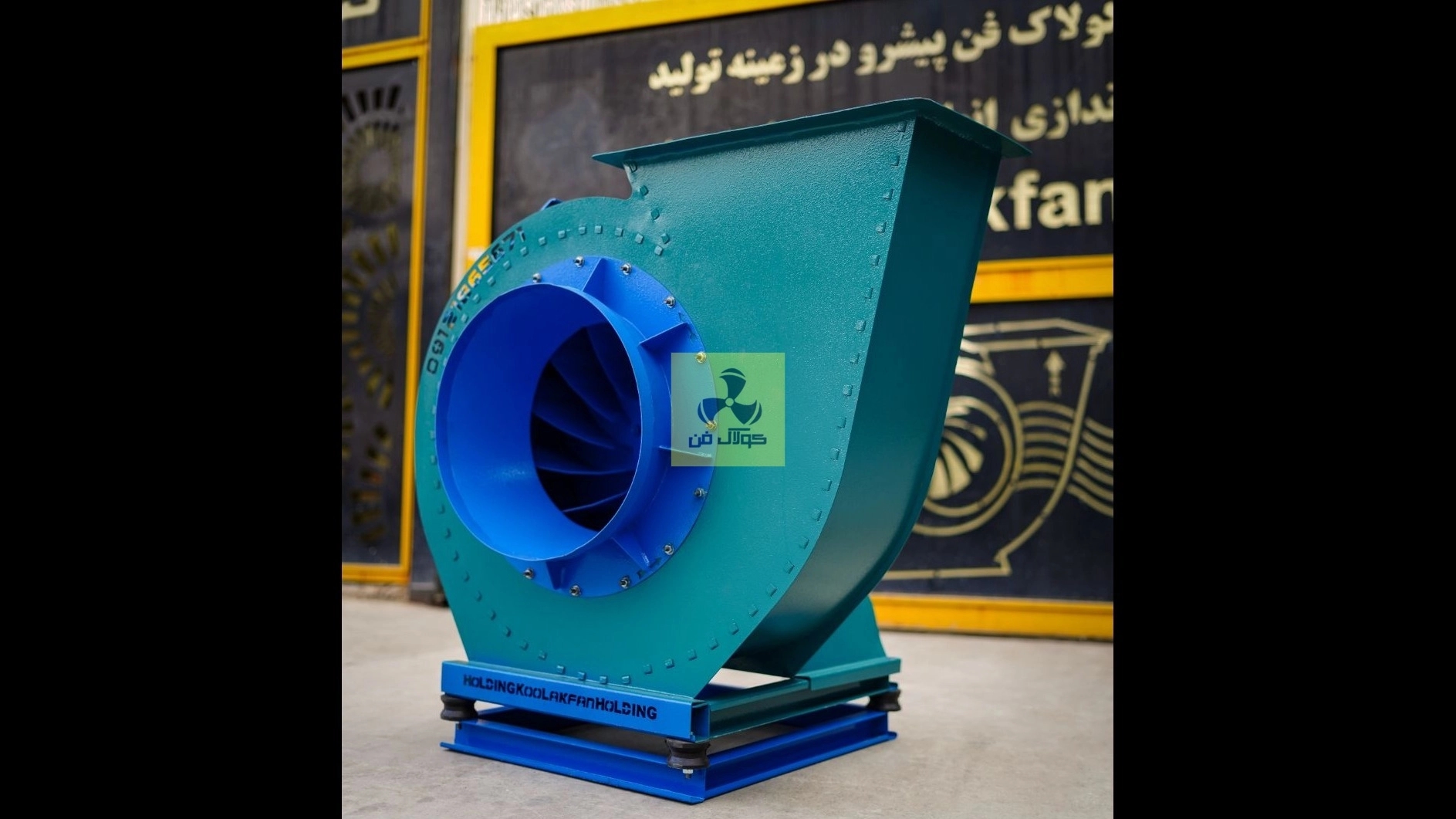
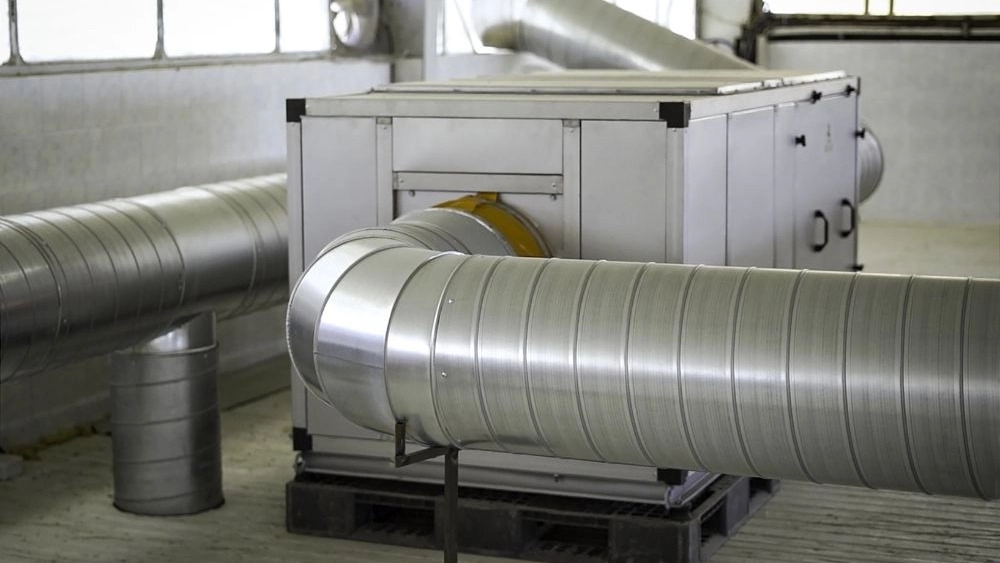

Centrifugal fan
1 Introduction
In many industries, there is a need to generate high pressure airflow, where axial fans are unable to provide sufficient pressure. In this situation, the centrifugal fan is the best option because it can produce static pressure up to several thousand pascal.
The first examples of centrifugal fans were introduced in the 18th century for the ventilation of mines, but in the 20th century, with the development of vane designs, these fans became the mainstream of the industry.
2. Scientific principles of performance
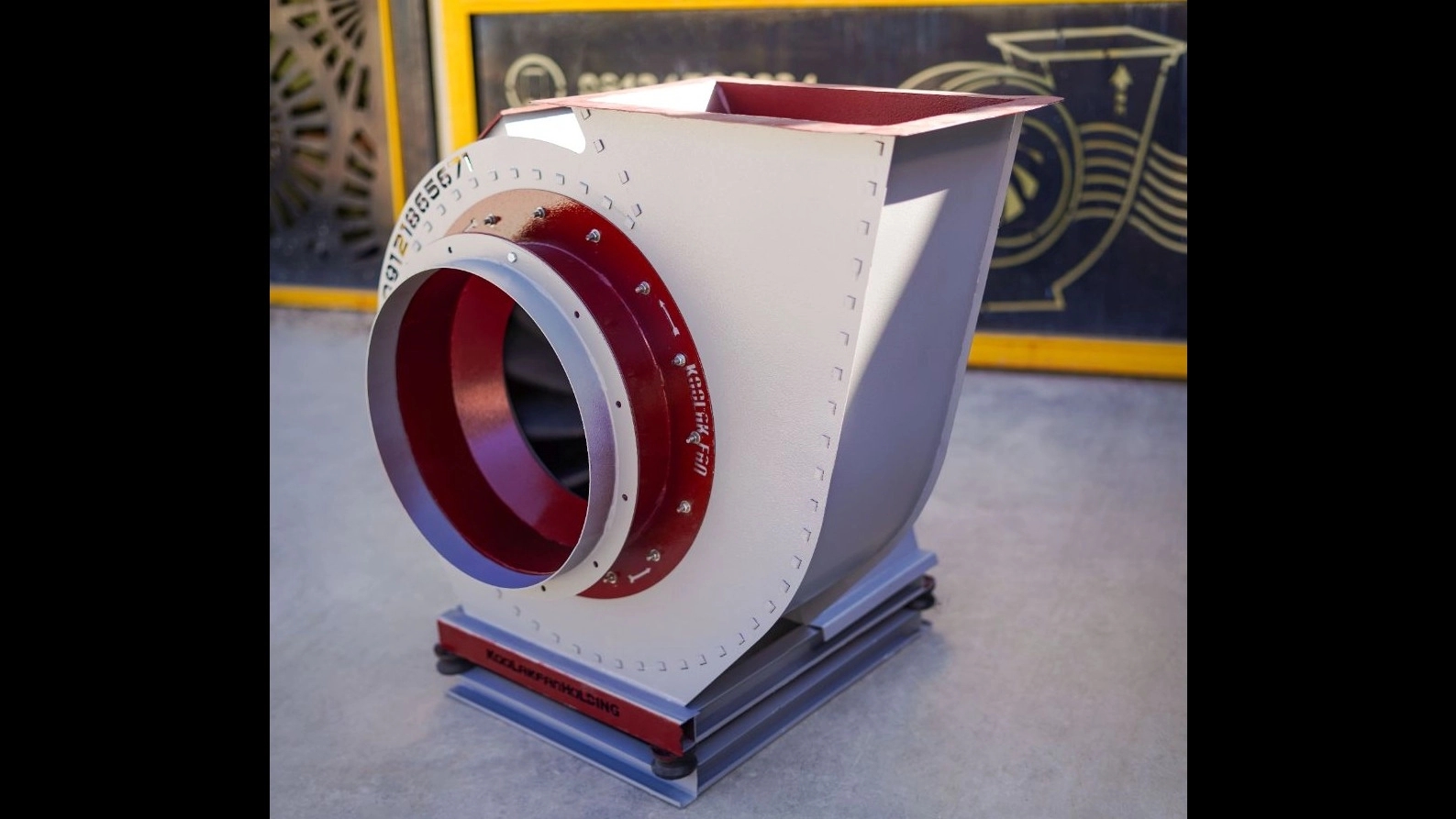
When the air enters the center of the fan, the rotating blades give it radial acceleration. Based on the law of conservation of energy, the speed and pressure of the air increases, and at the outlet, the flow with a higher speed and pressure is rejected.
In a typical centrifugal fan:
pt=ps+12ρv2 p_t = p_s + \frac{1}{2} \rho v^2 pt=ps+21ρv2
Where:
- pt p_t pt: total pressure
- ps p_s ps: static pressure
- ρ \rho ρ: air density
- v v v: air velocity at the outlet
Increasing pressure in a centrifugal fan is the result of converting kinetic energy into static pressure.
The angle of the blades, the number of blades and the rotation speed play a very vital role in the final efficiency.
3. Geometric design of blades
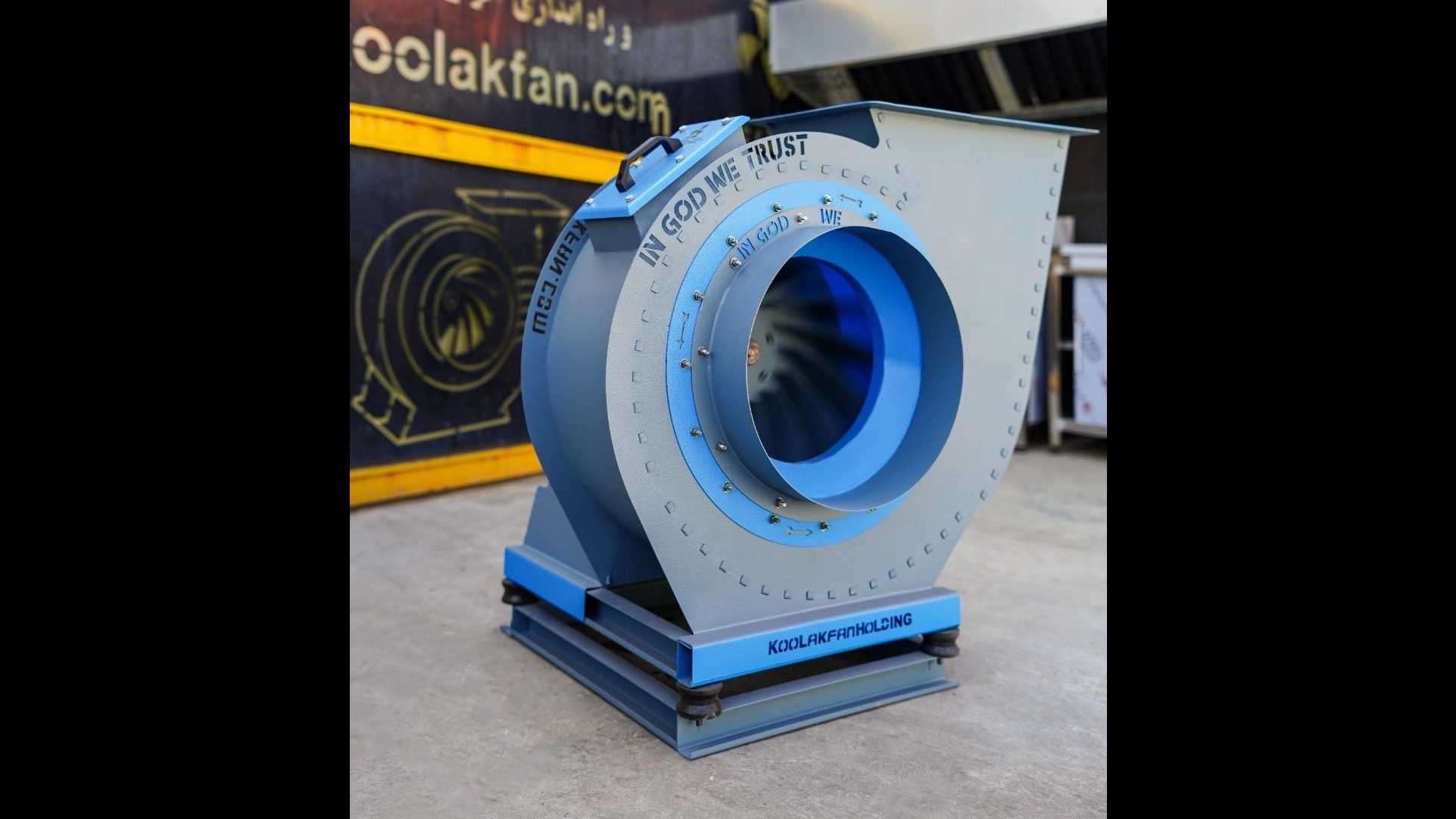
Blades are the heart of the fan. Their design is done strictly according to aerodynamic rules.
There are three basic types of blade geometry:
Forward Curved Blade:
For high flow with low pressure. The speed of the air output is high, but the energy consumption is higher and the probability of particle accumulation is high.
Backward Curved Blade:
Lower energy consumption, high efficiency, and stable performance curve. The direction of the air flow is opposite to the rotation of the propeller.
Radial Blade:
The simplest structure with high resistance to wear and industrial pollution.
4. Structural components
A standard centrifugal fan consists of the following parts:
- Shaft and bearing: transmission of power from the motor to the propeller.
- Supporting base: absorb vibration and maintain axis alignment.
- Motor cover: protection against dust and heat.
- volute housing: convert kinetic energy into pressure and guide air exit.
- Conical inlet (Inlet Bell): Reducing pressure drop and increasing flow uniformity.
- Adjustment system (Dampers / Louvers): Air volume and pressure control.
A standard centrifugal fan consists of the following parts:
Shaft and bearing: transmission of power from the engine to the propeller.
Supporting base: absorb vibration and maintain axis alignment.
Engine cover: protection against dust and heat.
Volute: converting kinetic energy into pressure and directing the air out.
Conical inlet (Inlet Bell): reducing pressure drop and increasing flow uniformity.
Adjustment system (Dampers / Louvers): air volume and pressure control.
The overall efficiency of the centrifugal fan consists of three parts:
ηtotal
=
ηmechanical
×
ηvolumetric
×
ηaerodynamic
Mechanical efficiency depends on bearing and power transmission (95-98%).
Volume efficiency depends on the design of the chamber and lack of leakage.
Aerodynamic efficiency is a function of blade design and air entry angle (70-85%).
The characteristic curve of the fan defines the relationship between flow rate (Q) and pressure (P). The optimal working point is located at the place of the highest efficiency and the lowest vibration.
6. Comparison of centrifugal fan with axial fan
Centrifugal fan feature, axial fan, high output air pressure (up to 25000 pascal), low (up to 2500 pascal), medium moving volume, very high energy consumption, less noise, more noise (controllable with new design), less application in heavy industries, dust collectors, general cooling central ventilation, wind tunnel, cooling tower
7. Wide application in industries
Centrifugal fans are used in hundreds of different applications, including:
- Petrochemical, oil and gas industries: evacuation of vapors and toxic fumes.
- Food industries: drying of food and regulation of humidity in production lines.
- Wood and paper industries: transfer of sawdust and dust particles.
- Power plants: supply of combustion air and smoke exhaust.
- Systems Heating, Ventilation and Cooling (HVAC): Fresh air circulation in large buildings.
- Pharmaceutical industries: Ventilation of clean rooms with HEPA filters.
8. Noise and vibration control
One of the important challenges in centrifugal fans is the noise resulting from the rotation and turbulence of the air.
To reduce noise, the following solutions are used:
- Installing Vibration Isolator between base and body.
- Using Acoustic Duct Lining in the outlet channel.
- Designing airfoil blades with soft curve.
- Adjusting rotation speed with inverter to reduce sound frequency.
The sound usually ranges from 60 to 85 dB and is adjusted depending on the type of fan and the environment.
9. Constructive materials
The material used in making the fan depends on the working environment:
- Stainless steel: for corrosive and hot environments.
- Aluminum: light and resistant in normal environments.
- Reinforced plastic (FRP): suitable for chemical environments.
- Titanium or nickel: for temperatures above 400 degrees Celsius.
In addition to mechanical resistance, the body should have vibration absorption and long life.
10. Advanced control systems
The following technologies are used in modern fans:
- Variable Frequency Drives (VFD): Adjust the fan speed without reducing efficiency.
- PID feedback system: Maintain constant pressure in the channels.
- Real-Time vibration sensor: Unbalance detection.
- Monitoring the temperature of the bearings: Prevent sudden failure of the motor and axles.
These technologies reduce electricity consumption by 40% and increase the useful life of the equipment.
11. Maintenance and troubleshooting
Correct maintenance ensures the long life of the fan.
Common faults:
- Severe vibration: Caused by propeller imbalance or loosening of screws.
- Pressure loss: Caused by blocked ducts or blade angle change.
- Abnormal noises: indicating bearing failure.
- Engine overheating: Caused by excessive load or insufficient ventilation.
Periodical maintenance includes lubrication, alignment, cleaning, and electrical inspection of the engine.
12. Standards and guidelines
Manufacturers and users of centrifugal fans must work with international standards:
- AMCA 210 / ISO 5801: Performance and pressure testing standards for fans.
- ISO 13349: Technical and safety specifications for fans.
- ASHRAE 52.2: Ventilation and filtering requirements.
- ANSI/SMACNA: Installation and ducting standards.
13. The future and new technologies
The fans of the new generation are moving towards becoming intelligent.
Improvements include:
- AI-Optimized Blades
- Soundproof bodies of nanocomposites
- Solar-powered fans for local ventilation systems
- Self-diagnostic systems based on the Internet of Things (IoT)
Centrifugal fan is a combination of mechanical engineering, aerodynamics and industrial design.
With the ability to produce high pressure, adaptability to harsh conditions and the possibility of precise performance control, these fans are considered the beating heart of many industries.
Progress in the design of blades and smart systems will determine a sustainable and low-consumption future for fan technology.
Centrifugal fan is one of the most widely used equipment in ventilation, gas transmission, dust removal and cooling industries. Its main function is based on centrifugal force; That is, the incoming air enters the center of the propeller and is thrown towards the external environment due to the rotation of the propeller at high speed. These types of fans are usually used in industrial and building ventilation systems that require high air pressure.
Structure and mode of operation
Centrifugal fan consists of several main parts:
1. Impeller: a rotating part with curved blades that increases the kinetic energy of the air.
2. Housing: a snail-shaped shell that directs the air flow.
3. Air inlet (Inlet): the central part from which the air enters the fan.
4. Engine: provides the driving force necessary to rotate the propeller.
During operation, air enters from the center of the fan and is accelerated by the propeller, then it is directed to the outlet by pressure. This process increases the static pressure and output air flow rate.
Types of centrifugal fans
Centrifugal fans are designed and manufactured in several types, each of which has a specific application:
Licence type, features, applications
Forward curved blade, large volume of air with low pressure of air conditioning, coolers
Radial vane (Radial) high resistance against pollution and dust of heavy industries, industrial filter
Backward curved blades, high efficiency and low noise industrial ventilation, HVAC systems
Airfoil blade quiet operation and low energy consumption in office and hospital environments
Applications
Centrifugal fan is used in many cases:
Building air conditioning systems (HVAC)
Cement, steel and mining factories
Industrial filters and dust collectors
Dryers and furnaces
Cooling electronic equipment
Advantages and disadvantages
Advantages:
Ability to produce high pressure
Suitable efficiency in heavy applications
Ability to work in contaminated environments
High useful life
Disadvantages:
Larger dimensions compared to axial fans
Relatively high noise in some models
The need for regular maintenance of bearings and propellers
Centrifugal fan is one of the most vital components of ventilation and air transmission systems due to its good efficiency, high pressure power and wide application in industries. The development of new designs of these fans is moving towards reducing energy consumption, reducing noise and increasing useful life.
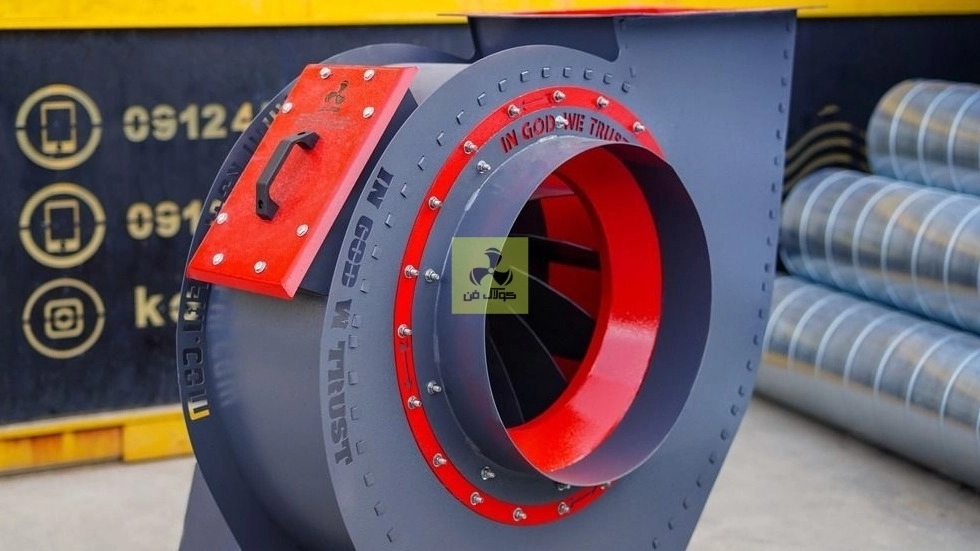
In many ventilation systems, air pollution control, and industrial processes, moving and transporting air and gases is one of the main needs. Fans are designed for this purpose to convert mechanical energy into kinetic and pressure energy in the air flow.
Among different types of fans, Centrifugal Fan has a special place due to its ability to create high pressure and its ability to work in difficult conditions. These fans work based on the principle of centrifugal force, and for this reason, they can create strong and stable air flow.
The principle of operation of a centrifugal fan
The basis of the work of the centrifugal fan is the use of Centrifugal Force.
When the fan impeller rotates at high speed, the incoming air entering from the center of the impeller is thrown towards the external environment. As a result, when the air leaves the axis of rotation, it gains more kinetic energy and its pressure increases. This pressure difference between the inlet and outlet causes continuous air flow.
The general equation of the performance of fans according to the law of conservation of energy is as follows:
Δp=12ρ(v22−v12) \Delta p = \frac{1}{2} \rho (v_2^2 - v_1^2) Δp=21ρ(v22−v12)
Where:
- Δp \Delta p Δp: pressure difference between inlet and outlet
- ρ \rho ρ: air density
- v1,v2 v_1, v_2 v1,v2: air speed at inlet and outlet
The main components of a centrifugal fan
- Impeller:The most important part of the fan that transfers mechanical energy to the air flow. The design of the blades (forward bend, backward bend, radial, airfoil) plays a fundamental role in the efficiency of the fan.
- Fan housing (Casing or Housing):The housing is usually designed in a spiral shape to guide the air flow correctly and prevent energy loss. reduce the pressure and turbulence of the air at the inlet.
- Outlet: The outlet of the compressed air flow, which is usually connected to the channel or ventilation system. The motor may be electric, diesel or turbine.
- Bearings and rotation axis:High-quality bearings are essential to reduce friction and vibration.
- Body and support base:Must be durable, strong and anti-vibration because fans usually work in harsh industrial conditions.
Types of butterfly designs
Centrifugal fans are made in several different designs. Each type has different performance, efficiency, sound and pressure:
Licence type, technical features, application benefits
Forward Curved blades, large number of blades, small diameter, large volume of air with low pressure, less noise of coolers, building ventilation
Backward Curved blade high efficiency, less number of blades, less energy consumption, lower noise of HVAC systems, factories
Radial vane (Radial), straight and resistant vanes with high dust and particle tolerance, mining industries, dust collectors
Airfoil (Airfoil) Aerodynamic shape of the blades, excellent efficiency, smooth flow
Functional characteristics
Centrifugal fans are used in most industries and facilities:
- Industrial ventilation systemsto provide fresh air and exhaust polluted air in factories.
- Steel, cement and petrochemical industriesTo cool equipment, discharge smoke and dust, and provide air flow in furnaces.
- Dust collectors and filtersExit purified air from cyclones and Bag filters.
- Dryers and thermal furnacesto supply warm air and control heat flow.
- Building and commercial facilitiesin chiller systems, central ventilation and wind tunnels.
Periodic maintenance and checks
Centrifugal fan needs continuous maintenance for reliable operation:
- Visit the condition of the bearings and regular lubrication
- Control the balance of the propeller to prevent vibration
- Check the amount of vibration of the motor and axis
- Clean the blades to maintain efficiency
- Check the level and mounting screws of the base
Common failures include bearing wear, blade breakage, air leakage from the chamber, and dynamic imbalance.
Safety tips
When working with a centrifugal fan, the following must be observed:
Never open the case during rotation.
The fan must have a safety guard in the entrance and exit area.
Periodic vibration and sound tests should be done.
Before repair and service, cut off the power completely.
The housing must be resistant to heat, corrosion and impact.
Advantages and disadvantages of centrifugal fan
Advantages:
High output pressure
Stable performance in the long term
Resistance to pollution and particles
Ability to work at high temperatures
Suitable for heavy production lines
Disadvantages:
Large dimensions and weight compared to the axial fan
Higher price
Efficiency drop at very low pressures
Need more installation space
Criteria for choosing the right centrifugal fan
These parameters should be considered when choosing a fan:
Air flow rate (cubic meters per hour)
Required static pressure (Pascal)
Ambient working temperature
Permissible sound level
type of air flow (clean or impregnated with particles)
Expected performance
Wrong fan selection can cause increased energy consumption, vibration or premature failure.
A look at the progress of centrifugal fans
In recent years, there have been significant developments in the field of designing and manufacturing fans:
Using light and resistant composite materials
Using CFD (Computational Fluid Dynamics) analysis for blade optimization
Using EC engines with electronic speed control for less energy consumption
Aerodynamic design to reduce audio noise
Using smart sensors to monitor the condition of the fan and predict failures
Centrifugal fan is one of the most important equipments in ventilation and air transmission industries, which plays a vital role in maintaining the stable performance of systems. The power of producing high pressure, high durability, and its adaptability to different environments have made it have a special place in all areas from heavy industries to commercial buildings.
With the advancement of design technology, the future of centrifugal fans is moving towards smart, energy-efficient and silent systems that will not only improve performance, but also reduce energy and maintenance costs