The strategic importance of springs in agricultural and industrial machinery
Technical differences in making agricultural and industrial springs
The role of alloy and raw materials in the final quality of the spring
heat treatment; The beating heart of spring manufacturing
In the process of making high quality agricultural and industrial springs by Tos Fener, after forming, the parts enter furnaces with precise temperature and atmosphere control. If the temperature is slightly lower than the standard, the spring remains soft and so-called "goes". If the temperature is slightly higher or the cooling time is not set correctly, the spring will become brittle and break on the first impact. Mastering heat treatment charts and using continuous furnaces and salt baths is the secret to achieving premium quality in this collection. It is the precision in the heat treatment that makes the difference between a normal market spring and the project of making high quality agricultural and industrial springs.
Types of springs widely used in industry and agriculture
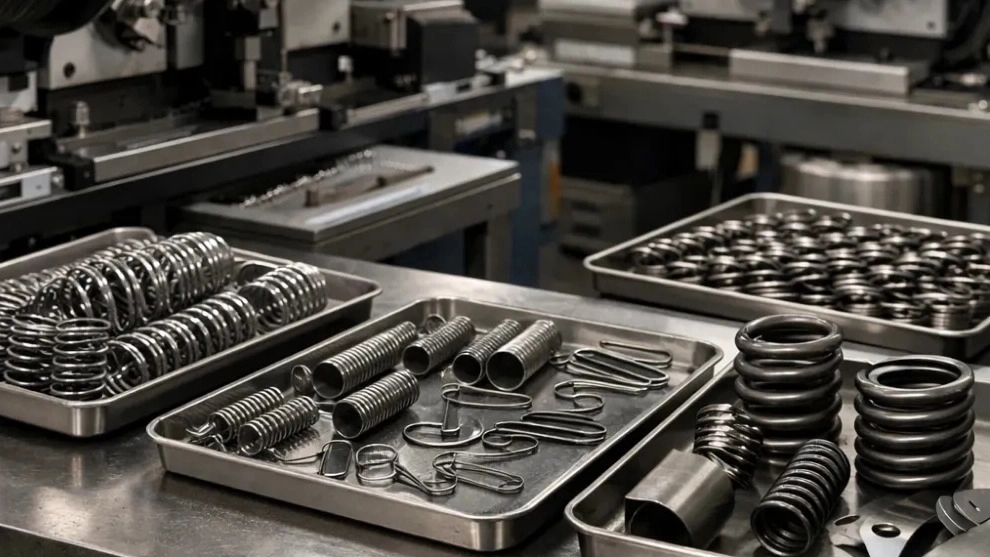
To better understand the scope of activity of "Tos Fener" in the field of manufacturing high quality agricultural and industrial springs, we should familiarize ourselves with the types of these products. The variety of these pieces is very large, but they can be divided into several main categories:
- Compression Springs: The most widely used type of spring used in engine valves, suspension systems and shock absorbers.
- Extension Springs: which have hooks at both ends and are used in garage doors, return mechanisms and some agricultural tools.
- Torsion springs Springs): which apply rotational force and are found in abundance in devices such as balers (forage packing machines) and solar rakes.
- Wire Forms: which have complex and non-standard shapes and are designed for special connections. Tubes are used.
The ability to produce all these models with different dimensions and technical specifications shows the high capacity of a group in making high quality agricultural and industrial springs.
Agricultural tool springs and production challenges
One of the important parts in agriculture is tillage tools. Parts such as packer chisel spring, reversible plow spring and cultivator springs directly engage with the toughest obstacle, compacted soil and rock. Manufacturing high quality agricultural and industrial springs for this sector, requires a special geometric design that distributes the tension along the length of the spring and prevents the concentration of tension in one point.
"Tus Fener" has been able to produce springs that compete with European samples by examining foreign samples and localizing production knowledge. Using Shot Blast (Shot Peening) on these springs is another technique for making high quality agricultural and industrial springs. In this method, steel balls hit the surface of the spring at a high speed and by creating residual compressive stress on the surface, they significantly increase the resistance of the spring against small cracks and fatigue. It is the technical details that lead professional farmers to use the products of this brand.
The importance of customization and reverse engineering
Many industries and farmers are facing the problem of supplying spare parts for old or imported machines. Sometimes the original spring model is not available in the market or has exorbitant prices. In this situation, the ability of reverse engineering is considered one of the pillars of making high quality agricultural and industrial springs. Customers can provide a broken sample or even a technical drawing of the part they want to "Tus Fener" specialists.
The engineering team will re-design and produce it by accurately measuring the dimensions, wire diameter, number of rings, spring pitch and material analysis. This process not only solves the problem of lack of parts, but in many cases, by optimizing the design and choosing newer materials, a product of higher quality than the original is provided. This problem solving approach is an integral part of the concept of making high quality agricultural and industrial springs in the modern world.
Quality control and production standards
In "Tos Fener", springs are tested randomly or 100% (depending on the sensitivity of the application). Checking the force of the spring at a certain height, ensuring no permanent deformation (set) after full compression and checking the quality of the surface coating, are among the items in the checklist of manufacturing high quality agricultural and industrial springs. These strictures make the customer confidently use these parts in their expensive machines.
Coating and increasing corrosion resistance
Agricultural springs often work in wet and muddy environments, and industrial springs may be exposed to chemicals. Therefore, making high-quality agricultural and industrial springs does not end only with mechanical production, but also includes coating processes. Rust is the number one enemy of the spring, because it causes tiny holes (pitting) on the surface and these holes are the starting point for cracks and sudden failure.
The use of furnace electrostatic paint coatings, galvanization, or special dachromate coatings are among the services provided in addition to making high quality agricultural and industrial springs. These covers act like a protective shield and multiply the life of the spring. Paying attention to the beauty of the appearance along with the technical efficiency shows the professionalism of the producer.
The role of spring birch in industrial self-sufficiency
In a situation where the import of spare parts is facing currency and time challenges, relying on domestic production capacity becomes doubly important. Manufacturing high quality agricultural and industrial springs inside the country, in addition to preventing the outflow of foreign currency, allows agricultural and industrial machinery manufacturers to assemble and launch their products more quickly.
"Tos Fener" with its high production capacity and unique variety of products, stands as a powerful arm of the supply chain alongside the artisans. When it comes to making high-quality agricultural and industrial springs, it is not just the production of a metal piece; Rather, the purpose is to create confidence, security and continuity of production in the country's factories and farms. Realizing its heavy responsibility, this group is always trying to keep its technology updated.
CNC technology and accuracy in mass production
One of the important factors in making high quality agricultural and industrial springs is the uniformity of products in high circulation. When an automotive or agricultural equipment manufacturer orders thousands of springs, it expects the first spring to be exactly the same as the thousandth. This level of uniformity is only possible using fully automatic CNC (Computer Numerical Control) machines.
Traditional devices depended on the skill of the operator and human error was inevitable in them. But in modern spring production lines, precise computer programs control the movement of the tools. This makes the manufacturing of high-quality agricultural and industrial springs to be done at a much higher speed and near zero error. The precision in the angle of the prongs, the uniformity of the spring pitch and the fixed diameter of the rings are all due to this technology.
technical advice; Added value for customers
When ordering, many customers do not know exactly what type of spring is the best option for their work. They may know the dimensions, but be confused about the type of alloy or spring rate. A leading manufacturer in the field of making high quality agricultural and industrial springs, also plays the role of a consultant.
The technical team of "Tos Fener" suggests the best and most economical solution by examining the working conditions of the part, the amount of load it must bear and the available space for installation. Sometimes a minor design change suggested by consultants can dramatically improve device performance or reduce production costs. This constructive interaction between producer and consumer is an integral part of the process of making high quality agricultural and industrial springs.
Summary and conclusion
With years of experience and expertise in this field, the "Tos Fener" collection has been able to gain the trust of artisans and farmers. The commitment to using the best raw materials, using the latest technologies in forming and heat treatment, and strict quality control has made this brand a reliable choice for those who are looking for the manufacture of high quality agricultural and industrial springs. Choosing Tus Faner is choosing durability, efficiency and peace of mind in production lines and farms. To improve the quality of your machinery, trusting the experts is the smartest step.