The development of urban and industrial infrastructure has always been one of the main pillars of the progress of modern societies. Meanwhile, fluid transmission networks, especially water and sewage, are known as the vital arteries of cities and industries. Carrying out high-quality wastewater welding projects guarantees public health, preserves the environment, and prevents the wastage of water resources. The connections made in these networks must be able to withstand pressure, temperature changes and chemical corrosion. In this regard, expert groups such as Khajovi mobile welding, by using modern knowledge and advanced equipment, play a significant role in the accurate and standard implementation of these projects. This article examines the technical dimensions, challenges and importance of the correct implementation of welding processes in water and sewage systems.
The vital importance of welding in water and sewage networks
Water and sewage systems are a complex set of pipes, pumps, tanks and connections that are responsible for collecting, purifying and distributing water. Any weakness or defect in the connections of this network can lead to leakage of fluids, contamination of underground water and incurring exorbitant repair costs. Therefore, doing wastewater welding projects requires engineering precision and careful monitoring. Welding in this field is not limited to connecting two pieces of metal or polyethylene; Rather, it is a process that should ensure the useful life of the network for tens of years.
Experienced executive teams such as Khajovi mobile welding know well that the quality of welding is the ultimate determinant of the strength of transmission lines. In sewage environments where there are corrosive gases such as hydrogen sulfide, if welding is not done with the right electrode or the correct method, corrosion will start from the welding area and quickly disrupt the entire system. Therefore, the expertise in the selection of material and welding technique is the first word in the success of carrying out wastewater welding projects.
Types of welding methods in water and sewage projects
Welding of polyethylene pipes
Welding of metal and steel pipes
Steel and stainless steel pipes are still used in main transmission lines (trunk lines), high pressure pumping stations and internal facilities of refineries. Carrying out wastewater welding projects in this sector requires welders with valid certificates. Methods such as manual electric arc welding (SMAW) and argon welding (TIG) are used in this sector. Especially in parts that require 100% sealing and resistance to high pressures, the quality of welding passes (root pass, filler and final pass) should be subjected to non-destructive tests (NDT) to ensure the health of the connection.
Technical challenges in carrying out wastewater welding projects
The implementation of welding operations in water and sewage related environments faces unique challenges that distinguish it from other industries. One of the biggest challenges is the presence of moisture and fluid in the work environment. Sewage water welding projects are often done in mud trenches, tight and wet manholes, or at the heights of facilities.
Corrosion and chemical erosion
Industrial and municipal wastewaters contain corrosive chemicals that can quickly destroy metals. In carrying out wastewater welding projects, it is very important to choose filler metal (Sim/Electrode) compatible with the base metal and resistant to the chemical environment. The technical team of Khajovi mobile welding, by examining the chemical analysis of the passing fluid, selects the best consumable material for welding in order to prevent the phenomenon of intergranular corrosion in the heat-affected zone (HAZ).
Difficult access and safety hazards
Many repair or development operations in existing networks require the welder to enter confined spaces. The existence of toxic gases and flammability in sewer networks makes doing wastewater welding projects a risky job. Observance of safety principles (HSE), use of proper ventilation systems and personal protective equipment are required in these projects. Professional groups such as Khajovi mobile welding always prioritize the safety of personnel and the work environment so that projects are completed without incident and with the highest quality.
The role of Khajowi mobile welding in improving the quality of projects
In today's competitive market, employers are looking for contractors who, in addition to technical expertise, have speed of action and high work commitment. Khajovi mobile welding site and collection, understanding the needs of civil and industrial projects, provides distinct services in the field of wastewater welding projects. One of the prominent features of this collection is the ability to move and quickly send equipped teams to the project site.
In many cases, pipeline breaks or facility failures occur suddenly and require immediate action. Having powerful diesel and gasoline welding engines, cutting machines and specialized polyethylene equipment, mobile teams are able to arrive at the site in the shortest possible time and begin repair or implementation operations. Execution of wastewater welding projects by a team that knows the importance of time and quality, leads to reduction of system downtime and prevention of secondary damages.
Standards and quality control in welding facilities
No project in the field of water and sewage can be accepted without complying with national and international standards. Standards such as ASME, AWS, and DIN have established detailed frameworks for carrying out wastewater welding projects. These standards include welding guidelines (WPS), welding procedure approval (PQR) and welder qualification test (WQT).
Quality control (QC) is an integral part of the process. Welding inspectors must check the condition of the joints before, during and after the welding operation. In the wastewater welding projects, hydrostatic tests (water pressure test) are performed after the welding is completed to ensure no leakage. By adhering to these principles and documenting the work steps, Khajovi Mobile Welding Group guarantees that all connections and repairs performed are in accordance with the highest engineering standards. This level of commitment to quality makes employers feel free to entrust their sensitive projects to this group.
Maintenance of water and sewage pipelines
In addition to the implementation of new projects, a major part of engineering activities is dedicated to the maintenance and repair (O&M) of existing networks. The wear and tear of pipes, leakage at the place of old connections and changes in the ground bed make the need for repair welding operations inevitable. Carrying out wastewater welding projects during the repair phase has its own difficulties, because usually the fluid flow must be temporarily interrupted or diverted.
In this situation, the speed and accuracy of the welders becomes doubly important. The use of new techniques such as "hot tap" (hot branching) or welding in wet conditions requires high skill. Khajovi Mobile Welding specialists with extensive experience in the field of emergency repairs, offer solutions that cause minimal disruption to the network. Repairing cracks in air and ground tanks, replacing worn flanges and strengthening piping supports are among the services provided by this group in the form of carrying out wastewater welding projects.
Equipment needed to implement huge projects
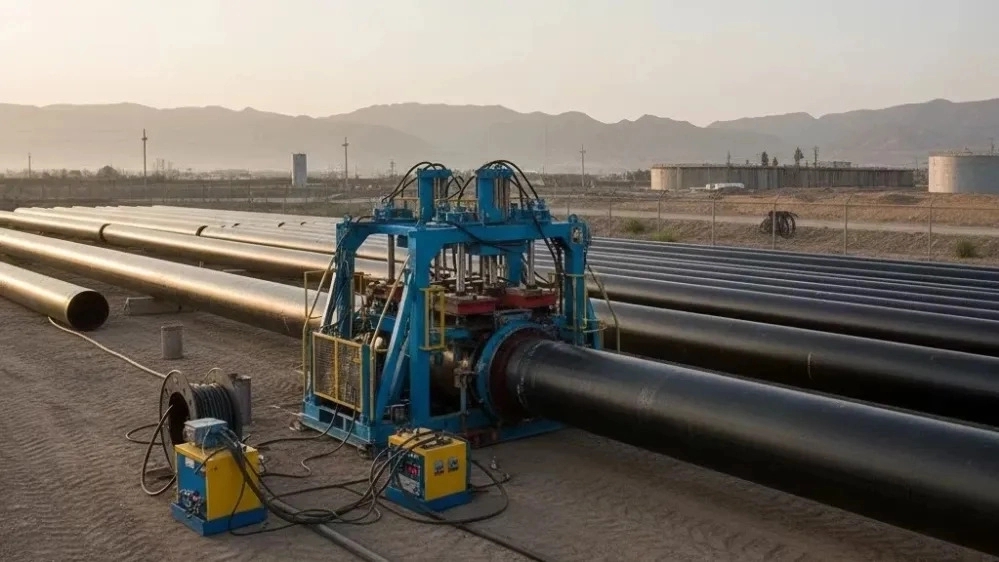
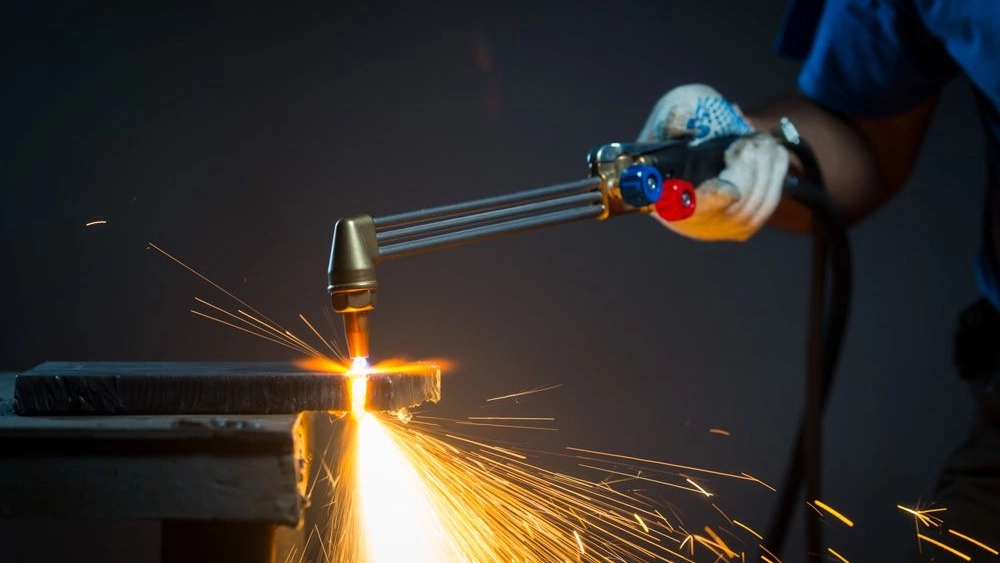
Success in carrying out large-scale wastewater welding projects is highly dependent on the equipment used. Advanced inverter welding machines that create a more stable electric arc, hydraulic polyethylene welding machines for thick pipes, and precision plasma and air cutting tools are just some of the essentials.
Furthermore, edge preparation equipment (Beveling Machines) is necessary to create the right angle in thick pipes for full penetration of the weld. If the edging is not done correctly, the weld will have defects such as lack of penetration, which will lead to fracture at high pressures. Khajovi mobile welding is able to implement the most complex projects by investing in modern equipment and constantly updating its tools. Having the right equipment along with skilled manpower is a winning combination to do wastewater welding projects with high efficiency.
Benefits of outsourcing to expert teams
Many water and sewage organizations, municipalities and main contractors prefer to leave the welding part of their projects to specialized second-hand contractors. This will make them focus on the macro project management and leave the welding technical issues to the experts. Outsourcing wastewater welding projects to a group like Khajovi mobile welding has several advantages:
- Cost reduction: There is no need to buy expensive welding equipment and permanent hiring of welders.
- Quality assurance: Using the expertise and experience of a group whose main job is welding improves the final quality.
- Execution speed: Specialized teams complete the work in a shorter time due to their high skill.
- Flexibility: It is possible to increase or decrease the workforce depending on the size of the project.
In fact, choosing a reliable welding contractor is an investment to avoid future rework and repair costs. Doing wastewater welding projects is successful when a chain of knowledge, skills, equipment and proper management are put together.
Key points in welding tanks of refineries
Water and sewage treatment plants have many tanks for aeration, sedimentation and chlorination. The material of these tanks can be concrete with metal coating or full metal. Carrying out wastewater welding projects in the tank sector requires precision in sealing the corners and bottom of the tank. Any porosity in the weld can cause sewage to penetrate into the underlying soil.
Welders must be familiar with welding techniques in different positions (flat, horizontal, vertical and ceiling), because it is not always easy to access all parts of the tank. Also, after welding, the welding surfaces should be thoroughly cleaned and polished so that there is no place for the accumulation of bacteria and microbial corrosion. Khajovi Mobile Welding provides stable and reliable services in this sector by complying with sanitary and technical protocols specific to refineries.
The future of the welding industry in the field of water and sewage
With the advancement of technology, new methods such as laser welding and robotic welding systems are entering the industry. Although it is currently more common to use traditional and semi-automatic methods in doing wastewater welding projects, the need to adapt to new technologies is felt. The use of new composite pipes and advanced alloys challenges welding knowledge.
The leading groups are always training their personnel and improving their technical knowledge so that they can meet the needs of the future. Carrying out wastewater welding projects in the future will require micron precision and higher speed. Along with these developments, Syar Khajovi Welding has also based its vision on providing modern services in accordance with the latest scientific achievements.
Environmental impact of proper welding
Perhaps at first glance, the direct connection between welding and the environment is not obvious, but doing wastewater welding projects correctly is one of the most important factors in protecting the ecosystem. Spillage of raw sewage into rivers or groundwater can be catastrophic. A poorly welded joint can be a source of great contamination.
On the other hand, in drinking water distribution networks, the waste of purified water due to leakage from connections is considered a national loss. Therefore, welders who work in this field have a social responsibility. Aware of this serious responsibility, the Khajovi mobile welding team makes every effort to contribute to the preservation of the country's water resources by providing flawless welding. Commitment to the environment in carrying out wastewater welding projects is not a slogan, but an executive requirement for this group.
Summary and conclusion
Executing wastewater welding projects is a specialized, sensitive and multifaceted process that requires a combination of engineering knowledge, technical skills and appropriate equipment. From polyethylene pipes to massive steel transmission lines, each part of the network requires a unique welding method. The quality of these connections guarantees the stability of urban infrastructure and the health of the environment.
Challenges such as corrosion, difficult access and unsuitable environmental conditions show the necessity of using experienced contractors more than ever. In this regard, Syar Khajovi Welding, as a reliable and reliable name, is ready to meet all the needs of employers in the field of installation, commissioning, repair and maintenance of water and sewage networks, relying on its experience and expertise. Choosing a professional team to carry out wastewater welding projects is a smart step towards the implementation of long-lasting and high-quality projects. To benefit from specialized services and technical advice, you can refer to the website of this group and use their abilities to advance your project goals.