
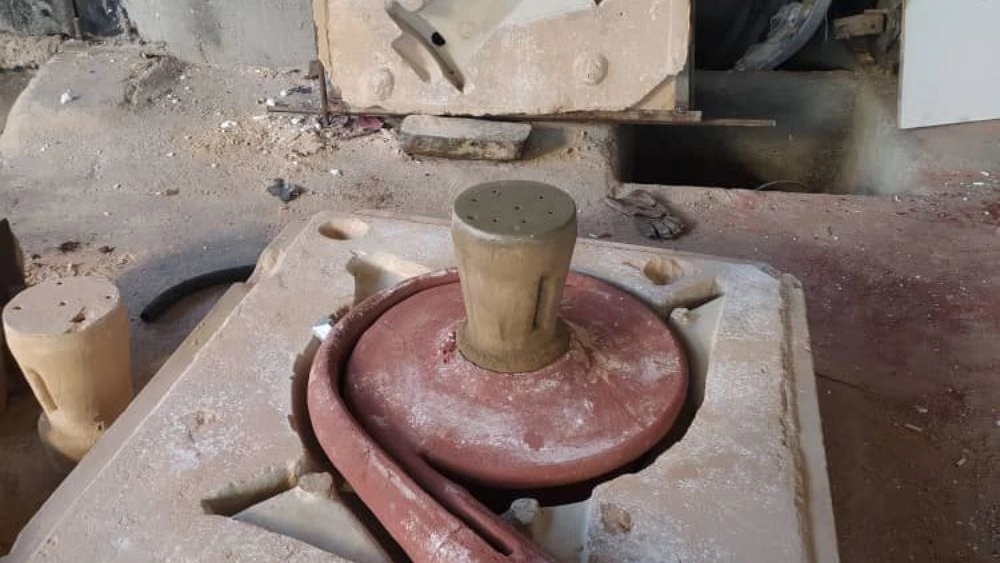
In many industries today, pumps play the role of the beating heart of production lines; From the transfer of corrosive fluids in chemical industries to the transfer of water and sewage in urban facilities and even the circulation of hot fluids in energy units. In the meantime, the quality of the "pump mold" and its cast parts determine the durability, efficiency and stability of the pump. Choosing the right alloy for making molds and related parts, especially in corrosive or high-temperature environments, is doubly important. One of the standard and widely used choices in this field is 316 steel; An alloy that has found a special place in industrial pump manufacturing due to its high resistance to corrosion and harsh working conditions.
In a city like Tehran, which is an important hub for industries, suppliers, and specialized workshops for the manufacture and production of parts, access to precise and engineered casting and pump mold making services is considered a competitive advantage. Akbarpour Steel and Duplex Casting focuses on the casting of stainless steel and duplex alloys, it advances the production of 316 steel pump molds from the stage of material selection to the final quality control, in a specialized manner and in accordance with the needs of industries.
The importance of the pump mold in the performance and lifetime of the equipment
Pump mold (as a general concept in the production of pump parts and its cast assemblies) plays a key role in the accurate and repeatable shaping of parts such as body, cover, housings and related components. Any errors in geometry, surface quality, concentricity or local thicknesses can lead to problems such as leakage, cavitation, vibration, pressure drop and even premature failure of the part.
In industrial pumps, parts are often exposed to one or more of the following damaging factors:
- Corrosion caused by chlorides, acids or chemical environments
- Abrasion caused by suspended solids or high-velocity currents
- Thermal shocks and temperature changes
- Mechanical stresses, vibration and on and off cycles
In such a situation, making the pump mold with an alloy such as 316 steel can be a reliable solution to increase the lifespan and reduce unwanted stops; Of course, provided that the casting process, finishing operations and quality control are done correctly.
Why is 316 steel the right choice for producing pump molds?
Steel 316 is one of the most widely used grades of austenitic stainless steel, which, due to the presence of suitable alloy elements, performs well against corrosion, especially in chloride-containing environments. This feature has made 316 steel to be used in the manufacture of many pump parts, industrial valves, fittings and process equipment.
Higher corrosion resistance than more common grades
In many applications, the main difference between 316 steel and some more common grades is better resistance to pitting and crevice corrosion. This issue is very important for pumps that work with water containing chloride ions, salt solutions or some process fluids.
Preservation of properties at various working temperatures
Pumps may operate in low temperatures, variable environmental conditions or even hot fluids. 316 steel generally offers acceptable mechanical properties in a wide range of temperatures, and along with the correct manufacturing process, it can be a reliable choice for the production of pump molds and related parts.
Machinability and proper finishing
After casting, many parts require precision machining, proper sealing and surface finishing. 316 steel, if the production principles are followed, has a good finishing ability and can approach the required tolerances in pump parts.
Tehran; The advantage of access to specialized services for the production of 316 steel pump molds
Tehran, as an industrial and logistics center, provides advantages such as access to the material supply network, machining facilities, quality control laboratories and engineering services. But what makes the real difference is the expertise and experience of the manufacturer in casting stainless and duplex alloys.
Akbarpour Steel and Duplex Casting in Tehran, focusing on industrial projects, tries to make the work output not just a cast piece, but an engineering solution for the durability and better performance of the pump in the real work field. This view has a direct effect, from the selection of the manufacturing method to the determination of geometric sensitive points and final quality control.
The production process of the pump mold with 316 steel material; From design to delivery
Manufacturing a 316 stainless steel pump mold is a multi-step process that requires careful coordination between design, casting, possible heat treatment, machining and inspection. In the following, we review the most important steps of this path.
Engineering design and requirements review
First of all, it must be determined in what conditions the part or assembly in question will work: fluid type, temperature, pressure, amount of solid particles, expected standards and dimensional sensitivities. Then the design or plan review is done to consider things such as appropriate thicknesses, radii, stress concentration locations, and casting feasibility.
In professional projects, paying attention to these details from the very beginning prevents defects such as mace, porosity or shrinkage and increases the final quality of the pump mold.
Choosing the right casting method for 316 steel
To produce pump parts with 316 steel material, the casting method should be chosen according to the complexity of the part, circulation, dimensional accuracy and surface quality. The final goal is to achieve a uniform, low-defect and reliable structure. Choosing the right process and controlling parameters has a direct role in reducing casting defects and increasing performance stability.
Akbarpur Steel and Duplex Casting Knowing the requirements of stainless alloys, tries to manage the casting process in such a way that the result is reliable parts for industrial applications.
Melting control, chemical composition and purity of the melt
In 316 steel casting, controlling the chemical composition and cleanliness of the melt is very important. Any deviation from the target composition or introduction of impurities can affect the mechanical properties and corrosion resistance. As a result, the correct management of melting and compliance with the principles of casting of stainless alloys are considered to be the foundations of the final quality.
Casting, feeding and preventing defects
Pump parts usually have thickness changes and sensitive areas. The design of the channel system and correct feeding prevents the creation of porosity and shrinkage. Also, controlling the cooling rate and paying attention to the hot spots in the piece, makes a more suitable metallurgical structure and reduces the risk of cracks or internal defects.
Cleaning, cutting and preparation for finishing
After the part is removed, the cleaning steps, the separation of additions and the preparation for machining are done. The quality of this step can affect the production time and even the quality of the final surface. In parts where sealing or precise tolerances are important, proper preparation is an integral part of 316 steel pump mold manufacturing.
Machining, polishing and achieving precise tolerances
Many pump parts require precise sealing surfaces, bearing locations, mechanical seal mounting locations, and assembly surfaces. Correct machining and dimensional control at this stage ensures that the part performs correctly in the final assembly and does not leak or misalign.
Akbarpur Steel Casting and Duplex focuses on industrial and usable output in the production process; That is, a part that in practice responds to the working conditions and needs of the customer.
The role of quality control in the production of 316 steel pump molds
The quality in the production of 316 steel pump mold is not only limited to the appearance of the part. Many defects can be internal and can only be identified by careful inspection. Quality control in this area usually includes the following:
- Dimensional and geometric inspection according to the plan
- Control of surface quality and sealing areas
- Evaluation of the overall health of the part and uniformity of the structure
- Attention to industrial requirements to ensure operation in real conditions
The more precise the level of quality control, the lower the risk of premature failure and production line stoppage. As a result, choosing a specialized set in steel and duplex casting is an economic and technical decision.
316 or duplex steel; Conscious choice based on working conditions
In some projects, customers are hesitant between 316 steel and duplex alloys. The fact is that the final choice depends on the working conditions and the type of fluid. 316 steel performs very well in many environments, but in certain situations, duplex may be considered as another option.
The important advantage of cooperation with a group like Steel Casting and Akbarpour Duplex is that the look is not just selling materials; Rather, the choice of alloy and the manufacturing process is based on the actual needs of the project and operating conditions so that the final output has the most durability and the least risk.
Advantages of cooperation with Akbarpour steel casting and duplex in Tehran
To produce a pump mold with 316 steel material, it is very important to choose a manufacturer who has real experience in casting stainless alloys. Akbarpour Steel and Duplex Foundry in Tehran, focusing on stainless alloys and duplex, tries to respond to the needs of industries with stable quality and engineering approach.
Specialized focus on steel and duplex alloys
Stainless casting has its own special subtleties; From melt control and melt cleanliness to special defect management. Expert experience in this field reduces the possibility of error and creates repeatable quality.
Ability to respond to industrial needs
Industrial projects usually require a part that works in real life, not just right on paper. Paying attention to tolerances, sealing, machining and quality control makes the part perform reliably during assembly and operation.
Tehran's accessibility and logistic advantage
Presence in Tehran simplifies project coordination, sending and receiving, and technical interaction. This is an important advantage for many industries and pump workshops that are sensitive to timing.
summary
Production of 316 steel pump molds in Tehran gives the best results when three factors come together: choosing the right alloy, engineered casting and strict quality control. 316 steel is one of the common and reliable choices for pump-related parts and molds due to its high corrosion resistance and good performance in industrial conditions. However, the final quality is directly dependent on the manufacturer's expertise in casting stainless alloys.