
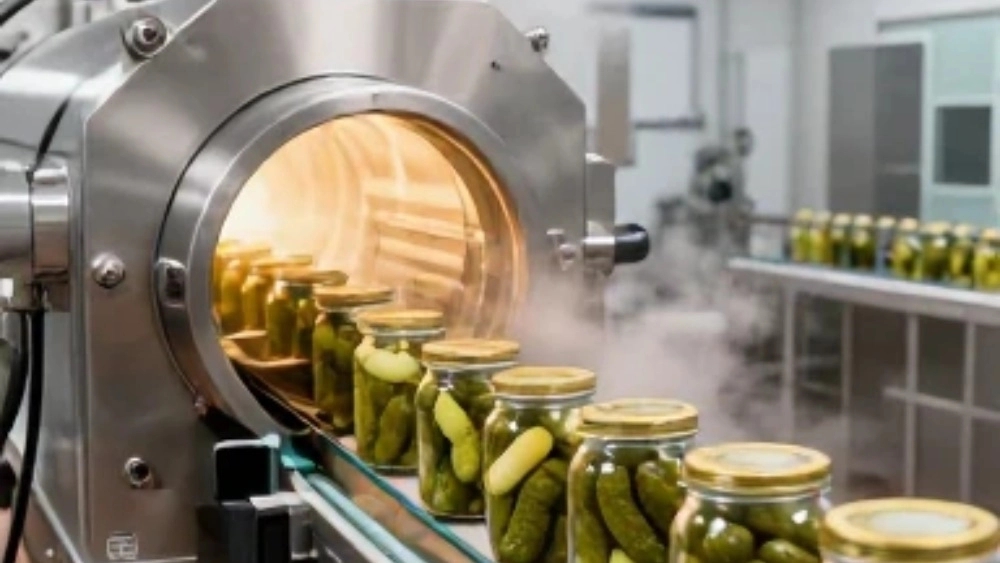
In the food industry, ensuring the safety of the product and increasing its shelf life without losing the quality of appearance and taste is one of the biggest technical challenges. In the meantime, the pasteurized tunnel construction technology for durability plays a vital role as the beating heart of packaged production lines. Pasteurized tunnels not only guarantee the health of the consumer by removing pathogenic and corrupting microorganisms, but also help to create an internal vacuum and prevent the re-infiltration of contamination by activating the sealing mechanisms in glass and metal containers. With an in-depth look at engineering principles, components, and optimization strategies, this article provides comprehensive guidance for engineers, production managers, and investors in the food industry.
The fundamental principles and strategic importance of pasteurization in the tunnel
Pasteurization is a process in which the temperature is raised for a certain period of time to inactivate harmful bacteria and microbes. Unlike sterilization, which requires much higher temperatures and may affect the taste and texture of the product, pasteurization ensures microbial safety by maintaining the organoleptic quality of the product. Pasteurization tunnel construction technology for durability is based on the principle that the combination of temperature and time (F-value) should be calculated in such a way that the minimum microbial lethality (Lethality) for the target pathogens is achieved without damaging the product tissue.
The importance of this technology is felt more and more in industries such as the production of tomato paste, sauces, pickles, compote fruits and processed dairy products. In these products, after filling the containers, the air inside the container expands and escapes due to heat. When the container enters the pasteurization tunnel and reaches the target temperature, the internal pressure is reduced and a natural vacuum is created with the sudden cooling. This vacuum not only seals the container tightly, but also creates a physical barrier against the re-entry of microbes. Therefore, the precise design of the pasteurization tunnel directly affects the product rejection rate and shelf-life.
Key components and pasteurization tunnel engineering
To properly understand the pasteurized tunnel construction technology for durability, we must get to know its main components. A standard pasteurization tunnel consists of several separate sections, each of which has a specific task in controlling temperature and time.
1. Preheating Zone
In this section, the water temperature gradually increases from the ambient temperature to the low pasteurization temperature. The main purpose of this step is to prevent thermal shock to the containers. If a cold container goes directly into hot water, there is a possibility of breaking glass or deforming plastic and metal containers. The design of the nozzles in this section should be such that a uniform distribution of hot water is created on all surfaces of the containers.
2. The main pasteurization section (Holding Zone)
This is the heart of the pasteurized tunnel. In this area, the temperature reaches the highest limit determined for the pasteurization process of the product and is kept at this temperature for a certain period of time (for example, 20 to 30 minutes). The temperature of this section varies depending on the type of product; For acidic products such as pastes and sauces, a temperature of 85 to 95 °C is used, and for dairy products or non-acidic compotes, lower temperatures and longer times are used. In this section, water circulation must be strictly controlled to maintain a uniform temperature in all parts of the tunnel. It is necessary to use high-flow pumps and mixing systems.
3. Cooling Zone 1
After leaving the storage area, the water temperature gradually decreases. This step is to start the gradual cooling process to avoid sudden temperature changes.
4. Final cooling section (Cooling Zone 2)
At this stage, clean, cold water (usually at or near ambient temperature) is sprayed into the containers to bring the product temperature to a safe level for handling and final packaging. Water quality is critical at this stage, as any contamination in the cooling water can re-contaminate the surface of the containers. The use of advanced filtration and chlorination or UV systems for cooling water is mandatory.
Technical challenges in the design and construction of pasteurization tunnels
Implementation of pasteurized tunnel construction technology for durability is associated with numerous engineering challenges that require high precision in design and implementation. One of the most important challenges is temperature uniformity. Even a slight fluctuation in temperature can lead to insufficient pasteurization in some places and burning or flavor changes in others. To solve this challenge, engineers use precise temperature sensors (PT100) at different points of the tunnel and use advanced control algorithms (PLC) to adjust the steam or hot water input.
Another challenge is the issue of "Cold Spots" in the tunnel. These spots usually occur at the edges of the conveyor belt or under improperly arranged containers. To overcome this problem, the design of the nozzles should be such that it creates a 360-degree coverage on the containers. Also, the use of high-quality and anti-corrosion conveyors that do not change shape when in contact with water and steam is of particular importance.
The third issue is energy consumption. Pasteurized tunnels have a high consumption of water and energy (to heat water). The new manufacturing technologies include heat recovery systems that absorb the heat of the outgoing water from the cooling section and use it to heat the incoming water in the preheating section. This not only reduces operating costs, but also increases the environmental sustainability of the production line.
Building materials and health standards
In technology of pasteurized tunnel construction for durability, the choice of construction material is one of the key factors in the durability and hygiene of the device. All parts in contact with the product and water should be made of stainless steel grade 304 or 316. These steels are highly resistant to corrosion caused by acids in food and chlorine in water. The use of thick sheets and polished argon welding (TIG welding) prevents the accumulation of contamination in the welding seams and enables easy cleaning of the device (CIP - Clean In Place).
In addition to the material, the interior design of the tunnel must be without corners and sharp angles so that there is no point left for bacteria to accumulate. Internal washing systems (Spray Balls) must be installed in such a way that they completely cover all the internal surfaces of the tunnel during washing. Compliance with international standards such as ISO 22000 and HACCP in design and manufacturing is required so that the final product is approved in terms of food safety.
Process control and intelligent automation
In today's age, technology of pasteurization tunnel construction for durability does not make sense without intelligent automation. Automatic control systems (SCADA/PLC) allow real-time monitoring of temperature, pressure, water flow and conveyor speed. These systems can automatically cut or alarm the steam input if the temperature deviates from the allowed range. Also, the ability to record data (Data Logging) is very vital for monitoring purposes and quality inspections.
Another advanced feature is Tracking & Sorting systems that can identify products with insufficient temperature or defective packaging and remove them from the production line. This level of quality control minimizes waste rates and ensures the quality of each can and glass output.
Maintenance and optimization of tunnel performance
Even with the best Pasteurization tunnel construction technology for durability, the performance of the device over time is affected by water deposits (Scale) and food deposits. Layer deposits on nozzles and tunnel walls disrupt heat transfer and cause cold spots. Therefore, it is necessary to plan periodic acid washing to remove calcium deposits and alkaline washing to remove fats and organic substances.
Also, regularly checking nozzles for clogging, calibrating temperature sensors and checking the performance of pumps and conveyor motors are preventive measures that should be included in the maintenance and repair (PM) checklist. A well-maintained pasteurization tunnel not only guarantees the product's shelf life, but also dramatically increases the useful life of the device.
conclusion
Investing in Pasteurization tunnel construction technology for durability is a strategic decision for any producer looking to compete in sensitive and export markets. Success in this field requires a combination of thermal engineering knowledge, precise mechanical design, high quality material selection and intelligent automation. By observing the technical principles, strict control of operational parameters and preventive maintenance, it is possible to build a tunnel that not only guarantees microbial safety, but also by maintaining the organoleptic quality of the product, it can attract consumer satisfaction. Finally, a deep understanding of the pasteurization process and the use of modern technologies is the key to achieving ideal shelf life and reducing waste in the food industry.