
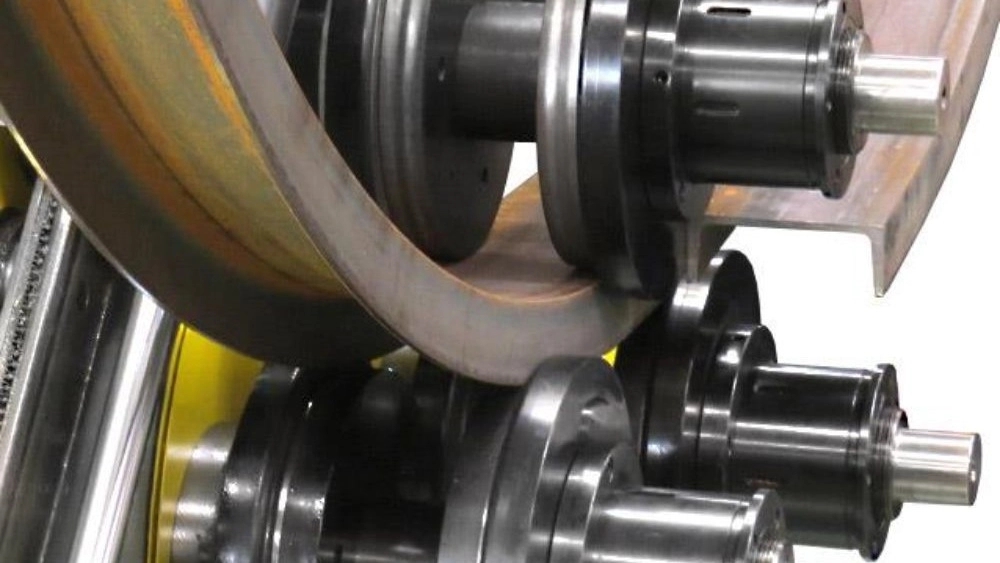
The manufacturing industry has undergone fundamental changes in recent decades, and one of the most important developments is the introduction of accurate and automatic technologies to metal forming processes. CNC bending as one of the main pillars of the production of metal parts in various industries, plays a key role in achieving high precision, appropriate speed and mass production capability. This technology provides the possibility of bending metal sheets with different geometrical complexities and has a special place in the modern production chain.
In this article, in addition to introducing the principles and advantages of CNC bending, we will examine industrial applications, processable materials, important points of quality measurement, as well as the role of Aria Industry Nano Research in providing advanced bending services.
The concept of CNC bending
CNC bending technology is basically a process in which a metal sheet is bent on a mold by pressure and a certain angle is created. The main difference between this method and traditional bending is in the precise numerical control of the device. In CNC machines, all movements, pressures, speeds and directions are controlled by the computer. The result of this intelligent control is very high accuracy, uniformity of production parts and reproducibility on a mass scale.
In modern factories, CNC bending is not just a simple sheet bending operation, but a core technology that ensures the final product quality. The digital settings of the device allow even the most complex angles and shapes to be produced without errors and at high speed.
The importance of CNC bending in mass production
Mass production requires quality stability, high speed and minimum human error. CNC bending meets all these needs. This method not only reduces the production time, but also significantly enables the production of parts with very low tolerance.
Some of the most important reasons for the importance of this technology in mass production are:
- Complete uniformity in each output piece
- Programmability to produce very high numbers
- Reduction of raw material waste
- Possibility of producing complex shapes without the need for secondary operations
- Reduction of human error
CNC bending is an integral part of production lines in the aerospace, automotive, household appliances, medical equipment, and electrical industries.
Technical advantages of CNC bending
The CNC bending technology brings a set of technical advantages that distinguish it from traditional methods.
1. Very high accuracy
Numerical control systems manage all steps with micron precision. The exact angle of the bend, the uniformity of the lines, and the prevention of unwanted errors are the results of this technology.
2. Reproducibility
In mass production, each piece must be exactly the same as the previous piece. Digital control allows each bend to be created with the same specifications without any differences.
3. Reduction of production cost
By reducing material waste and eliminating human errors, the final cost of production will be lower.
4. The possibility of bending thick and thin sheets
Therefore, a wide range of industries can benefit from this method at the same time.
5. Compatibility with complex parts
New industrial designs require the production of parts with special geometry. CNC bending makes it possible to produce parts with multiple forms without quality loss.
Common materials suitable for CNC bending
One of the important features of CNC bending is its compatibility with all kinds of metal materials. Depending on the type of project, thickness and mechanical properties, the following metals are usually processed in this technology:
- Normal steel
- Stainless steel
- Aluminum
- Galvanized
- Copper
- Brass
Each of these metals has its own physical characteristics, and the CNC machine is able to accurately set the parameters for each material.
Industrial applications of CNC bending
Applications of this technology exist in almost all technical and production fields. Some of the most important of them are:
1. Automotive industry
Manufacturing chassis parts, holders, brackets, shields and internal parts of the body.
2. Electricity and electronics industry
Manufacturing electrical panels, telecommunication racks, electronic equipment boxes and metal cooling systems.
3. Household appliance industry
Designing the main body of refrigerator, stove, cooler and other metal appliances.
4. Architecture and decoration industry
Building metal facades, decorative ceilings, handrails and architectural elements.
5. Medical industry
Production of high precision steel parts for hospital equipment.
This breadth of application shows that CNC bending is not only a manufacturing technique, but an industry standard.
Why does CNC bending require precision engineering design?
In the production of complex parts, the smallest error can cause the part not to match with other components. Therefore, before starting the CNC bending process, engineers make a detailed model of the part with 3D design software. Then this model is converted into comprehensible codes for the CNC machine.
Parameters like:
- Bend radius
- Bend direction
- Allowed tolerance
- Sheet thickness
- Metal spring return
must be calculated carefully. This step is very important and has a direct effect on the final quality of the output.
The role of Sanat Aria nano research in providing advanced CNC bending services
Among the groups active in the field of metal parts production, Aria Nano Research is known as one of the leading companies in providing CNC bending services. Using modern devices and an experienced team, this collection has been able to gain a special position in various industries.
Prominent features of Sanat Aria nano research:
- Using state-of-the-art CNC machines
- High precision in the implementation of complex designs
- Quick delivery of mass production projects
- Continuous quality control at different stages
- Ability to process all types of metals with different thicknesses
- Technical and engineering support until the moment of delivery of the part
With this approach, this collection has been able to gain the trust of the country's important industries and become a specialized reference in CNC bending.
Quality measurement in CNC bending
In order for the final output to fully match the initial design, a series of tests must be performed:
- Control of the bending angle
- Checking the final dimensions
- Controlling the uniformity of the edges
- Evaluating the bending line in terms of cracks or waves
- Approving the engineering plan
In the Aria Industry Nano Research Group, all these steps are performed with accurate measuring equipment so that the final parts are presented without errors and according to production standards.
The role of automation and software in final quality
Combining industrial automation with modern software systems has made CNC bending become the most accurate bending method. Devices equipped with advanced sensors measure and correct the amount of force, depth and bend angle moment by moment. This level of intelligent control reduces human errors to almost zero.
summary
CNC bending Today, it is an integral part of the mass production process of metal parts in various industries. High accuracy, appropriate speed, error reduction and the ability to produce complex parts have made this technology a vital tool for factories and industrial workshops.
Aria Industry Nano Research Group, having advanced equipment, engineering expertise and extensive experience in the field of bending, has been able to provide reliable and high-quality services to the country's industries. This collection implements the CNC bending process with global standards and meets the industry's need to produce accurate and standard parts in the best possible way.