
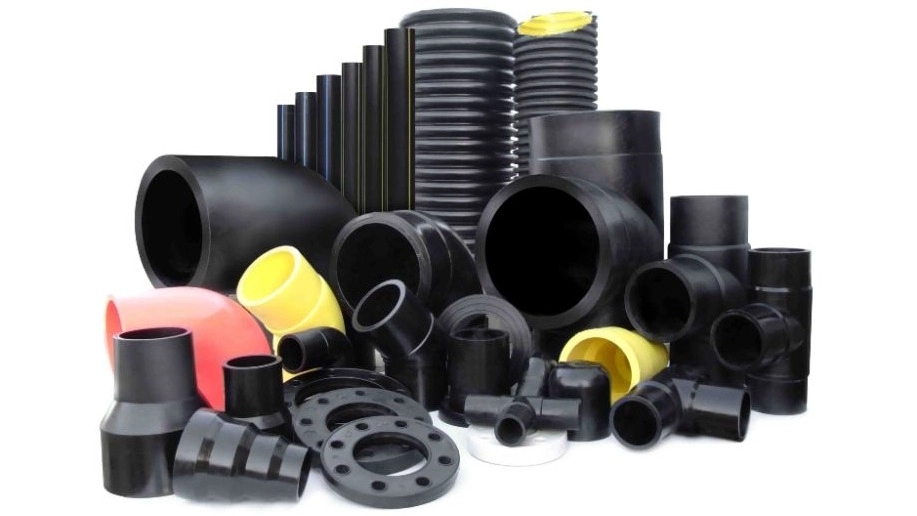
In the modern world of civil engineering and facilities, piping is one of the main pillars of urban, industrial and construction infrastructure. Among different materials, polyethylene (PE) pipes have found a special place due to their high durability, excellent chemical resistance and easy installation. But a healthy and leak-free plumbing system is not only dependent on the quality of the pipes; Rather, polyethylene connections play a vital role in the integrity and performance of this system. Choosing the correct type of connection, depending on the application, working pressure and pipe diameter, can have a direct impact on system life and maintenance costs. In this comprehensive article, we will carefully review the types of widely used polyethylene fittings, connection methods and important technical points, and finally we will introduce one of the most reliable suppliers of these products in the Iranian market, namely Zamzam Pipe Khodadadi Trading.
The importance of connections in polyethylene piping systems
General classification of polyethylene joints
Polyethylene connections can be classified from several perspectives:
- Based on connection method: thermal welding (boot fusion), threading (flange or male/female), press (fastening) and covered.
- Based on geometric shape: knee (angled), tee, two-way (direct connection), manisque (reducer) and flange.
- Based on application: water piping drinking, sewage, gas, agriculture and chemical industries.
In the following, we examine the most commonly used types of these connections in detail.
Butt Fusion
Welded or butt fusion connections are one of the most reliable and common connection methods in pipelines with a high diameter (usually above 63 mm) and high working pressures. In this method, the two ends of the pipe and the connector (which is usually a manisque or tee) are heated using a heat welding device and then pressed together under pressure.
Advantages of welded joints
- Completely integrated connection: After cooling, the connection becomes as tight as the pipe itself and there are no weak points.
- High leakage resistance: Due to the absence of external parts such as gaskets or threads, the possibility of leakage is zero.
- Suitable for high pressures: These fittings are ideal for main water supply networks and high pressure pipelines. are.
Disadvantages and challenges
Fastening or covered connections
Press or fastening connections are a new generation of polyethylene connections that are installed without the need for thermal welding. These fittings have a durable plastic shell (usually made of polypropylene or reinforced polyethylene) and an internal mechanism consisting of tension rings and rubber washers.
How it works
In this method, the polyethylene pipe is inserted into the press connection. Then, using a special wrench, the screws on the outer shell are tightened. This makes the inner rings that are on the tube press the tube hard and create a complete seal.
Advantages of press fittings
- Very high installation speed: The installation of these joints is several times faster than the welding method and does not require cooling time.
- No need for heavy equipment: Only a special wrench is needed, which reduces the initial cost.
- Suitable for limited space: Due to its smaller dimensions and the lack of space for the welding machine, it is perfect for tight spaces and underground. are.
- Separability: If repair or rerouting is required, the connection can be opened and closed again (although it is recommended to replace the washers).
Applications
Press fittings are very popular for indoor plumbing, drip irrigation systems, medium pressure gas networks and projects where short lead times are a priority.
Threaded & Flanged connections
Sometimes it is necessary to connect polyethylene pipes to metal equipment (such as pumps, brass valves or steel pipes). In these cases, threaded or flange connections are used.
Threaded connections
These connections have internal (female) or external (male) threads. Polyethylene pipe is usually connected to this system through a press fitting that has threads. Or the end of the pipe is connected to the thread using special threading tools (for thin pipes) or using transition fittings.
Important note: In threaded connections, it is necessary to use Teflon tape and thread glue to create complete sealing. You should also be careful not to over-press the wrench to crack the plastic connection.
Flanged connections
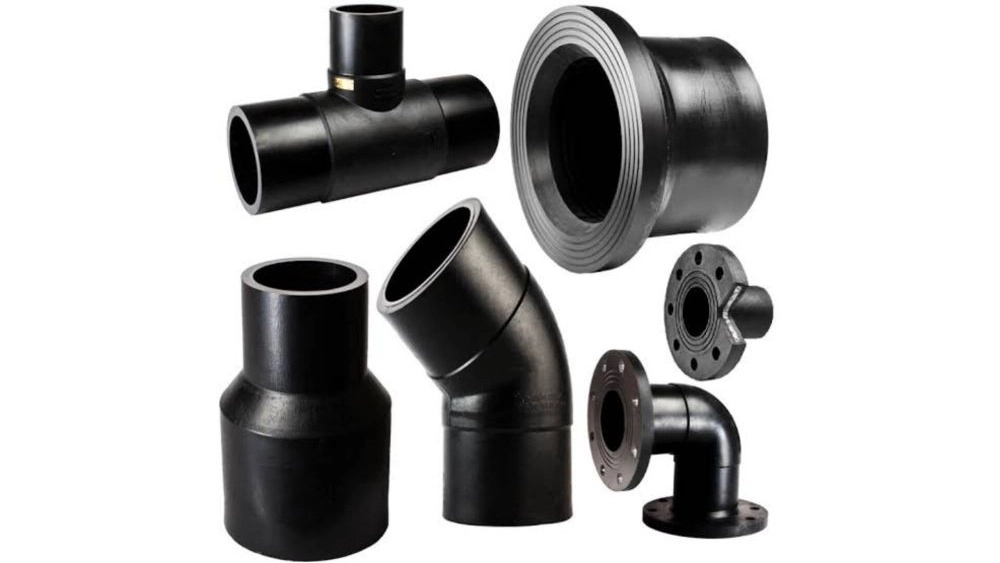
Flanges are round plates that are welded or pressed to the end of a pipe or fitting and are bolted to the flange of other equipment. This method is used to connect to large pumps, industrial valves and points that require frequent disassembly (opening).
Flange advantages:
- Easy to open and close for maintenance and repairs.
- High resistance to vibration and impact.
- Suitable for high diameter connections where the use of threads is not practical.
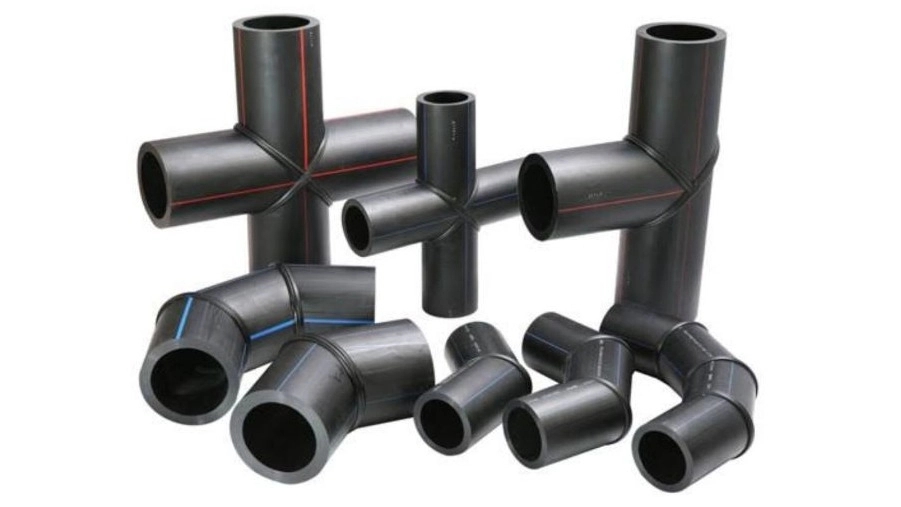
Knee joints, tee and meniscus
These items refer to the geometric shape of the connections and can be produced in different ways (welded, pressed or threaded).
elbow
Used to change the direction of the pipe (usually 45 or 90 degrees). In press connections, 90-degree elbows should be installed more carefully due to greater hydraulic resistance and the possibility of getting dirty sooner.
Tee
It is used to divide the stream into two paths or combine two streams. In press connections, tees have three connection points, each of which requires uniform pressure.
Meniscus (Reducer)
It is used to connect pipes with different diameters. Menisci can be concentric (Centric) or offset (Eccentric). In gas systems, it is important to use offset menisci to prevent the accumulation of liquids at the bottom of the pipe.
Key points in buying and installing polyethylene fittings
To ensure the correct operation of the piping system, it is necessary to observe the following points:
- Standards: Make sure that the fittings are certified by Iran's national standard, EN (Europe) or ASTM (USA) standard.
- Pressure compatibility: The allowable pressure (PN) of the fittings must match the working pressure of the system. Usually, PN10 and PN16 fittings are widely used.
- Quality of raw materials: Using fittings made of pure PE80 or PE100 grade increases durability and resistance to cracking.
- Correct installation:
- In the welding method, the surface of the pipe must be completely clean and smooth.
- In the pressing method, the pipe must be inserted all the way into the joint and from the knee To prevent pipe damage during installation.
- In the threaded method, use high-quality adhesives and tapes.
Why is the quality of connections critical?
Many leaks and failures of water and sewage networks are rooted in poor quality connections. Inexpensive fittings may have impurities in the raw materials, may not have accurate dimensions, or may have suffered internal stresses during the manufacturing process. These cases lead to early failure over time and under water pressure or temperature changes. The cost of replacing a connection underground or inside the wall is ten times the cost of buying a quality connection. Therefore, investing in quality connections is not an expense, but an insurance for your installation system.
conclusion
Bazargani Zamzam Pipe Khodadadi with years of experience in the pipe and fittings industry, offers a wide range of polyethylene fittings including press (fastening), welding, threaded, flange, knee, three-way and manisque with international standards and in different sizes. By focusing on providing high quality products (PE80 and PE100 grade), competitive prices and technical consulting services, this group helps its customers to make the best choice for their projects. In addition to product variety, after-sales support and delivery speed are other benefits of cooperation with Zamzam Pipe Khodadadi. If you are looking for a supplier that offers quality, authenticity and professional service together, this business will be an ideal choice for your civil, construction and industrial projects.
اتصالات لوله پلی اتیلن بازرگانی زمزم پایپ خدادادی
برای سفارش و استعلام قیمت لطفا تماس بگیرید