
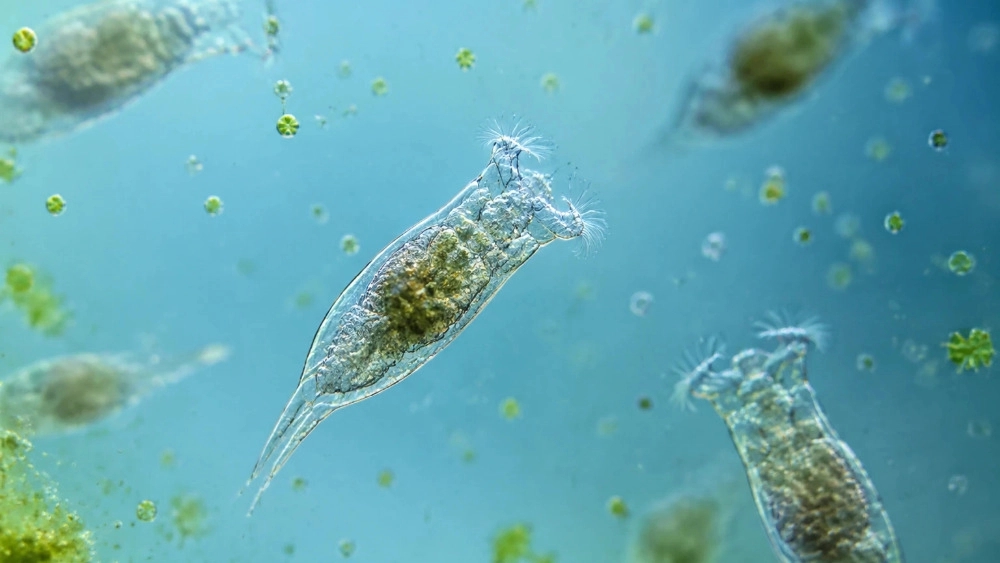
In the modern aquaculture industry, providing high-quality live food for fish and shrimp larvae is one of the most important success factors in production. Meanwhile, rotifer cultivation is known as one of the most common and practical methods of live food production. Rotifers play a vital role in the early stages of larval development due to their small size, high nutritional value, and ability to reproduce quickly.
Despite the high importance of these tiny creatures, many aquaculture activists, especially beginners, face challenges in rotifer cultivation at the beginning of the path. For this reason, using rotifer cultivation training services for beginners can shorten the learning path and increase the success rate.
In this context, Gahar Biotechnology Company has been able to help many producers to set up sustainable and economical live food production systems by providing specialized and practical educational services in the field of aquaculture, especially in the field of rotifer cultivation.
What is rotifer and why is it important in aquaculture?
Rotifers are microscopic aquatic organisms found in freshwater and saltwater environments. Due to their very small size, active movement in water and good nutritional value, these creatures are used as the primary food of many fish and shrimp larvae.
In aquatic breeding systems, rotifer cultivation is one of the main bases of production because:
- Their size is suitable for feeding larvae
- They multiply quickly
- They have the ability to enrich with nutrients
- They have high nutritional value
For this reason, many professional breeding centers use standard rotifer cultivation systems. But starting this system without proper training can be associated with problems such as population density reduction, pollution or complete destruction of cultivation.
Why is rotifer cultivation training necessary for beginners?
People who have just entered the field of aquaculture breeding are usually not familiar enough with the technical details of rotifer cultivation. Not knowing the proper environmental conditions or how to manage cultivation can cause failure in production.
Using rotifer cultivation training services for beginners has several advantages:
- Reducing initial errors in system setup
- Increasing rotifer production efficiency
- Learning hygiene principles in cultivation
- Better water quality management
- Familiarity with nutrition and enrichment methods
In this way, Gehar Biotechnology Company, by providing practical training courses, helps those interested to get to know the scientific and practical principles of rotifer cultivation and to be able to create sustainable living food production systems.
The main stages of rotifer cultivation
In order to succeed in rotifer cultivation, certain steps must be done in principle. Each of these steps is fully taught in the specialized trainings of Ghar Zeit Fanawar Company.
1. Preparation of culture tanks
The first step in rotifer cultivation is to prepare suitable tanks. Tanks must be completely clean and free of contamination. Plastic or fiberglass tanks are usually used for this purpose.
Important parameters at this stage include the following:
- Appropriate water salinity
- Stable temperature
- Sufficient oxygen
- Proper filtration
The correct management of these factors is very effective in the success of rotifer cultivation.
2. Preparation of rotifer starter
In order to start rotifer cultivation, an initial population or starter is needed. The quality of the starter has a great influence on the success of cultivation. The starter must be healthy, active and free of contamination.
In the courses of training services for rotifer cultivation for beginners provided by Gahar Biotechnology Company, the method of selecting and maintaining the starter is taught in full detail.
3. Nutrition of rotifers
One of the most important factors in rotifer cultivation is their proper nutrition. Rotifers usually feed on microscopic algae or alternative foods.
Common feeding methods include the following:
- Using live algae
- Using yeast
- Using commercial rotifer foods
Choosing the right feeding method can have a significant effect on the quality of rotifer cultivation.
4. Management of population density
In professional rotifer farming systems, population density management is very important. If the density increases too much, the water quality will decrease and the possibility of mortality will increase.
To avoid this problem you should:
- Regular harvesting should be done
- Water quality should be monitored
- Feeding should be controlled
Professional methods of density management in rotifer cultivation are taught practically in the training courses of Gahar Biotechnology Company.
5. Rotifer harvesting
Rotifer harvesting is an important step in the rotifer cultivation process. Harvesting should be done in such a way that the mother population is maintained and the production remains stable.
Usually special filters are used for extraction. After harvest, rotifers can be used to feed larvae or enriched before consumption.
Common problems in rotifer cultivation
Many beginners in rotifer cultivation face various problems. Some of the most common problems are:
- Sudden population decline
- Contamination with bacteria or protozoa
- Decreased water quality
- Improper nutrition
Many of these problems can be avoided by getting training services for rotifer cultivation for beginners. The specialized trainings of Gehar Biotech Company help producers to manage these challenges.
Benefits of using rotifer cultivation training services
Using training services for rotifer cultivation for beginners has many benefits for aquaculture activists. These trainings make the learning process faster and more professional.
The most important advantages are:
- Learning the scientific principles of rotifer cultivation
- reducing the costs of trial and error
- increasing the quality of live food
- increasing efficiency in breeding centers
- possibility of setting up sustainable production systems
Gehar Zeit Fanavar Company provides these educational services in a professional and practical manner by using experts in the field of aquaculture.
Why is Gehr Zeit Fanavar company the right choice for rotifer cultivation training?
In recent years, Gahar Zeit Fanawar Company has been recognized as one of the active groups in the field of biotechnologies and aquaculture. This company helps to develop technical knowledge in the aquaculture industry by providing specialized educational services.
Some of the features of this collection are:
- Providing training services for rotifer cultivation for beginners
- practical and applied training
- providing expert advice
- scientific support for propagation centers
Using the educational services of Gahar Biotechnology Company, those interested can learn the skills necessary for rotifer cultivation in a basic way and be more successful in the aquaculture industry.
The future of rotifer cultivation in the aquaculture industry
With the rapid growth of the aquaculture industry in the world, the need for high-quality live food has also increased. In the meantime, rotifer cultivation is still considered one of the most important methods of providing the primary food for larvae.
Developing new technologies, improving rotifer cultivation methods and providing specialized training can play an important role in increasing the productivity of breeding centers.
In this way, groups such as Ghar Zeit Fanavar Company can play an important role in the transfer of knowledge and development of this industry by providing educational services for rotifer cultivation for beginners.
summary
Rotifer farming is one of the key sectors in the aquaculture industry and success in this field requires technical knowledge and practical experience. For people who are new to this field, using Rotifer Cultivation Training Services for Beginners can make the learning process much easier.
By receiving specialized training, it is possible to set up sustainable and economic rotifer cultivation systems and increase the quality of live food in breeding centers.
Meanwhile, Gehar Biotechnology Company is recognized as one of the suitable options for learning and developing professional skills in the aquaculture industry by providing practical and specialized training in the field of rotifer cultivation.