
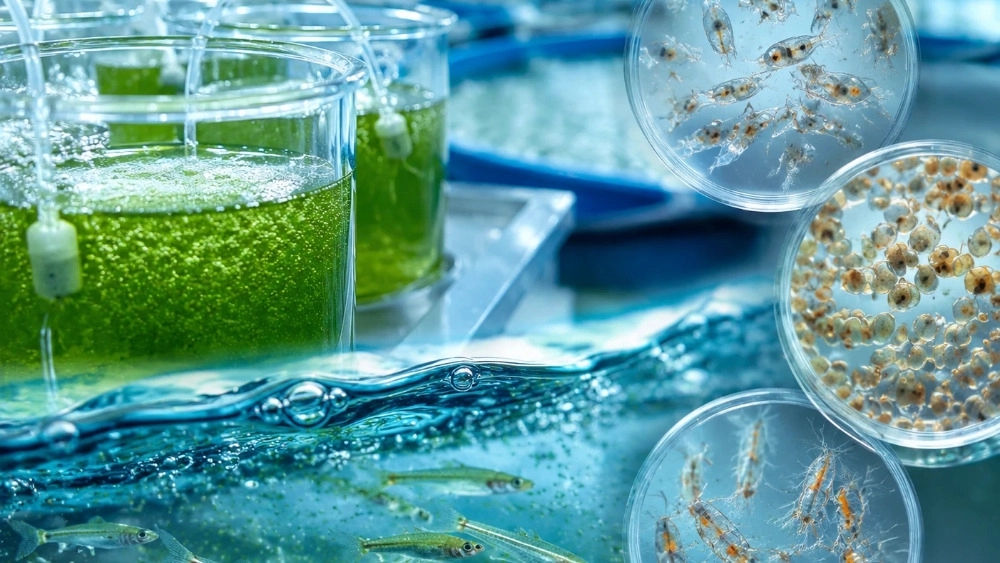
In the aquaculture industry, one of the most important success factors is the use of suitable and high-quality food for different stages of aquatic growth. In the meantime, live food plays a very vital role in the growth, health and increasing the survival rate in the initial stages of fish and shrimp life. Many breeders are looking to know how to get cheap and high-quality live food so that both production costs are reduced and production quality is increased.
The fact is that if we know the basic methods of producing live food, we can produce high-quality live food at a much lower cost than buying ready-made products. Also, the use of suitable equipment, technical knowledge and specialized products can make the process of live food production much simpler and more economical.
In this article, we thoroughly examine how to prepare cheap and high-quality live food, what types of live food are suitable for aquaculture and how to reduce production costs with the help of specialized technologies and products. We will also get to know the services and products of Ghar Zeit Fanavar Company, which specializes in this field.
What is live food and why is it important?
Before we look at how to get cheap and quality live food, it is necessary to understand what exactly live food is and why it is so important in the aquaculture industry.
Live food refers to living micro-organisms that are used as a source of nutrition for larvae and fry. These organisms include types of microalgae, artemia, rotifer and daphnia.
The importance of live food is summarized in the following:
That's why many professional growers are looking to learn how to get cheap, high-quality live feed to improve their farm performance.
Types of live food in aquaculture
In order to know how to prepare cheap and high-quality live food, we must first familiarize ourselves with the most important types of live food.
1. Microalgae
Microalgae are the main base of the food chain in many aquaculture systems. These algae are a food source for rotifers, artemia and some aquatic larvae.
The benefits of using microalgae:
- rich in essential fatty acids
- fast growth
- high scale production possibility
Microalgae production is one of the best answers to the question of how to get cheap and high quality live food.
2. Rotifer
Rotifers are very small organisms that are very useful in the early stages of marine fish larvae feeding. Due to their small size and high nutritional value, these creatures are considered one of the most important types of live food.
Characteristics of rotifer:
- Rapid reproduction
- High nutritional value
- Suitable for fish larvae
Rotifer cultivation along with microalgae is one of the effective methods for producing cheap and high quality live food.
3. Artemia
Artemia is one of the most well-known types of live food in the aquaculture industry. Due to its high protein and essential fatty acids, this small creature is used to feed the larvae of many species.
Advantages of Artemia:
- High nutritional value
- Ability to keep as eggs
- Fast hatching
Using artemia is also an important answer to the question of how to prepare cheap and high-quality live food.
4. Daphne
Daphnia are mostly used in freshwater fish breeding. These creatures are easily bred in small ponds or tanks.
Advantages of Daphne:
- Easy production
- Fast growth
- Suitable for baby fish
Daphnia breeding is also a simple way to produce cheap and high-quality live food.
How to prepare cheap and high-quality live food?
Now we come to the most important part of the article. Many breeders ask how to get cheap and high quality live food without raising production costs too much.
For this, you must follow some important principles.
Choosing the right type of live food
The first step to know how to prepare cheap and high quality live food is to choose the right species. Each aquatic species needs a specific type of live food.
For example:
- Marine fish larvae: Rotifer
- Shrimp: Artemia
- Freshwater fish fry: Daphnia
The correct choice reduces costs and increases efficiency.
Use of suitable culture medium
Cultivation environment plays a very important role in the quality of live food. The use of clean water, proper light and sufficient nutrients increases the rate of reproduction of living organisms.
If the culture medium is not standard, not only the production of live food will decrease, but also microbial contamination may occur.
Proper management of environmental conditions
In order to know how to prepare cheap and quality live food, suitable environmental conditions must be provided.
The most important factors are:
- Adequate temperature
- Sufficient light
- Adequate ventilation
- Control of population density
Complying with these items will increase production and reduce losses.
Use of new technologies
Nowadays, knowledge-based companies have been able to make the process of producing live food much simpler and more economical by using new technologies.
One of the active companies in this field is Ghar Zeit Fanavar Company, which provides specialized products and technical know-how to help growers to produce high-quality live food at a lower cost.
The role of Ghar Zeit Fanawar Company in the production of live food
In response to the question of how to prepare cheap and high-quality live food, the role of knowledge-based companies in this field cannot be ignored.
Ghar Zeit Fanavar Company is one of the leading groups in the field of production and development of technologies related to live food in the aquaculture industry. Using specialized knowledge and practical experience, this company offers new solutions for live food production.
This company's services and products include the following:
- Providing specialized culture media for microalgae
- Production of live food breeding equipment
- Specialized advice in the field of live food production
- Training on new methods of live food reproduction
Using the products and services of Gahar Biotechnology Company, growers can easily learn how to prepare cheap and high-quality live food and increase the productivity of their farm.
Benefits of producing live food on the farm
Many breeders prefer to produce it themselves instead of buying ready-made live food. This work has many advantages.
Among the most important advantages:
That's why learning how to make cheap and high quality live food is very important for every breeder.
Important tips to reduce the cost of live food production
If your goal is to know how to prepare cheap and high-quality live food, you should pay attention to the following points:
- Using simple and cheap tanks
- Using natural light if possible
- Correct management of population density
- Preventing pollution of the cultivation environment
Also, the use of specialized products of companies such as Gehar Biotechnology Company can significantly reduce costs.
summary
In this article, we tried to fully investigate how to prepare cheap and high-quality live food and what methods exist for economic production of live food in the aquaculture industry.
Live food is one of the most important success factors in aquaculture and its use can increase growth, improve health and increase the survival rate in the early stages of aquatic life.
By choosing the right species, providing standard environmental conditions and using new technologies, it is possible to produce high-quality live food. In the meantime, Gehar Zeit Fanavar Company plays an important role in the development of live food production in the country by providing specialized solutions and innovative products.
If you are looking to know how to prepare cheap and high-quality live food, using the technical knowledge and products provided by Gahar Biotechnology Company can be the best starting point for you.