
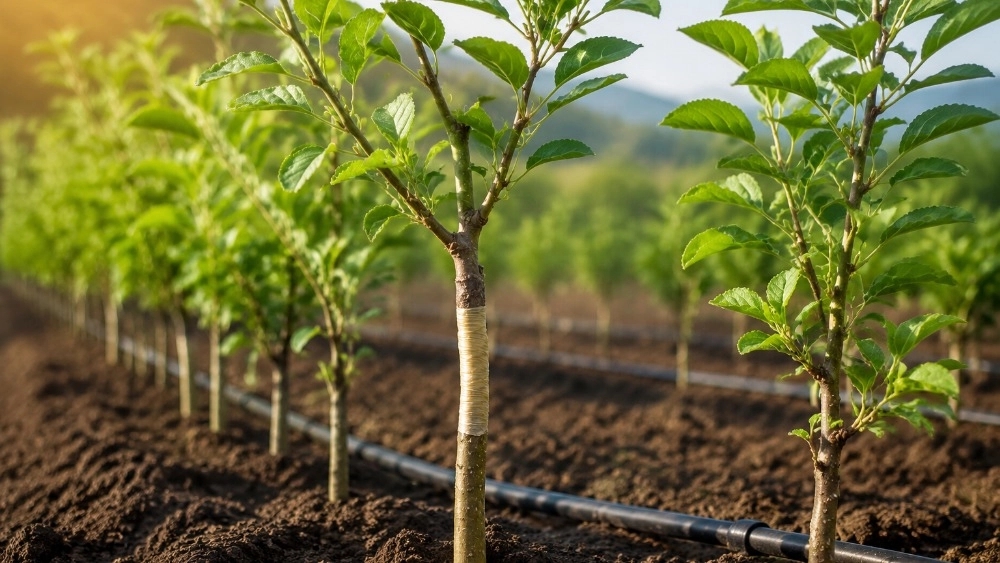
Choosing the type of seedling is one of the most important decisions faced by gardeners and agricultural activists. Seedling quality has a direct effect on tree growth, fruit yield, disease resistance, and ultimately garden profitability. Among the different types of seedlings, there are two very common and important types that many gardeners have questions about: grafted seedlings and vegetative seedlings.
Understanding the difference between these two types of seedlings can help make a more informed and successful choice. Many novice gardeners think that these two concepts are the same, while each of them has different characteristics, production methods and applications.
In this article, we fully examine the difference between transplanted and vegetative seedlings, what are the advantages and disadvantages of each, and in what conditions is it more appropriate to use them. We will also point out the role of reputable nurseries in producing standard and healthy seedlings.
What is a transplanted seedling?
A transplanted seedling is a kind of seedling that comes from the combination of two different plants. In this method, a part of a plant that has desirable characteristics such as high yield or better fruit quality is transplanted onto another plant that usually has stronger roots and more resistance.
The lower part that forms the root is called base and the upper part that produces branches and fruit is called graft.
The goal of producing transplanted seedlings is to combine the best features of two plants in one tree. For example, the base of a tree may have high resistance to soil conditions or diseases, while the scion has very high fruit quality.
This combination makes the final tree both resistant and produces a quality product.
What is a vegetative seedling?
Vegetable seedling is a seedling produced through asexual or vegetative propagation methods. In these methods, instead of using seeds, parts of the mother plant such as branches, roots or plant tissues are used to produce a new plant.
Common methods of vegetative propagation include the following:
The important point is that in vegetative reproduction, the new plant will be completely similar to the mother plant, because its genetic material does not change.
Therefore, the trees produced by the vegetative method have fixed characteristics and the quality of their fruit is predictable.
What is the difference between transplanted and vegetative seedlings?
Now that we are familiar with the definition of both types of seedlings, we can better examine the difference between transplanted and vegetative seedlings.
The important point is that transplanted seedling is actually one of the types of vegetative propagation. In other words, every grafted seedling is a vegetative seedling, but every vegetative seedling is not necessarily grafted.
In the following, we examine the most important differences between these two types of seedlings.
Difference in production method
The main difference between transplanted and vegetative seedlings is in their production method.
In transplanted seedlings, two different plants are combined with each other. That is, the base and the graft are from two separate sources.
But in many methods of vegetative propagation, such as cuttings or bedding, the new plant is created directly from the same mother plant, and no new genetic composition is formed.
For this reason, the grafted seedling has a composite structure, while some vegetative seedlings arise entirely from one source.
Differences in resistance to environmental conditions
One of the most important reasons for using transplanted seedlings is to increase tree resistance. In this method, a foundation is usually chosen that is resistant to adverse soil conditions, salinity, lack of water or diseases.
In contrast, vegetative seedlings that are produced through cuttings or other methods usually have the same characteristics of the mother plant, and if the mother plant is weak against certain conditions, the new seedling will also have the same weakness.
Therefore, in many professional gardens, the use of transplanted seedlings is preferred.
Difference in fruiting speed
The reason for this is that the scion is taken from a mature tree and retains part of its physiological maturity.
Of course, some vegetative seedlings can also have relatively fast fruiting, but in many fruit trees, transplanted seedlings have a faster performance.
Differences in product uniformity
One of the important advantages of vegetative seedlings is that their characteristics are constant and uniform. Because these seedlings are a version of the mother plant.
In transplanted seedlings, this uniformity exists to a large extent, but the combination of rootstock and scion can cause minor differences in growth or performance.
However, in commercial horticulture, both types of seedlings are superior to seed seedlings due to their uniformity.
Advantages of using transplanted seedlings
Knowing the difference between transplanted and vegetative seedlings becomes more important when the advantages of each are examined.
Increase tree resistance
Using resistant bases makes the tree more resistant to diseases, pests and harsh environmental conditions.
Improving fruit quality
In many cases, cuttings are selected from superior cultivars. This makes fruits with better taste, size and quality to be produced.
Tree size control
In some bases, the size of the tree can be controlled. This issue is especially important in modern gardens that need easy management.
Compatibility with different soils
Some bases have the ability to grow in special soils such as calcareous or saline soils. Transplanting different cultivars on these foundations provides the possibility of cultivation in various conditions.
Advantages of vegetative seedlings
Vegetable seedlings also have important advantages that make them used in many cases.
Full preservation of the characteristics of the mother plant
In vegetative methods such as cuttings, the new plant is completely similar to the mother plant. Therefore, the quality of the product will be predictable.
Rapid production of seedlings
In some vegetative methods, a large number of seedlings can be produced in a short period of time.
Uniformity in the garden
In gardens where vegetative seedlings are used, trees usually have more uniform growth and fruiting.
Application of transplanted seedlings in modern horticulture
With the development of agriculture and the increasing need to produce high-quality products, the use of transplanted seedlings has been expanded in many gardens.
Trees such as apples, pears, peaches, cherries, walnuts and many other fruit trees are often produced by grafting. This method helps gardeners to have trees that are resistant, fruitful and compatible with the conditions of their region.
Choosing the right base and quality cuttings plays a very important role in the success of these types of seedlings.
The importance of choosing a reputable nursery
Regardless of whether you choose transplanted seedlings or vegetative seedlings, the quality of the seedlings plays a decisive role in the future of the garden.
Seedlings produced in reputable nurseries usually have the following characteristics:
- Complete health and disease-free
- Authentic variety
- Strong and healthy roots
- Compatibility with climatic conditions
One of the collections that works in the field of producing and supplying high-quality seedlings is Central Nursery of Safar Handonekar. Using specialized knowledge and practical experience in the production of seedlings, this collection tries to provide gardeners with standard and healthy seedlings.
Paying attention to the quality of seedlings during the construction of the garden can prevent many problems in the coming years and increase productivity.
Which is better: transplanted or vegetative seedling?
The answer to this question depends on various factors. In many fruit trees, transplanted seedlings are a more appropriate choice because they have higher resistance and better performance.
But in some plants, other methods of vegetative propagation such as cuttings can also have very good results.
Therefore, to choose the best option, the following should be considered:
- Type of tree or plant
- Climatic conditions of the region
- Type of soil
- Purpose of building a garden
Consulting with specialists in the field of seedlings and choosing seedlings from reputable centers can be very effective in this decision.
summary
In this article, we fully investigated the issue of the difference between transplanted and vegetative seedlings. As explained, grafting is actually a type of vegetative propagation in which two different plants are combined with each other to create a tree with superior characteristics.
On the other hand, vegetative seedlings can be produced by various methods such as cuttings, bedding or tissue culture, and they usually retain the characteristics of the mother plant.