
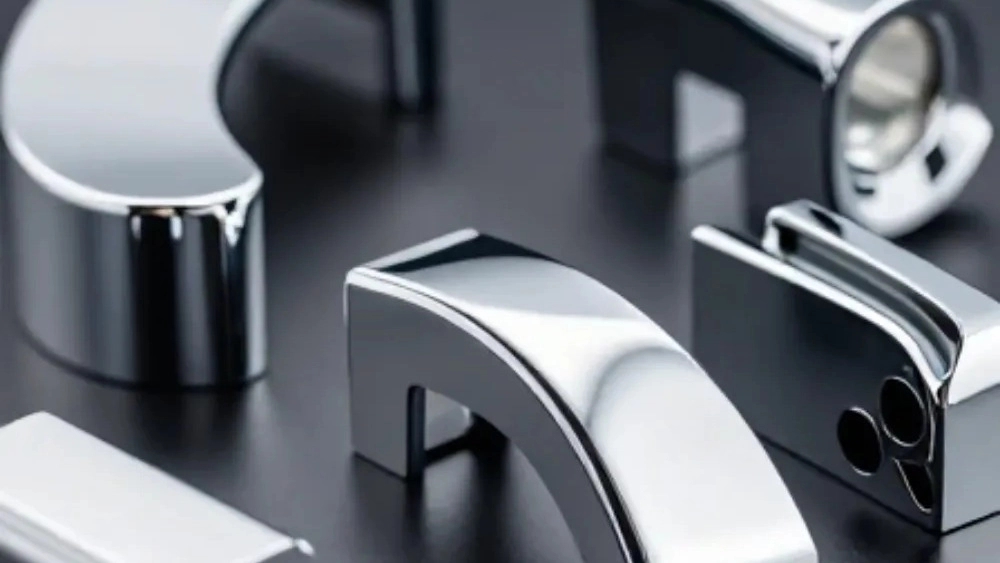
In the modern industrial world, the replacement of metal parts with plated plastic parts has created a great transformation in reducing the costs and weight of products. But the biggest challenge among them is to ensure the quality and durability of the coating created on the polymer. Plastic plating is a very sensitive and complex process, the smallest error in its steps can lead to the final failure of the project. In this article, we will take a closer look at the criteria that will help you recognize the quality of plating and why the overcoat plating series is recognized as a leader in this industry.
The importance of quality detection in ABS plastic plating
1. visual inspection; The first step in determining quality
The first and easiest way to evaluate the quality is to visually inspect the part. In a standard electroplating performed by overcoating specialists, the surface of the part must be completely uniform.
Absence of holes and porosity
The presence of tiny black dots or microscopic holes indicates the lack of proper preparation of the plastic surface or the presence of pollution in the plating baths. The surface of chrome plating should be like a smooth mirror without any impurities.
Color shade uniformity
In nickel and chrome plating, the change in color at the edges of the part or the difference in the color spectrum at different points indicates the lack of proper distribution of electric current. High quality is achieved when the piece reflects the same light at all angles.
Absence of burning phenomenon
Burning usually occurs on the sharp edges of the part due to the intensity of the high electric current, and its appearance becomes cloudy or rough. In the precise processes of overcoat plating, this defect is prevented by the precise control of amperage.
2. adhesion test; The most important quality factor
Metal to plastic adhesion is the most difficult part in ABS plastic plating. If the foundation and "etching" stage is not done correctly, the metal layer is easily separated from the plastic surface.
Cross-Hatch Test
In this test, scratches in the form of small squares are created on the surface. If the scratched edges are raised or the coating is peeled off, the adhesion quality is poor. overcoat plating by using high-quality acids and accurate timing in the roughening stage, creates the highest level of molecular adhesion.
Adhesive tape test
After creating a scratch, a standard adhesive tape is attached to the surface and quickly peeled off. The absence of any trace of metal particles on the adhesive tape indicates the perfect execution of the underlying nickel plating.
3. Investigating the thickness of plating layers
A high-quality electroplated piece consists of several layers: a copper layer, various nickel layers (semi-gloss and gloss) and finally a chrome layer.
The role of copper layer in flexibility
Copper as an interface layer compensates for the different thermal expansion coefficient. In overcoat plating, the thickness of the copper layer is adjusted in such a way that the coating does not crack due to physical impacts.
The importance of chrome thickness in wear resistance
Chrome plating is the final layer that provides surface hardness. If this layer is too thin, it wears off quickly, and if it is too thick, it tends to crack. Detection of this issue is usually done with advanced thickness measuring devices (X-Ray or eddy current) that are used in accredited quality control units.
4. Resistance to thermal shocks
Plated plastic parts are often used in environments with temperature changes (such as car parts). One of the methods to detect the quality is to place the piece at a very high temperature and then at a very low temperature.
If the quality of plastic plating is not favorable, due to the difference in the rate of expansion and contraction of plastic and metal, the coating will suffer "blistering" or separation. overcoat plating by optimizing the chemical formulation, produces parts that maintain their stability even in the harshest climatic conditions.
5. Salt Spray Test
This test is done to measure corrosion resistance. The piece is placed in a chamber with salt vapor for many hours. The appearance of rust or oxidation spots indicates weakness in the nickel plating layer. The quality of the nickel used in the covering set is such that it creates a strong barrier against the penetration of corrosive agents.
Common defects in plastic plating that you should know
In order to be able to correctly recognize the quality, you must be familiar with possible weaknesses. These defects are considered a red line in professional collections such as overcoat plating and parts with these defects are removed before leaving the line.
- Peeling: Indicates a strong weakness in the adhesion of the primary layers.
- Color change to yellow: Indicates the low thickness of chrome and the appearance of the underlying nickel layer over time.
- Roughness: Caused by the presence of suspended particles in the electrolyte tubs.
- Effect "Clouding": cloudy spots that indicate a chemical imbalance in plating solutions.
The role of ABS plastic in the final quality
You should know that the quality of electroplating is highly dependent on the quality of the injected piece itself. Plating grade ABS plastic has "butadiene" particles that are dissolved in the acid treatment step and create microscopic holes for mechanical locking of the metal. Farapoushan Plating always advises its customers to use the best material for molding so that the final output of chrome plating is perfect.
Why is overlay plating the first choice of professionals?
In today's competitive market, the longevity of your brand depends on the quality of the details of your products. Faraphashan Plating, realizing this issue, has implemented strict standards in all stages of Plastic Plating.
Using new technologies
The use of mechanized tubs and continuous filtration systems in this collection has made all parts, from the smallest dimensions to large industrial parts, to be produced with the same quality and without errors.
Strict quality control
At every step of the process, from preparation to the final nickel and chrome coating, quality inspectors closely monitor parameters such as temperature, pH and material concentration. This accuracy of operation has made the name Faraposhan synonymous with trust and durability in the electroplating industry of Tehran.
Expertise in complex projects
Many plastic parts have hidden angles and difficult geometry, which requires high technical knowledge to be plated. Our experts, by designing specialized jigs, guarantee complete and uniform coverage even in remote parts of the part.
The effect of plating quality on your brand value
When a customer touches a piece with a metallic appearance, the sense of quality and luxury is transferred to him. If this coating changes color or spills after a period of use, the credibility of the manufacturer's brand will be severely damaged. Smart choice of services such as those provided in Farapaushan Plating is an investment in the credibility of your product.
Plastic plating is more than a chemical process, it is an industrial art. In order to achieve stunning gloss and eternal durability, all parameters, including the type of polymer, degreasing steps, activation, and finally the application of electrolytic layers, must be set with mathematical precision.
conclusion
Determining the quality of plastic plating requires looking beyond surface beauty. Checking the adhesion, resistance to the environment and the uniformity of the coating are the main pillars of a standard part. With years of experience in the field of chrome and nickel plating on all kinds of ABS parts, Farapophan series is proud to launch products that are unmatched not only in appearance, but also in performance and durability, in compliance with the highest global standards.
If you are looking to improve the quality of your manufactured products and you want your plastic parts to have the appearance of pure and strong metal, trusting the expertise and technical knowledge of the Faraposhan team is the surest way to reach the highest quality in the industry. Satisfying customers and keeping the shine of the parts is a mission that we carefully follow in every project.