
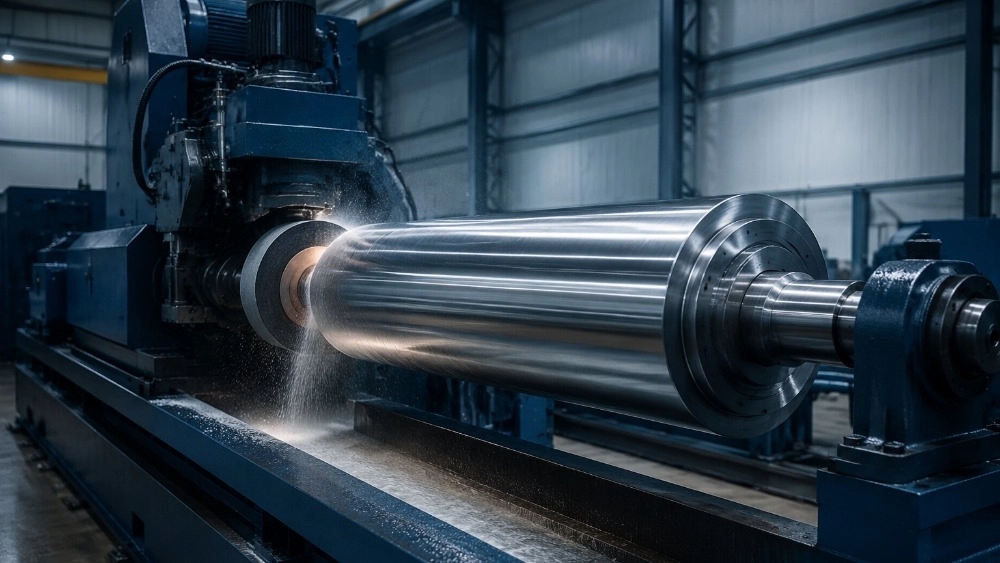
In various industries, from paper and printing to steel, packaging, textile and rubber, industrial rollers play a very important role in the final quality of the product. Any scratches, unevenness, corrosion, reduction of surface accuracy or quality loss in these parts can directly affect the performance of the production line. For this reason, grinding and polishing of industrial rollers is known as one of the specialized and vital services in maintaining, restoring and increasing the life of these parts.
In this article, with a complete and SEO-oriented view, we examine the cost of grinding and polishing industrial rollers, we explain the factors affecting the price and show why choosing a specialized set such as Parsiyan Plating can make a big difference in quality, durability and long-term savings.
What is grinding and polishing of industrial rollers?
Grinding of industrial rollers is a process during which the surface of the roller is polished and modified with precise devices and special stones to remove unevenness, scratches, minor distortions and surface damage. This operation is usually done to achieve high dimensional accuracy and prepare the surface for the next step.
Polishing of industrial rollers is also a finishing step that is done after grinding to make the final surface of the roller smoother, shinier and more uniform. In many applications, the quality of polishing has a direct effect on the performance of the machine and the quality of the production output.
In short:
- Grinding to modify the surface and dimensions
- Polishing to increase the smoothness, uniformity and final quality of the surface
Why is the cost of grinding and polishing industrial rollers variable?
One of the important points in this service is that the cost of grinding and polishing industrial rollers is usually not fixed and is calculated on a project basis. The reason for that is the big difference in dimensions, material, amount of damage, required accuracy and type of operation.
For example, grinding a simple roller with a healthy surface is not the same as completely rebuilding a large industrial roller that has suffered wear, corrosion or deformation. These differences allow the final price to be determined based on the actual work conditions.
The most important factors affecting the cost of grinding and polishing industrial rollers
1. Diameter and length of the roller
The bigger the roller, the more work time, tool consumption, and required precision. Diameter and length are the main parameters that determine the price.
2. Roller material
3. The amount of surface damage
If the surface of the roller only needs polishing, the cost is lower. But if the surface has:
- Deep scratch
- Corrosion
- Roughness
- Ovalization
- Slight warping
Yes, the reconstruction operation takes more time and the cost increases.
4. Required accuracy
In some industries, the tolerance and smoothness of the surface must be very precise. The higher the final accuracy, the more precise tools, more time, and stricter quality control is required.
5. Type of coating or previous plating
If the roller has already been plated, chromed or coated, the type of surface restoration becomes more important. In such a situation, coordination between grinding, polishing and plating is very important.
6. Number of pieces
In high quantity orders, there is a possibility of better cost management. Usually, multiple projects are more cost-effective than single work in terms of final price.
7. The urgency of doing the work
If the project is urgently needed and the delivery time is limited, the cost may increase. Proper planning can control this part of the cost.
The method of calculating the cost of grinding and polishing industrial rollers
In some specialized collections, pricing is based on the level of work and the features of the piece. In fact, instead of a fixed rate for all parts, criteria such as machinable surface, length, diameter and surface conditions are considered.
This method makes the pricing more fair and accurate, because each roller has its own conditions. For this reason, to accurately estimate the cost of grinding and polishing industrial rollers, it is necessary to check in person or get the technical specifications of the piece.
The difference between grinding and polishing in cost
Usually, grinding affects the final price more than polishing due to the higher volume of operation. Polishing is more of a finishing step that improves the surface quality and smoothness.
In general:
- If only grinding is done, the cost is lower than the combined case.
- If grinding + polishing is required, the cost will be higher.
- If the surface restoration is accompanied by precise dimensional control, the price will increase accordingly.
Why is service quality more important than price?
In industrial services, choosing the cheapest option is not always the best choice. If grinding or polishing is done with low accuracy, the following problems may occur:
Therefore, the focus should not only be on the cost of grinding and polishing industrial rollers, but also the quality of execution, the experience of the collection and the final accuracy. In this field, Abakari Parsian with its specialized and industrial approach can be a safe choice for sensitive projects.
The advantages of grinding and polishing in Parsian electroplating specialized complex
1. High precision in the execution of operations
In industrial services, accuracy is the first word. The basic implementation of grinding and polishing makes the surface of the roller uniform, smooth and suitable for industrial use.
2. Increase the useful life of the part
Proper resurfacing of the roller can significantly increase its life and reduce the need for early replacement.
3. Improving the quality of the production line
The proper surface of the roller makes for better contact, more stable performance and higher quality output.
4. Reduce long-term costs
Although the initial cost is important, but the correct implementation of the work ultimately saves on repair costs and production line downtime.
5. The possibility of coordination with electroplating and surface restoration services
One of the important advantages of cooperation with Abakari Parsian is the possibility of providing complementary solutions such as surface preparation, restoration, polishing and specialized plating. This issue is very valuable for industrial parts.
Grinding and polishing applications of industrial rollers
This service is used in various industries, including:
- Printing industry
- Steel industry
- Paper production
- Packaging industry
- Plastic industry
- Textile
- Rubber production
- Food industry
- Transfer and processing lines
In each of these areas, the quality of the roller surface can directly affect the production process.
When should the industrial roller be sent for grinding and polishing?
There are signs that the roller needs rebuilding:
- creating scratches on the surface
- decreasing the quality of contact or transfer
- loss of surface uniformity
- abnormal roughness
- signs of corrosion
- decreasing performance accuracy in the production line
- observing vibration or malfunctioning
If these signs are seen, it is better to perform grinding and polishing operations before further damage.
The role of surface preparation in final quality
Before starting the operation, it is very important to check the condition of the roller. Cleaning, troubleshooting, dimensional control, and checking the amount of wear are all effective in the final result. Proper preparation of the surface allows grinding and polishing to be done with higher quality and the final result is more stable.
Why Parsian electroplating is suitable for industrial roller services?
Abakari Parsian, focusing on specialized surface services, can be a good choice for employers who care about quality and accuracy. With an industrial and experience-oriented perspective, this group has a detailed understanding of the needs of industrial rollers and can provide effective services in the processes related to grinding, polishing and surface preparation.
The important features of this approach are:
- Attention to surface accuracy
- Principle implementation of the process
- Suitable for sensitive industrial parts
- Helping to increase the durability of the part
- Reducing costs due to failure and re-repair
summary
The cost of grinding and polishing industrial rollers depends on various factors such as diameter, length, material, amount of damage, required accuracy and type of operation. For this reason, it is not possible to consider a fixed price for all rollers. The best method is to carefully check the specifications of the part and choose a specialist group to do the work.
If your goal is to increase roller life, improve surface quality and reduce long-term costs, working with a group like Abakari Parsian can be a smart choice. With a specialized approach in surface services and industrial parts restoration, this collection can cover the needs of various industries in a professional manner.