
همین حالا تماس بگیرید!
پاسخ فوری و مشاوره رایگان در انتظار شماست.
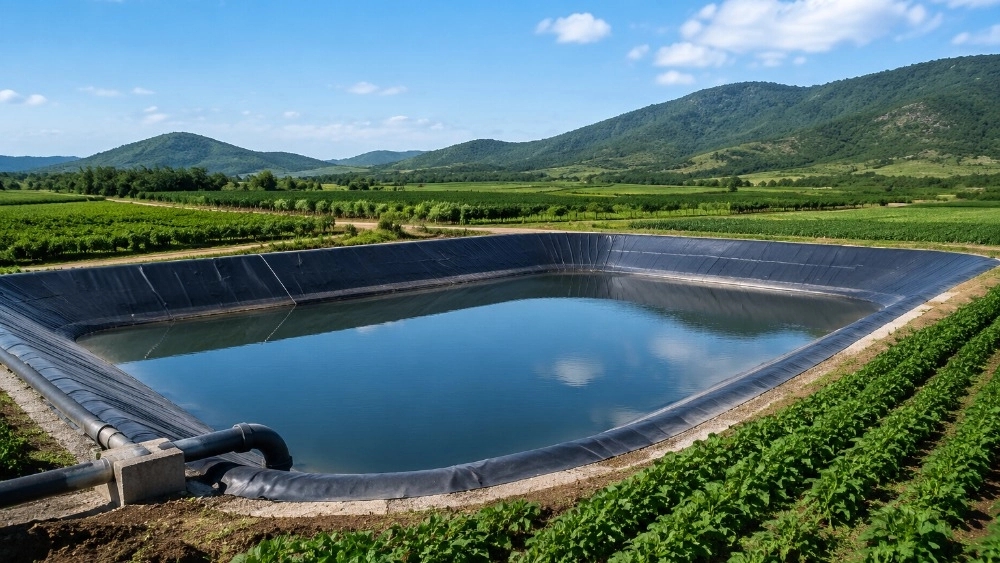
The lack of water resources, the increase in water supply costs, climate changes and the need for accurate irrigation management have made the implementation of agricultural water storage pools with geomembranes by Canaan Company become one of the key and productive solutions in many regions of the country. The water storage pool is not just a simple tank; Rather, it is an infrastructural strategy to increase irrigation productivity, reduce water loss, production stability and ensure water supply in critical crop seasons. In the meantime, the use of geomembranes as a reliable waterproofing layer significantly increases the durability and efficiency of the pool and prevents water infiltration and waste.
Kanaan Company focuses on principled implementation, standard material selection and compliance with technical details. In this article, we will fully and practically examine what a geomembrane pool is, why it is logical to choose it for agriculture, how the implementation steps are done, and why entrusting the work to a professional team like Canaan can optimize the final result.
What is an agricultural water storage pool and what role does it play in productivity?
An agricultural water storage pool is an engineered structure to collect and store water from various sources such as wells, aqueducts, rivers, transmission channels, rainwater, or treated agricultural wastewater. The main purpose of these pools is to create time balance between water supply and water consumption; That is, when water is available, it is stored and when needed, it is used for irrigation or other farm purposes.
The main functions of the water storage pool in agriculture include the following:
- Decreasing dependence on fluctuations in water resources
- Possibility of irrigation under pressure and precise irrigation planning
- Reducing water losses due to evaporation, infiltration into the soil and leakage in the transmission path
- Increasing the stability of production in periods of water scarcity or limited harvesting
- Creating reliable storage for peak times of plant needs
In many regions, an important part of water in traditional earthen reservoirs is lost due to soil permeability. The standard and industrial solution for this problem is sealing with geomembranes; A method known as a professional choice in agricultural and industrial projects.
What is geomembrane and why is it the best option for an agricultural pool?
The important advantages of geomembranes for agricultural ponds are:
- reducing leakage and water penetration and preventing wastage of resources
- faster installation than traditional methods and the possibility of delivering the project in a short time
- high durability if standard material is chosen and correct implementation
- compatibility with different soils even very permeable soils
- possibility of local repair if The occurrence of possible damage
- Reduction of maintenance costs due to the stability of the sealing
However, it should be noted that the quality of the final result does not depend only on the geomembranes themselves; An important part of the success of the project depends on design, substrate preparation, installation method, welding, quality control and execution details. For this reason, the selection of an expert executor is particularly important, and this is where the experience and executive discipline of Kanaan Company can be decisive.
Why is the implementation of an agricultural water storage pool with geomembranes recommended by Canaan Company?
In civil and agricultural projects, the difference between a "just built" pool and a "properly executed" pool lies in the technical details. Kanaan Company implements the agricultural water storage pool with an engineering and step-by-step approach; That is, every part of the work, from the initial design to the final delivery, proceeds according to standard principles.
The most prominent features of the project implementation by Canaan Company are:
- Attention to the correct selection of geomembranes according to the climatic conditions and the type of use
- exact execution of underlaying and substrate preparation to prevent perforation
- use of basic welding and connection methods for integrated sealing
- performing quality control of seams and reducing the possibility Leaks
- Adherence to safety and performance standards at the project site
- Managing the project schedule for reliable delivery
The main goal of Kanaan company is that the final pool, in addition to complete sealing, remains stable over time and the user can use it with the least worries.
Implementation steps of agricultural water storage pool with geomembranes
Successful implementation of a geomembrane pool requires following the correct order of operations and paying attention to details. In the following, we review the main stages of implementation of the agricultural water storage pool with geomembranes by Canaan Company regularly.
Preliminary investigation and selection of the right place
In the first step, the location of the pool is checked in terms of access, slope of the land, proximity to the water source, piping route, security of the place and soil conditions. Choosing the right place will reduce the cost of excavation, reduce the risk of subsidence and increase the productivity of the operator.
Dimension, depth and slope design
The dimensions of the pool are determined based on the water requirement, source discharge, type of irrigation and cultivation plan. Also, the slope of the walls, the type of flooring, the location of the entrance and exit, and the placement of the control equipment should be such that both the stability of the structure is maintained and the operation is easy.
Excavating and shaping the pond
After the design, the excavation operation is carried out. At this stage, the terrace and shaping of the walls is very important. The walls must have a standard slope in order to prevent the soil from falling and to enable the uniform installation of geomembranes.
Preparing the bed and removing harmful factors
One of the most sensitive parts is substrate preparation. Any sharp stones, roots, burrs or protrusions can damage the geomembrane in the future. Basic leveling and leveling, creating a uniform surface and, if necessary, using protective layers are measures that guarantee the final quality.
Expanding geomembranes and adjusting folds
The geomembrane must be spread precisely so as not to create additional stress on the sheet. Controlling the creases and the way the rolls are placed on the slope of the walls plays a serious role in the durability and performance of the sealing.
Welding, joining and sealing of seams
Seams and connections are the main point of leakage risk. Welding must be done with the proper method and by a skilled operator. The principled implementation of connections and compliance with the standard overlap will prevent water penetration and separation of seams.
Implementation of input, output and overflow details
Agricultural pool without the right details will suffer in practice. Water inlet, outlet, safe overflow, discharge path and protection of sensitive points should be implemented in such a way that the water pressure or the movement of the pipes do not damage the geomembranes.
Quality control and preparation for operation
After installation, the quality check of the seams, review of sensitive points and sealing is done. Then the pool is ready for operation so that the operator can confidently start storing and managing water.
Key tips for a longer life geomembrane pool
Even the best material will not give good results if it is not used correctly. Professional implementation and compliance with several important principles can increase the life of the pool:
Protecting geomembranes against mechanical damage
Passing machinery, hitting sharp objects, or improper installation of connections can cause damage. Traffic management and compliance with operating principles prevent these damages.
Control of water level fluctuations
Sudden and frequent filling and emptying can cause additional stresses on the sheet. Water consumption planning and water level management help sustainability.
Periodic maintenance and review
Regular visits to the walls, connections and entry and exit points help to detect possible problems in the early stages and to carry out local repairs at a low cost and time.
Economic and operational advantages of agricultural water storage pool with geomembranes
One of the most important reasons for the acceptance of this method is the simultaneous combination of saving water and increasing production efficiency. When leakage is minimized, more water volume is available for effective irrigation and the operator can manage the field more precisely.
- Decreasing water loss and increasing irrigation efficiency
- Increasing the ability to plan irrigation and reducing plant water stress
- Reducing costs due to frequent repairs of earthen pools
- Possibility of combining the pool with modern irrigation systems
- Reducing the risk of stopping production in periods of water scarcity
Finally, the agricultural water storage pool is an infrastructural investment and will be most effective when its implementation is done in a completely principled and standardized manner. Kanaan Company in this way, relying on experience and step-by-step implementation, tries to deliver a project that is both technically reliable and simple and reliable in terms of operation.
Conclusion: A reliable choice for agricultural water storage
In a situation where water has become the most important factor limiting agricultural production, solutions such as water storage pools with geomembranes can play a decisive role in the stability and increase of farm productivity. Execution of the agricultural water storage pool with geomembranes by Canaan Company focusing on the quality of execution, compliance with the principles of infrastructure, standard welding, quality control and paying attention to the details of operation, is a professional option for farmers who are looking for reliable and durable sealing.
If your goal is to reduce water wastage, increase control over the time and amount of irrigation, and build a reliable infrastructure for years to come, implementing a basic geomembrane pool with an expert team is a smart decision. Kanaan Company paves the way to a standard and sustainable pool for agricultural operators with an engineering perspective and regular implementation.