
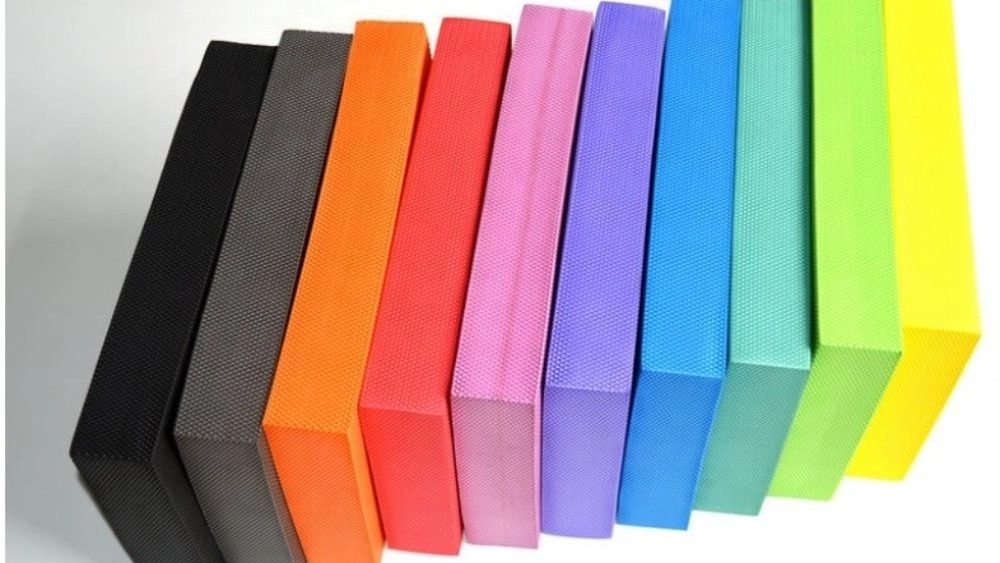
The production process of professional industrial foam in Firuzi production
Selection of raw materials and formulation
Foam production processes
- Extrusion: This method is one of the most common processes for producing foam sheets and rolls. In this process, molten polymer materials are passed through a mold (die) along with foaming agents. By reducing the pressure or applying heat, the foaming agents release gas and cause the expansion of the material and create a cellular structure in the foam. Then the foam is cooled and is made into sheets or rolls. This method is very suitable for the production of turquoise foam roll and foam roll.
- Injection Molding: In this method, molten polymer is injected into the mold along with foaming agents. Pressure and temperature are controlled during the process and after cooling, a foam piece with complex shapes is produced.
- Compression Molding: In this method, the foaming material is placed inside the mold and under pressure and heat, the process of swelling and forming occurs.
Quality control
Types of production foams and their uses
Polyethylene foam (PE Foam)
- Packaging industries: Protection of fragile and fragile goods against impact and vibration during transportation.
- Floor: Use in sports clubs, kindergartens, and play spaces due to its shock absorption and insulation properties.
- Automotive: Use in dashboards, seats, and sound insulation and Heat.
- Construction: As an insulating layer in ceilings and walls.
- Sports equipment: Production of helmets, sports mats, and protectors.
Polypropylene foam (PP Foam)
Polyurethane foam (PU Foam)
- Furniture and mattresses: high comfort and flexibility.
- Thermal insulation: in buildings, refrigerators and freezers.
- Automotive: seats, dashboards, and insulation.
- Shoe industry: soles of shoes.
EVA foam (Ethylene-vinyl acetate)
- Sports equipment: sports shoes, yoga mat, protectors.
- Toys: puzzle pieces, soft toys.
- Crafts: artistic and creative uses.
Innovation and customization in turquoise manufacturing
research and development (R&D)
Product customization
- Dimensions and thickness: Production of foam sheets and rolls in exact dimensions and thicknesses required by the customer.
- Density and hardness: Adjust the density and hardness of the foam to achieve the desired level of impact, flexibility, or strength.
- Color and texture: The possibility of producing foam in different colors and with various surface textures.
- Special properties: Add Features such as flame resistance, high chemical resistance, or anti-static properties.
Technical support services
Specialized introduction of "Production of turquoise foam roll and foam roll"
The key advantages of turquoise foam sheet and roll
- Variety of materials: These products can be produced from different polymers such as polyethylene (PE), polypropylene (PP), and EVA, each of which has its own unique properties. This diversity allows customers to choose the best option based on their needs (such as moisture resistance, heat resistance, or flexibility).
- Flexibility in dimensions: The ability to produce in very thin to thick thicknesses, and in long roll lengths or specific sheet dimensions, allows for high adaptability. This reduces waste and optimizes production processes for customers. Excellent properties: These foams are light, flexible, resistant to shock and vibration, suitable heat and sound insulation, and resistant to chemicals. Ease of cutting and shaping: Foam sheets and rolls can be easily cut, punched, and shaped into various shapes, which facilitates the production processes for customers.
- Wide use: From the packaging of electronic and fragile goods to the use in the automotive industry, construction, and the production of sports equipment, the applications of these products are very diverse.
Special applications of turquoise foam sheet and roll
- Protective packaging: The best option to protect products from impact, scratches and vibration. Foam rolls can be wrapped around products or used as layers in boxes.
- Intermediate layer in the construction of sandwich panels: due to thermal and sound insulation properties.
- Floor underlayment: To increase softness, reduce sound, and insulation.
- Sealing and impact parts: In various industries to prevent penetration Water and shock absorption.
- Raw materials for the production of other products: such as insulated bags, bags, and protective equipment.
Why turquoise foam roll?
A look at the future of foam production and the production role of turquoise
Future trends in the foam industry
- Sustainable and biodegradable foams: With increasing environmental awareness, the demand for foams made from renewable resources or biodegradable is increasing.
- Smart foams: Foams that are able to respond to external stimuli such as temperature, pressure, or electric field.
- Improving properties Insulation: Development of foams with excellent thermal and sound insulation capabilities for advanced applications in building and automotive.
- High strength and low weight foams: Combining the strength of metals with the lightness of foams for structural applications.