
همین حالا تماس بگیرید!
پاسخ فوری و مشاوره رایگان در انتظار شماست.
Purchasing an industrial and hydraulic lift with quality assurance is not just a simple purchase decision; This choice directly affects the safety of employees, the speed of moving goods, the productivity of production lines, the order of the warehouse, and even the credit of your collection. Many common problems such as sudden stops, vibration, abnormal noise, loss of efficiency and premature failures, start from where the technical criteria and quality of construction are not taken seriously during the selection and ordering stage. For this reason, if your goal is to provide a reliable and standard industrial lift or hydraulic lift, you should focus on "quality", "principle design", "precision manufacturing" and "professional service" from the beginning.
Importance of buying industrial and hydraulic lift with quality assurance
In many environments, the lift plays the role of the backbone of transportation; From small workshops to multi-purpose factories, from department stores to distribution centers and high-traffic warehouses. In such an environment, any stoppage or breakdown can lead to delivery delays, increased maintenance costs, and reduced safety. Therefore, buying an industrial and hydraulic lift is valuable when quality assurance is considered at the level of design, material, assembly and final control.
Quality assurance in industrial lift and hydraulic lift means:
- The structure and chassis should be designed with real load bearing and appropriate reliability factor.
- Hydraulic system or power transmission should be selected and assembled in principle.
- Safety and protection standards should be observed in the implementation.
- Testing process, start-up and performance control should be done before delivery.
When these things are observed, the result is an industrial lift or hydraulic lift with smooth, stable, low consumption and reliable performance.
Industrial lift and hydraulic lift; Differences and commonalities
In order to buy an industrial and hydraulic lift with quality assurance, it is necessary to distinguish the concepts correctly. "Industrial lift" mostly refers to the user; It means a lift that is designed for working environments, heavy loads, high traffic and harsh conditions. But "hydraulic lift" refers to the type of drive system and movement mechanism. In practice, many industrial elevators are hydraulic elevators, because hydraulics are very suitable for carrying heavy loads, uniform movement, and high controllability.
Important subscriptions
- Both require strong structure and safe design.
- Both should be selected based on capacity, height and installation conditions.
- Both require periodic service and standard maintenance.
Key Differences
- Industrial lift can be hydraulic, chain, cable or scissor; But the hydraulic lift obviously works with a power unit and a jack or cylinder.
- The selection criteria in an industrial lift is mostly around capacity, durability and continuous operation; While in the hydraulic lift, the quality of hydraulic parts, hoses, valves and sealing is particularly important.
Types of elevators widely used in industry and construction
Knowing the categories helps to make the purchase of industrial and hydraulic lifts more accurate with quality assurance. In the following, we review some common examples.
Jacked hydraulic lift (direct or indirect)
In this model, the power generated in the power unit is transferred to the jack and the lifting platform moves. The quality of the cylinder, sealing, safety valve and flow control play a decisive role in this type of hydraulic lift.
Scissor Lift
Scissor lifts are very common in warehouses, distribution centers and loading applications. This type of industrial lift can work with hydraulic system and is an efficient option for medium heights with high capacities.
Rail or column lift
This type of industrial elevator is usually designed to move in a specific and repetitive path and is used in production lines or limited space. Rail strength, guide quality, and track alignment are critical for proper operation.
Lift and lift
Industrial lift is usually a carrier, but in some projects there is a need for people carrier or mixed use. In this case, safety requirements become stricter and should be included in the design from the beginning.
Key components that make up quality assurance
To buy an industrial and hydraulic lift with quality assurance, you must know exactly which parts "quality" means. Next, we review the most important parts.
Structure, chassis and platform
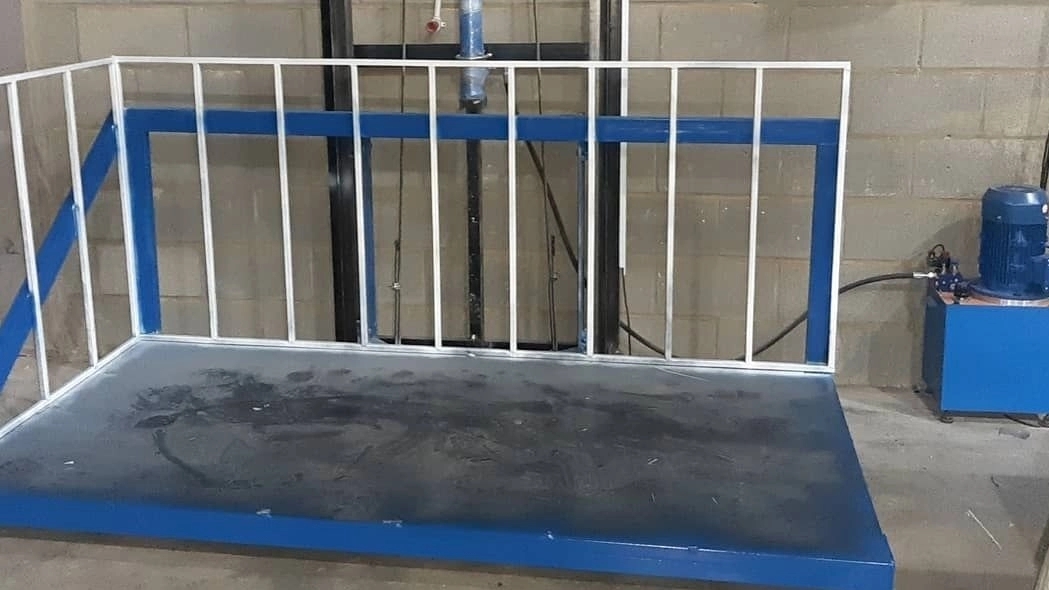
In an industrial lift, the structure must be resistant to bending, twisting and impact. The quality of welding, the type of profile or sheet, reinforcements and braces determine that the lift does not suffer from warping or loss of alignment over time.
Power unit and hydraulic circuit
In hydraulic lift, power unit includes electric motor, pump, tank, filter and valves. Choosing the right flow rate and pressure, the standard of the control valve and observing the principles of piping and hose laying have a direct effect on the smoothness of the movement and the reduction of depreciation.
Jack or hydraulic cylinder
The quality of the cylinder, sealing, shaft surface finish, and installation alignment make the hydraulic lifter not leak or lose power in the long run. When buying an industrial and hydraulic lift, this part is one of the sensitive points.
Control and safety system
Electrical panels, control switches, electrical protections and sensors are critical parts for safe operation. In an industrial elevator, the design of the control circuit must be appropriate to the working environment, dust, humidity and the amount of use.
Rail, guide and moving parts
In many models, the quality of steering parts and sliders is very important. Any looseness or misalignment can lead to vibration, noise and gradual damage.
Selection criteria for purchasing industrial and hydraulic lift
If you want to purchase an industrial and hydraulic lift with quality assurance, consider the following criteria as a decision-making checklist.
Actual capacity and reliability factor
Capacity should be selected based on actual maximum load and working conditions. The industrial lift in high traffic environments should be designed with a suitable reliability factor so that the working pressure is not transferred to the system.
Height and number of stops
The moving height and the number of floors or stops affect the type of design and selection of hydraulic lift components. The higher the height, the greater the sensitivity on safety, guidance and control.
Platform dimensions and load type
The type of load (pallet, carton, machine, bulk material) and the way of loading (by forklift, manual, wheeled) determine how the platform should be designed. In an industrial lift, the design of the platform and entrances must be completely functional.
Environmental conditions
Temperature, humidity, dust, open space or closedness of the installation place, all affect the choice of coverings, the type of cabling and even the type of hydraulic oil. Quality assurance means compatibility with the real environment of the project.
Daily performance
An industrial lift that works in multiple shifts requires a higher level of component quality and design. In such a situation, the selection of consumable parts and easy access for service becomes more important.
Why hydraulic lift is the first choice in many projects?
Hydraulic lift is a popular option in many applications due to its technical and functional features. These benefits become meaningful when the purchase of an industrial and hydraulic lift is made with quality assurance.
- Smooth and controllable movement: Oil flow control enables smooth movement.
- High power for carrying heavy loads: Hydraulics are very suitable for high capacities.
- Optimum use of space: In some models, the design can be done according to the space limitation.
- Compatibility with various uses: from cargo lift to Industrial platforms.
Common mistakes in buying industrial and hydraulic lifts
To avoid hidden costs, you need to know some common mistakes:
Focusing solely on appearance or general characteristics
Industrial lift may look similar, but the real quality is determined in the details of construction, structural design and quality of parts.
Select the capacity close to the requirement limit
When the capacity is chosen as a minimum, the hydraulic or industrial lift is constantly working under pressure and depreciation increases. Quality assurance means designing with a reasonable margin of confidence.
Ignoring service and support
The lift is not a short-term consumer equipment. Having a service path and supply of parts is considered a part of quality assurance.
Lack of final testing and control before delivery
Purchase of industrial and hydraulic lift should be accompanied by performance, alignment, safety and leak control tests. This step reduces the risk of early failures.
The role of custom design in guaranteeing the quality of industrial elevators
In many projects, the requirements are quite unique: height restrictions, narrow widths, special loading conditions or the need to coordinate with production lines. In such cases, a ready-made industrial lift may not be the best choice. Custom design is successful when it is done by a team that has practical experience in manufacturing and installing hydraulic and industrial lifts.
Basic custom design can:
- Prevent wasting space,
- Increase safety based on installation location,
- Increase moving efficiency,
- Reduce future maintenance costs.
Pars Sanat Navin; A reliable way to buy industrial and hydraulic lifts with quality assurance
When it comes to buying an industrial and hydraulic lift with quality assurance, it is very important to choose a reliable manufacturer and contractor. "Pars Sanat Navin" by focusing on engineering design, precise construction and principled implementation, tries to provide industrial lift and hydraulic lift according to the real needs of the project; Not just a general product.
Production based on project needs
Quality of construction and assembly
Details are decisive in quality assurance. Choosing the right material for the structure, accuracy of assembly, observing the alignment of components and final performance control are the things that have a direct impact on the final output. Pars Sanat Novin pays special attention to these details in the manufacturing process so that the performance of the device remains stable over time.
Standard execution and professional delivery
In many projects, the main challenge starts with the installation phase. Correct installation, accurate alignment, safe operation and proper commissioning are as important as build quality. Pars Sanat Novin tries to make the execution and delivery process regular and according to technical standards.
Focus on safety and durability
In addition to efficiency, industrial lift and hydraulic lift must have reliable safety. In this regard, the design of guards, motion controls, and the selection of suitable parts are done with the aim of increasing durability and reducing operational risks.
Summary: A purchase defined by quality
Purchasing an industrial and hydraulic lift with quality assurance means simultaneously paying attention to engineering design, choosing the right type of lift, parts quality, standard implementation and professional support. The industrial lift is not only a device for lifting loads; It is a key tool to increase productivity and reduce risk in the workplace. The hydraulic lift will be the best choice when its components are selected and assembled properly and tested in the real conditions of the project.
If you are looking for a reliable way to order and execute an industrial lift and a hydraulic lift, "Pars Sanat Novin" can be a reliable partner for your collection with a project-oriented approach and focus on the quality of construction and implementation.