

همین حالا تماس بگیرید!
پاسخ فوری و مشاوره رایگان در انتظار شماست.
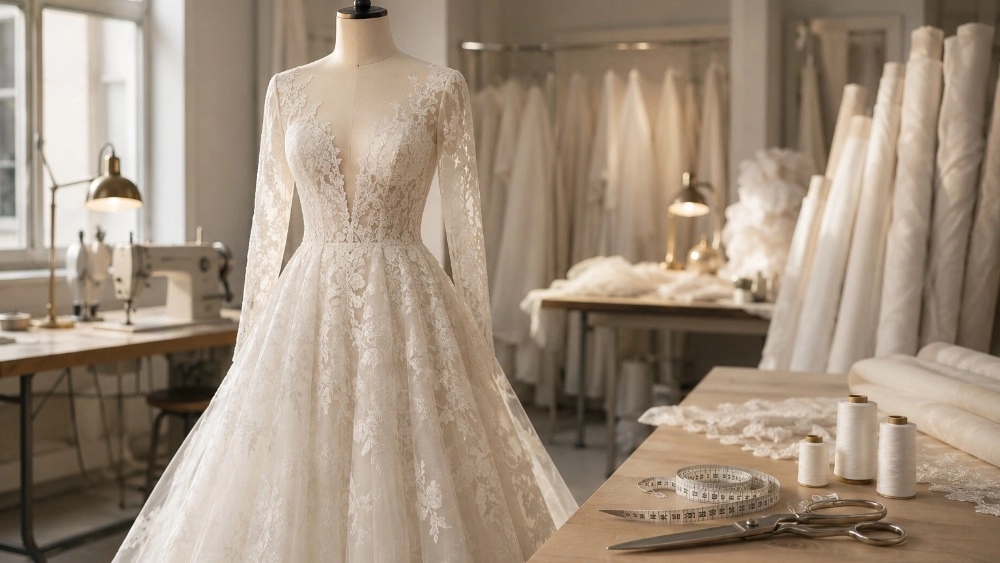
Learning to make patterns and sew wedding dresses in Isfahan is a serious and promising choice for many fashion and tailoring enthusiasts; Because the wedding dress is one of those clothes that have higher standards than everyday clothes in both design and sewing. When it comes to the final result, the slightest error in measurement, transfer of pins, choice of fabric, layering or installation of net and lace can change the entire shape of the garment. For this reason, basic and step-by-step learning is very important.
In this article, we will talk in a complete and regular manner about the training of pattern making and sewing wedding dresses in Isfahan: from basic skills to professional techniques, from material selection to finishing and correction. We also explain why learning in a standard educational path like "Nargis Academy" can shorten your time and raise the quality of your work to several levels.
Why is it important to learn how to make patterns and sew wedding dresses?
A wedding dress is not just a dress; It is a combination of design, fit, fabric stability, elegance of decorations and sewing engineering. In training for pattern making and sewing wedding dresses in Isfahan, you usually face challenges that are less common in simpler dresses; Such as structuring the upper body, controlling the weight of puffy skirts, performing the neckline without slipping, or creating an hourglass shape without creating extra folds.
Here's the key: if the pattern isn't accurate, even the best fabric and cleanest stitching can't save the result. Pattern making is the skeleton of clothes and sewing is the exact execution of the same skeleton.
Basic skills needed before getting into bridal wear
If your goal is to teach pattern making and sewing wedding dresses in Isfahan, it is better to take some basic skills seriously so that the learning path becomes faster and more professional:
Accurate measurement and body shape analysis
Measuring in a wedding dress is not just around the chest and waist. You should be familiar with the concept of size difference, shoulder drop, waist arch, chest bulge, and the correct position of the waist line. This skill is vital in bridal gowns.
Recognizing the basic patterns and transfer of Pence
The pattern of the top, skirt, sleeves and collar should be clear to you. In wedding dresses, it is very common to transfer pleats and turn them into princess cuts, wand cuts or decorative cuts.
Skill in neat sewing and control of seams
In a wedding dress, the inner embroidery and the cleanliness of the work are as important as the outer appearance. Techniques such as hemming, pursing, French seams (in certain cases), and hemstitching are the mainstays.
The standard way of teaching wedding dress patterns
Learning to make patterns and sew wedding dresses in Isfahan is successful when the learning path is structured and moves from simple to complex. Wedding dress patterning is usually formed around the "upper body" and "skirt", because the most changes and sensitivities are in these two parts.
Modeling the bride's upper body: the heart of dress shaping
The top of the wedding dress should be both beautiful and sit well on the body. In this section you deal with the following:
- Correcting the pattern of the upper body according to the body shape
- Designing princess cuts for better shaping
- Making cups and controlling breast volume
- Designing common collars: neckline, sweetheart, halter, boat neck
- Open or semi-open back design while maintaining strength
At Nargis Academy, training is usually done in a practice and project-oriented way so that the student does not just "memorize", but can adjust the pattern on different organs. This issue is a serious advantage for entering the job market in Isfahan.
Bridal skirt patterning: volume, weight and movement control
The skirt of the wedding dress can have various models: cloche, semi-cloche, fish, princess, puffy, or multi-layered skirts. Each has its own patterning logic:
- Exact calculation of fabric looseness and shedding
- Pile design or controlled folds
- Combination of layers for better stability
- Managing the weight of the skirt and the connection to the body
When you follow the training of pattern making and sewing wedding dresses in Isfahan professionally, you will learn how to control the volume of the skirt so that it is eye-catching in the photos and does not restrict the movement of the bride.
Choosing fabric and material in wedding dress (from an educational point of view)
One of the important parts in teaching pattern making and wedding dress sewing in Isfahan is knowing the fabric. Because the fabric determines not only the appearance, but also the behavior of the clothes: shedding, stability, stretch and reaction to ironing.
Common fabrics and their use
- Satin: shiny, formal, suitable for classic forms
- Crepe: good flow, suitable for minimal and fish models
- Tor and lace: suitable for puffy and layered skirts
- Lace: for decoration, top or details of sleeves and collar
- Organza: light but stable, Great for volumizing
In professional training, you learn how to match the fabric to the model; For example, the fish model does not sit nicely with a fabric that is too static, and the princess model does not give the desired volume with a very loose fabric.
Laying, lining and layering
The wedding dress is usually multi-layered. Liner, layer, spring, cup, and sometimes reinforcement layers play a decisive role. Learning these parts correctly makes the clothes look "clean" and "professional".
Specialized sewing techniques in wedding dresses
Education of pattern making and wedding dress sewing in Isfahan does not end only with pattern making; The main part is the implementation of specialized sewing techniques. Some of the most important skills:
Sewing and installing cups and springs
The cup and spring help the dress keep the shape of the upper body, especially in low-cut and backless models. The correct placement of the spring, choosing the type of spring, and the cleaning method inside the clothes are some of the things that you should learn carefully.
Implementation of the neckline without slipping
The décolleté collar is beautiful, but if some principles are not implemented, it will slide or become misshapen in movement. Reinforcement techniques, choosing the right lining and controlling tension are key here.
Installation of hidden zipper and covered buttons
Details are important in a wedding dress. The installation of a hidden zipper with high cleanliness and the sewing of coated buttons make the appearance of the dress more luxurious. These skills fit better in detailed and step-by-step courses.
Working with net, puffer and skirt layers
Tor requires a different sewing technique due to its slipperiness and special texture. Also, adjusting the bottom layers of the skirt to create a balanced volume is one of the attractive but sensitive parts.
Perms and retouches: where wedding dresses go professional
In teaching pattern making and wedding dress sewing in Isfahan, Peru section is of special importance. Many of the differences between "average work" and "professional work" are precisely defined in Peru.
Pro I: balance control and main lines
In the first fit, the waist line, bust line, sleeve fit (if any), and overall symmetry are checked. Small corrections at this stage prevent larger corrections.
Pro II: Consolidation of form and details
In Peru II, the form is more final and the focus is on the details: the collar, the back of the dress, the zipper, and the skirt stand.
The Ultimate Pro: Cleanliness, Comfort and Mobility
A wedding dress should be both beautiful and moveable. In the final pro, walking, sitting, and hand movements are examined. This part makes the dress not only good for "photos", but also perfect for the ceremony.
Common mistakes in learning wedding dresses and how to prevent them
In the course of teaching pattern making and wedding dress sewing in Isfahan, some mistakes are repeated a lot:
- Starting directly with complex models without mastering the basic pattern
- Ignoring ironing and its role in the final form
- Choosing inappropriate fabric for the chosen model
- Sewing decorations before fully fixing the feathers
- Ignoring the internal embroidery and cleanliness of the clothes
The way of prevention is step-by-step training and practice under the supervision of a teacher. By focusing on real projects and fundamental reforms, Nargis Academy helps students to take a more logical path instead of costly trial and error.
Why training at Nargis Academy is a good choice for wedding dresses?
If your goal is to learn pattern making and wedding dress sewing in Isfahan seriously, practical and usable for the job market, the educational environment plays a decisive role. With a skill-oriented approach, Nargis Academy tries to bring the student to a level that can:
- Modify the pattern to suit different body types
- Proceed common wedding dress models from zero to implementation
- Do professional sewing and cleaning techniques correctly
- Work with different materials (net, satin, lace, etc.)
- Complete the final project with peru and standard correction
The important advantage is that learning is not only limited to theory and the student recognizes errors and practices the correct method during implementation; Something that is very valuable for entering the workshops and masons of Isfahan.
Summary: A safe way to learn bridal wear in Isfahan
Learning to make patterns and sew wedding dresses in Isfahan is a specialized and precise path that requires a combination of pattern knowledge, fabric knowledge, sewing skills and Peruvian experience. If you follow this structured path, you can reach a level where you understand the design, get the pattern right, and sew cleanly and professionally.
Narges Academy, focusing on practical, project-oriented and principled training, is the right choice for students who want to be serious and professional in the field of wedding dresses and the quality of their work is at a level that can compete with the standards of reputable maisons.