
Understanding the steel lock nut: definition, structure and types
Types of steel lock nuts:
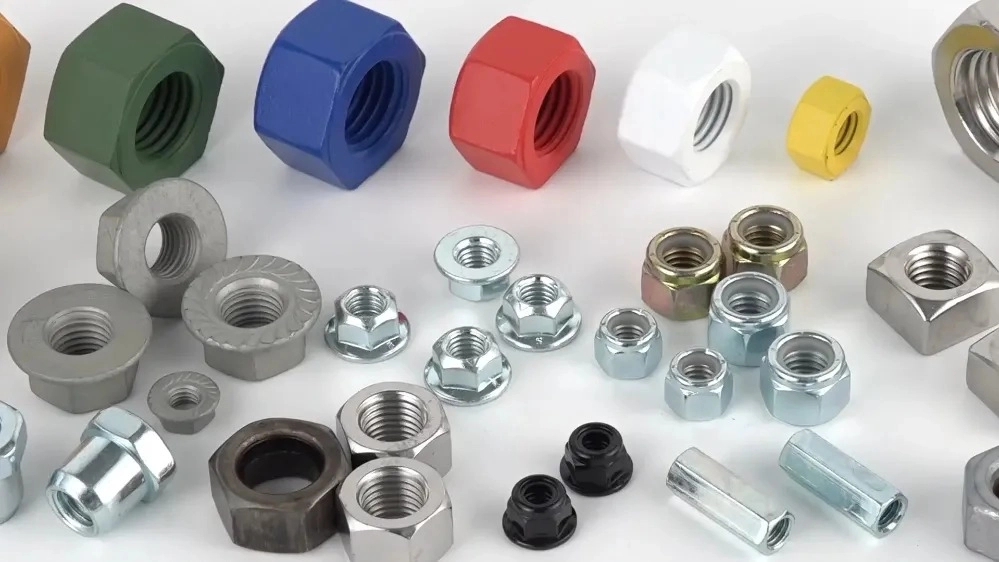
- Lock nut with internal washer (Nyloc Nuts): This type of nut has a nylon ring at the end, which when closed, compresses the screw thread and creates friction. This friction prevents the nut from rotating due to vibration.
- Serrated Flange Nuts: These nuts have serrated edges in their lower part that come into contact with the surface of the part and sink into it. These teeth prevent the rotation of the nut and keep the connection tight.
- Crowned lock nut (Castle Nuts): These nuts have slots in their upper part, after closing, a pin or nail is passed through these slots and the screw hole and prevents the nut from opening. This type is mostly used in sensitive and high safety applications.
- Double locking nut (coupling or Coupling Nuts): These nuts are actually two ordinary nuts that are connected with an internal thread and are used to connect two screws to each other or to increase the length of the thread. In some models, a locking mechanism is also built into them.
- Spring Nuts: These types of nuts use an internal spring to create pressure and prevent opening.
Wide applications of steel lock nuts in various industries
- Automotive industries: In suspension, engine and chassis to ensure safe operation under severe vibrations.
- Building and structure industry: In bridges, tall buildings and industrial facilities for stability against earthquakes and dynamic loads.
- Industrial machinery: In mining equipment, cranes and production lines.
- Industries Rail: in the manufacture of wagons, locomotives and rails.
- General equipment: bicycles, motorcycles, scaffolding and lighting equipment.
Advantages of using steel lock nuts
- Increased safety and reliability: Prevents unintentional opening and accidents.
- Reduced maintenance costs: Eliminates the need for frequent inspections and retightening.
- Vibration resistance: Ideal for high-vibration environments.
- Longer life: Maintains pressure integrity in Connections.
- Ease of installation: Compatibility with standard tools.
- Cost-effectiveness: Economic justification in the long term due to high durability.
Steel lock nut production process
Manufacturing a steel lock nut is a precise engineering process that includes the following steps:
- Selection of raw materials: Use of quality alloy steels (high carbon or stainless).
- Cold forming: Pressing in several steps to reach the initial shape.
- Thread Rolling: Create a stronger and smoother thread without chipping.
- Heat treatment: Hard working and Tempering to increase wear resistance.
- Creating a locking mechanism: Inserting a nylon ring or creating special teeth.
- Covering: Cold or hot galvanized to resist corrosion.
- Quality control: Check dimensions and tolerances according to international standards.
Poladan Sazeh Company: a pioneer in the production and supply of steel lock nuts
Poladan Sazeh Company is known as one of the most reliable suppliers in this industry with years of experience in the field of steel fittings production.
Advantages of buying from Poladan Sazeh:
- Commitment to quality: Compliance with the strictest production and inspection standards.
- Product diversity: Providing a wide range of lock nuts and custom production based on technical drawings.
- Direct sales: Eliminating middlemen and providing competitive prices to customers.
- Expert consultation: Technical support by experts to choose the most optimal part for the project. You.
conclusion
The steel lock nut is a small component that plays a vital role in ensuring the safety and stability of the equipment. Choosing a reliable manufacturer like Poladan Sazeh will ease your mind in terms of quality, durability and compliance with engineering standards. Contact Poladan Sazeh's sales team to get all kinds of steel lock nuts and get technical advice and take a firm step towards improving the safety of your projects.