
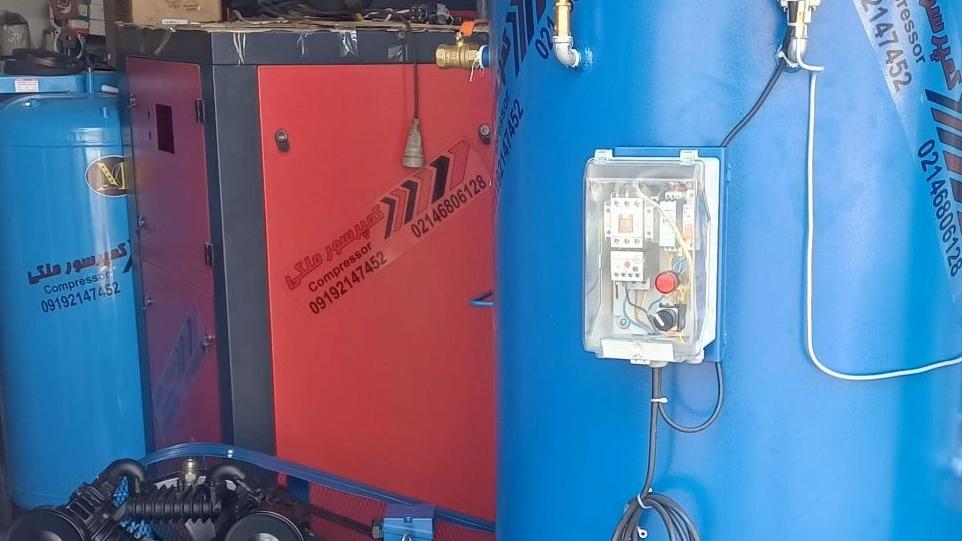
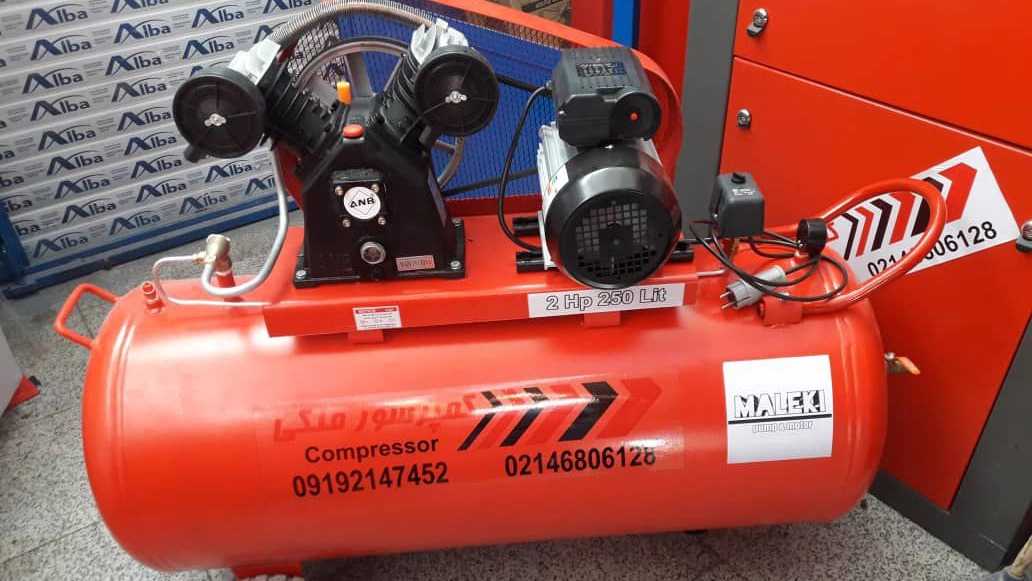

Choosing and supplying compressed air system is one of the most sensitive decisions in setting up and developing production lines and technical workshops. In industrial environments, compressed air is often known as the fourth pillar of energy along with water, electricity, and gas, and any disturbance or pressure drop in the network directly overshadows the efficiency of tools, the quality of parts output, and the speed of work. Providing equipment whose output power is less than the demand of the tools causes continuous pressure drop, frequent stoppage of processes and premature depreciation of the internal parts of the engine; While buying a system with much larger dimensions than the actual need, it leads to the loss of initial capital and the imposition of staggering electricity costs. Therefore, mastering the engineering principles of determining the flow rate, working pressure and dimensions of the tank is essential for every craftsman. As one of the reputable and long-standing names in the design, production and supply of industrial compressed air equipment, Malki Compressor Specialist Group, with years of practical experience in various industries, is considered a reliable consultant to guide craftsmen in choosing the most suitable industrial air compressor. In this specialized article, all the factors, formulas and experimental steps needed to evaluate the consumption volume of tools are reviewed so that the investment path for your workshop is clear and transparent.
The importance of choosing the right capacity of the industrial wind compressor in the workshop
Management of a production unit requires continuous optimization of the chain of tools and energy. If the calculations related to the consumption of compressed air are not done accurately, the workshop will face a flow reduction crisis during peak production hours. When an industrial wind compressor with a capacity lower than the specified standard is put on the line, the electric motor and the air-generating unit have to work continuously and without stopping under load. This continuous operation greatly increases the temperature of the oil and parts, aggravates the sedimentation of the oil, and in a short period of time causes the winding of the electric motor to burn or the air conditioner to jump.
On the other hand, investing in equipment that produces a much higher flow rate than the actual need leads to continuous shutdowns and restarts, electric shocks to the workshop's electrical panel, and a huge waste of active and reactive power. Malki compressor technical specialists always emphasize that the balance between production flow rate, output pressure, working regime of pneumatic lines and specifications of industrial wind compressor is the only guarantee of maintaining economic efficiency and increasing the lifespan of workshop parts. Before placing an order or checking the models, one should master the technical language of compressed air and measure its basic components.
Key terms and parameters in compressed air measurement
To get into engineering calculations, it is important to know the basic definitions and the difference between measurement units. Three basic factors, including production air flow rate, working pressure and storage volume, form the main basis for choosing pneumatic equipment.
The unit for measuring the volume of produced air is usually defined as cubic feet per minute (CFM) or liters per minute (L/min); In addition, in heavy industries, cubic meters per hour or cubic meters per minute are also used to describe the power of the system. Cubic feet per minute shows the volume of air movement per sixty seconds and is the most accurate indicator for matching the power of the device with air tools. The free flow rate of delivered air (FAD) also accurately indicates the amount of air that the compressor delivers after passing through the filters and applying compression under standard environmental conditions. Malki Compressor conducts strict flow measurement tests for all its products based on ISO standards so that the nominal specifications are completely consistent with the actual output efficiency in workshop conditions.
The second basic index is called working pressure, which is usually expressed in pounds per square inch (PSI) or bar (Bar). Pressure means the force exerted by a compressed gas per unit area. The majority of workshop tools such as air blowers, sanders and paint guns reach their maximum efficiency in the pressure range between 6 to 8 bar (about 90 to 120 PSI). The industrial air compressor must have the ability to maintain this working pressure at the end of the piping path under full load.
Identification of pneumatic requirements and air consumption of air tools
The first step in determining the capacity of the industrial wind compressor is a complete and accurate inventory of all the tools that are currently active or will be added in the mid-term expansion plans of the workshop. Each pneumatic device has a different consumption and neglecting the consumption of even a continuous tool will change the final calculations.
Common wind tools in workshops have huge differences in terms of consumption pattern:
Manual and automatic paint spray guns typically use between 3 and 8 cubic feet per minute (about 100 to 230 liters per minute) of air at continuous pressure.
Small to medium impact wrenches require 4 to 6 cubic feet per minute of air flow to open and close fasteners, while heavy industrial one-inch openers may reach 10 to 15 cubic feet per minute.
Tools with continuous rotary motion such as finger mills, orbital sanders and air drills have the highest continuous demand and their air consumption often fluctuates between 8 and 15 cubic feet per minute.
Plasma cutting machines, pneumatic cylinders of packaging lines and air cleaning nozzles also have specific parameters, which the manufacturer's technical catalog is considered the most definitive reference for their extraction. By asking the experts of Maliki compressor, you can get the technical tables of standard equipment consumption to base a realistic estimate on your workshop equipment.
The formula and step-by-step steps for calculating the required capacity (CFM and liters per minute)
To obtain the final capacity of the industrial wind compressor, the simple algebraic addition of the numbers on the tool catalog is not enough, because all the tools in a workshop are not simultaneously and continuously active at 100% power. Therefore, two very important coefficients should be used under the headings of "simultaneity coefficient" and "working cycle".
In the first step, record the air consumption of each tool in terms of cubic feet per minute and multiply it by the percentage of its duty cycle; If a tool is only active for 15 minutes during an hour, its duty cycle factor will be 0.25.
In the second step, enter the simultaneity factor into the equation. This coefficient determines the maximum proportion of machines and tools connected to the line at the busiest working hours. In small workshops with 2-3 users, the synchronicity factor is often between 0.7 and 0.8, while in larger factories with dozens of pneumatic stations, this factor is adjusted between 0.5 and 0.65.
In the third step, the obtained number should be equipped with the network error coefficient and future development. Any piping network, even with the highest standard grade, may suffer from hidden leaks in connections, which engineers consider at least 10-15% loss for leaks. In addition, between 20 and 30% of excess capacity should always be added to the final total to avoid imposing heavy pressure on the electric motor and also to support new tools in the coming years.
As a calculation example: Suppose the total corrected simultaneous demand of your workshop tools is estimated to be 25 cubic feet per minute. By adding 20% safety reserve and 10% coverage of possible piping leaks, the definitive capacity of the system reaches 33 cubic feet per minute (approximately equivalent to 950 liters per minute). In this scenario, the workshop should go for a standard industrial air compressor with a minimum flow rate of 1000 liters per minute. Maliki compressor engineers optimize these calculations based on the required pressure and layout of your workshop to avoid choosing inappropriate capacities.
The method of determining and calculating the volume of the air storage tank
Pressure tank plays a fundamental role in the operational cycle of compressed air. The tank is not just a container for accumulating wind; Rather, this tank is responsible for dampening the extreme pressure fluctuations caused by the sudden operation of high-use tools, cooling and distilling the initial humidity of the input, and allowing the compressor control system to rest in a non-responsive or no-load mode at certain time intervals without cutting off the network pressure.
If the tank is considered too small, the industrial wind compressor will have frequent switching. These continuous starts and steps will cause severe damage to the electrical circuit, contactors and belts. On the contrary, extra large tanks, if they are not suitable for the production flow of the pump, will make the filling time of the line very long and keep the pump in the cycle for a long time under load.
A valid empirical formula for choosing the volume of the industrial wind compressor tank based on liters is as follows:
The volume of the tank in gallons is equal to the product of the peak process time and the allowable pressure drop, which is defined as a general rule equal to 3 to 5 gallons per 1 cubic foot per minute of system air flow. If we convert this ratio to liters, an empirical engineering standard recommends that the volume of the tank be chosen approximately equal to one-third to one-half of the output of compressed air in liters per minute; For example, for a system with a capacity of 1000 liters per minute, a suitable storage tank is evaluated between 350 and 500 liters. The standard tanks produced in Malki Compressor are made using thick steel sheets and hydrostatic tests in accordance with the regulations of pressure vessels to ensure the complete safety of the workshop space.
Choosing between piston and screw compressors for workshop use
After the accurate estimation of the aeration capacity and tank volume, it becomes important to make a decision about the wind production technology. There are two main systems in workshop and industrial dimensions: piston compressor (reciprocating) and screw compressor (spiral rotary). Knowing the difference between these two systems guarantees the coordination of cost with efficiency.
Piston compressors are extremely suitable for environments with an intermittent work pattern; Carpentry shops, auto body shops, auto body shops and medium-sized metalworking units where operators use air tools intermittently get very good returns from piston models. These systems operate periodically and require shutdown intervals to cool the cylinders. Their duty cycle is usually set between 60 and 70%. On the other hand, the screw-type industrial wind compressor has a structure focused on the duty cycle (100% duty cycle). If your workshop has continuous sandblasting lines, advanced laser cutting machines, textile and two-shift or three-shift non-stop assembly lines, the screw compressor is the best choice. Extremely low noise, excellent energy efficiency, absence of impact in the wind output and long life of moving parts are considered to be the characteristic features of the screw. Maliki compressor sales line experts are ready to suggest the best type of device according to your budget by checking the working hours and operational shifts of the workshop.
Investigating the pressure drop in pipelines and the role of air purification
Many workshop managers complain that despite the provision of powerful compressors, the wind tools at the end of the hall do not show the necessary efficiency. The cause of this problem often lies in not calculating the friction and pressure drop in the piping system and connections. The passage of dense volume of air through pipes with a small diameter, the presence of elbows, numerous non-standard valves, and the use of long spring hoses with a thin section, creates a pressure drop between 1 and even 3 times in the place of the instrument.
To prevent this loss of efficiency, it is recommended to implement the piping distribution line of the workshop as a closed loop circuit (ring) with galvanized or aluminum pipes of suitable diameter so that the pressure reaches the farthest stations uniformly. In addition to the frictional loss, the peripheral equipment also imposes a specific hydraulic resistance to the air flow. Air purification systems, such as refrigeration dryers, water traps, and microfilters for absorbing dust and oil vapor, create a pressure drop several tenths of times. As a result, when choosing an industrial wind compressor in a property compressor, the output pressure of the air conditioner is always set between 1.5 and 2 times higher than the minimum pressure used by the tools in order to fully cover the structural losses of the network.
Climatic factors and environmental conditions affecting compressor capacity
A point that is often neglected in theoretical calculations is the direct effect of the climatic conditions of the workshop on the amount of free flow of delivered air. Air density depends on temperature and altitude. In cities with a high altitude above sea level, such as Tehran, Isfahan, or Tabriz, due to the thinner atmosphere, the mass of air entering the cylinder in each suction is less than in port cities and at sea level. This height difference can reduce between 10-20% of the nominal efficiency of the air conditioner.
Also, the high temperature of the environment in hot seasons causes the air to expand before entering the intake manifold and lowers the volumetric efficiency percentage. When ordering equipment from Maliki compressor, the geographical parameters of the installation location such as the altitude and average annual temperature are entered in the formula tables and the atmospheric correction factor is applied in the selection of the electric motor power and cylinder size so that the device does not suffer from a decrease in flow rate in the hottest days of the year and in the actual conditions of the line.
Benefits of cooperation and purchase from Malki compressor
Choosing a workshop air compressor is more than a simple purchase; This process is considered a technical partnership in order to ensure a stable flow of production. Relying on decades of engineering experience and commitment to customer-oriented principles, Malik Compressor creates solutions for craftsmen that are the result of combining high-quality materials and standard calculations. By choosing a Maliki compressor, you will benefit from these benefits:
Engineering design of air conditioners based on the most reliable global brands with anti-wear cylinders and high durability parts.
Manufacturing of standard pressure vessels with molded lenses, industrial sub-powder welding and moisture and corrosion resistant coatings.
Providing free advice by expert experts to calculate the consumption capacity of the workshop without imposing excess costs on customers.
Reliable corporate warranty and easy access to spare parts, filtration and original industrial air compressor oils for years of continuous operation.
Providing solutions to reduce electric energy consumption through the use of advanced control systems, smart inverters and safe switchboards.
The constant effort of the Malik Compressor team is to provide products with the highest operational stability so that small business owners and large factories can focus on increasing the productivity of their business without worrying about pressure drops or sudden stops.
Checklist of actions before buying a compressor for the workshop
To achieve the clearest evaluation before finalizing a purchase, reviewing the following steps is a practical roadmap for any technical manager:
summary
Purchasing and equipping production lines with compressed air systems requires knowing all the physical and mechanical components of consumption. A lower capacity than the device needs will ground the production line and encourage premature depreciation of the equipment, while choosing a system that is much larger than the daily use will make running costs unreasonable. By analyzing variables such as air consumption of tools, application of synchronization coefficients, assessment of climatic conditions, selection of standard tank volume and measurement of air distribution lines, the most ideal industrial wind compressor can be prepared according to the nature of the workshop. With a wide range of industrial wind equipment and after-sales services, the technical specialists of Maleki Compressor have paved the way to achieve stable and economical wind pressure for Iranian industries.
