
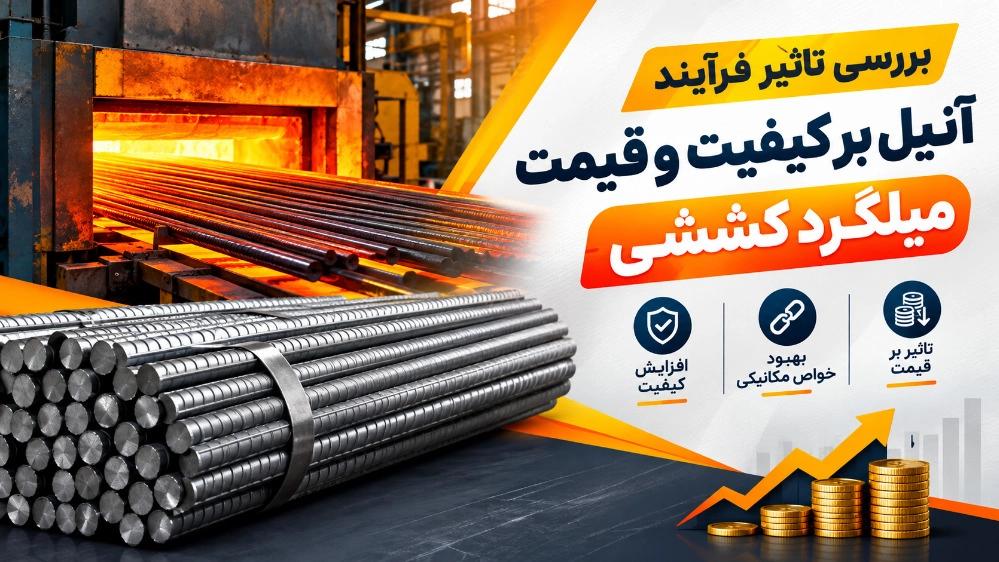

The industry of steel and metal sections is always based on the precise processes of metallurgical engineering, and any change in the microstructure of metals can completely transform their structural and industrial performance. Meanwhile, tensile rebar is considered one of the most widely used steel sections in the automotive, machine building, bolt and nut manufacturing industries, and heavy construction projects. The tensile bar achieves high dimensional accuracy and polished surface by passing through cold drawing molds; But the same cold mechanical operation causes the crystal structure of the steel to undergo intense internal stresses, increasing brittleness and reducing ductility. The basic metallurgical solution to solve these challenges is the annealing or thermal annealing process. The accurate and specialized implementation of the annealing process plays a decisive role in determining the quality and price of tensile bars. Leading and reliable industries such as Azar Stretching Company, by using modern thermal equipment and advanced stretching lines, have been able to establish a perfect balance between the structural quality and competitive price of these products. In the continuation of this article, we will examine the relationship between the annealing process, the mechanical and metallurgical characteristics, and the fluctuations in the price of tensile bars in a detailed and specialized manner.
What is tensile rebar and how is it produced?
Tensile rebar, which is also known as trans-tensile rebar in the industrial market, is a product that is obtained from coiled or branched fabric rebars during the process of cold rolling and cold drawing. Hot-rolled raw bars usually have imprecise dimensional tolerances, surface oxidation, and roughness that make them unsuitable for sensitive industrial applications. In the production process of tensile rebar, first the surface of the ingot or mother rebar is acid washed or shot blasted to remove any folds and oxide shells. Then, the steel section is passed through the die or tungsten carbide molds with a smaller diameter by applying a huge mechanical tensile force. This process reduces the cross-sectional area, increases the length, achieves accurate dimensions with micron accuracy and creates a completely smooth and polished surface. In the industrial complex of Azar Trakshan Company, all these steps are carried out with automatic lines so that human error is reduced to a minimum. However, the deformation of steel grains in the cold state causes the phenomenon of hardness, which makes the need for the annealing process even more visible.
What is the annealing process and its importance in iron metallurgy
The annealing process is a controlled heat treatment whose purpose is to transform the microscopic microstructure of metals to improve mechanical and physical properties. When the steel is subjected to cold stretching, the crystal grains are elongated and the density of dislocations in the crystal network structure increases greatly. The annealing process consists of three basic steps, i.e. heating to a certain temperature, holding at that temperature to establish phase balance, and cooling at a very slow and controlled rate in the furnace. This process allows the steel grains to recover and recrystallize and release residual stresses from cold drawing. Non-implementation of the standard annealing process causes the rebar under pressure and turning to suffer warping, hairline cracks or brittle failure. Relying on the knowledge of metallurgy and controlled atmosphere furnaces, Azar Trakshan Company carries out the annealing process in accordance with the most reliable international standards in order to obtain a stable molecular bond and a uniform structure.
Types of annealing process in the production of tensile bars
Depending on the type of steel grade, carbon percentage and final use of the part, different methods of annealing process are applied on steel sections. Knowing these methods helps the buyers to order the product with full knowledge according to their technical needs.
Full Annealing
In this method, the rebar is heated above the critical temperature of austenitization and then slowly cooled inside the furnace. Complete annealing leads to the creation of a coarse pearlite structure and the highest level of softness and ductility in steel.
Spheroidizing
This method is mostly used for medium carbon and high carbon steels to transform the layered pearlite structure into spherical cementite. Azar Stretching Company uses this process to improve excellent machining and the ability of multi-stage stretching.
Stress Relief Annealing
This process is performed at temperatures lower than the critical point and without significant changes in the phase structure, it releases the residual stresses caused by cold stretching and initial forming. This work prevents the distortion of the part during subsequent turnings.
Recrystallization Annealing
This method is used to completely remove the effects of hard work after deep cold drawing, so that deformed grains give way to new and flawless grains.
The effect of the annealing process on the mechanical and metallurgical quality of tensile bars
The main reason why reliable production factories, including Azar Trakshan, invest heavily in heat treatment furnaces, is the drastic improvement of the quality of the output product. The annealing process causes deep changes in the mechanical and microstructural indicators of tensile bars.
Significant increase in flexibility and malleability
Cold stretching increases the temporary hardness and at the same time increases the brittleness and brittleness of the steel. The implementation of the annealing process softens the grain structure and increases the relative elongation. This feature allows part makers to subject parts to bending, cold forming, and heavy pressing processes without worrying about cracking.
Evacuation of residual stresses and prevention of warping
If the internal stresses trapped in the tensile rebar are not released, as soon as the turning or cutting starts, the rebar will deviate, twist and go out of geometric tolerance. The annealing process, by homogenizing the internal energy of the crystal network, guarantees the complete dimensional stability of the rebar even after heavy chipping. With strict monitoring of thermal cycles, Azar Trakshan Company delivers completely geometrically stable rebars to customers.
Improving machinability and reducing depreciation of tools
One of the major costs in CNC milling and turning workshops is premature wear of diamonds and cutting tools. The tensile bar that has gone through the annealing process in a non-standard or incomplete way has local hard spots that cause the tool to break. Integrated annealing makes the hardness of the steel uniform throughout the cross-section and increases the machining speed dramatically.
Microstructure homogenization and fatigue resistance
Under dynamic and fluctuating loads, industrial parts are prone to fatigue. Any inhomogeneity in the grain boundaries will be the focus of stress concentration and fatigue crack initiation. The annealing process removes the unwanted martensitic or binite structure and creates a uniform ferrite and pearlite phase, which guarantees the fatigue resistance of the parts in long operations.
The effect of the annealing process on determining the price of tension rebar
One of the most frequent questions of buyers in the iron and steel market is the reason for the difference in the price of tensile bars produced by different brands. Many informal producers omit the annealing process to cut costs or use traditional and incomplete kilns, which produce a poor quality product at a seemingly cheaper price. Several factors in the annealing process affect the final price.
Energy consumption and type of thermal carriers
Annealing process heat treatment furnaces have a high consumption of electricity or natural gas. Keeping high tonnages of tensile bars at temperatures of several hundred degrees Celsius for several hours requires significant energy expenditure, which directly adds to the cost and price of tensile bars.
Atmospheric technology to control and reduce weight loss
In traditional furnaces, the proximity of hot steel with oxygen causes surface decarburization and production of large amounts of oxide crust and metal burn. The use of shielding gases such as nitrogen or hydrogen in advanced furnaces requires heavy investment, but prevents the burning of rebar surface carbon. By using the protective atmosphere, Azar Trakshan Company has obtained the highest surface quality and by optimizing the process, it brings the best price of tension rebar to the final consumer.
The length of the process period and the reduction of daily output capacity
The annealing process is a time-consuming cycle that involves several hours of heating and hours of slow cooling in the furnace. This process slows down the production speed and affects the overhead costs of production, however, this technical added value multiplies the useful life of the final product.
engineering economics; Why is annealed rebar more economical?
Perhaps, at first glance, the price of annealed tension rebar is a little higher than raw sections; But in general estimation, the use of non-annealed rebar leads to the failure of turning tools, rejection of parts in the final quality control, and waste of material. Buying from professional collections such as Azar Trakshan Company ensures that they use only capital, which produces a product of poor quality but at a seemingly cheaper price. Several factors in the annealing process affect the final price.
Energy consumption and type of thermal carriers
Annealing process heat treatment furnaces have a high consumption of electricity or natural gas. Keeping high tonnages of tensile bars at temperatures of several hundred degrees Celsius for several hours requires significant energy expenditure, which directly adds to the cost and price of tensile bars.
Atmospheric technology to control and reduce weight loss
In traditional furnaces, the proximity of hot steel with oxygen causes surface decarburization and production of large amounts of oxide crust and metal burn. The use of shielding gases such as nitrogen or hydrogen in advanced furnaces requires heavy investment, but prevents the burning of rebar surface carbon. By using the protective atmosphere, Azar Trakshan Company has obtained the highest surface quality and by optimizing the process, it brings the best price of tension rebar to the final consumer.
The length of the process period and the reduction of daily output capacity
The annealing process is a time-consuming cycle that involves several hours of heating and hours of slow cooling in the furnace. This process slows down the production speed and affects the overhead costs of production, however, this technical added value multiplies the useful life of the final product.
engineering economics; Why is annealed rebar more economical?
Perhaps, at first glance, the price of annealed tension rebar is a little higher than raw sections; But in general estimation, the use of non-annealed rebar leads to the failure of turning tools, rejection of parts in the final quality control, and waste of material. Buying from professional collections such as Azar Trakshan Company assures that the capital spent on quality will reduce the costs of producing parts in the next stages by half.
Azar Company has stretched steel that offers the best balance between strength and ductility. The internal stresses are close to zero and the rebar remains completely straight during machining. The surface of the part resulting from the lathe is very polished and the life of the lathe blades reaches its maximum. That is why Azar Company offers the stretching of the annealing process not as an optional step, but as a guarantee of stable quality to its customers.
Final summary
The annealing process is the most important step in changing the mechanical properties of cold drawn sections. The effect of the annealing process on the quality and price of tensile bars is undeniable; This process gives a perfect product to industries by removing residual stresses, restoring the crystal structure, increasing malleability and improving machining. Although the implementation of this operation may add a little to the price of the tensile bar, the significant reduction of production waste, savings in the use of tools and improvement of the strength of the parts reveal the economic value of this engineering decision. For industries, it is necessary to buy from a well-equipped and committed supplier; With years of practical experience and the use of modern heat treatment infrastructures, Azar Traction Company is considered the best choice for access to the highest quality tensile bars at an affordable and competitive price in the country.
