
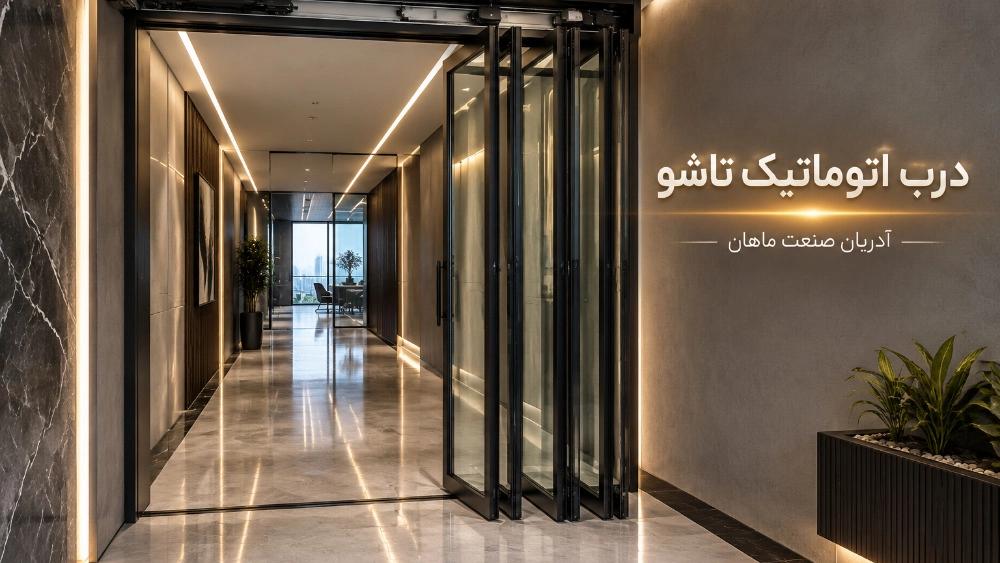


Modern architecture and the limitations caused by urban construction in today's projects have doubled the need for optimal use of the smallest dimensions of space. In the meantime, building entrances and internal passageways, especially narrow corridors, are always a major challenge for architects, builders, and employers. The installation of traditional hinged doors usually occupies a major part of the useful space of the corridor when opened, and the use of common sliding or sliding doors is also practically impossible in such plans due to the urgent need for lateral space for the movement of the hinges on the walls. This is where the importance of engineering and technical points of implementing an automatic folding door or a bus in narrow corridors is determined; An intelligent and engineered system that provides the highest amount of useful opening in the most compact dimensions possible.
Functional mechanism of automatic folding door
The automatic folding door, which is known in the market and engineering terms as bus door or folding door, consists of two, three or four movable hinges that are connected to each other by resistant industrial hinges. The function of this door is very similar to the door opening and closing mechanism of city buses; In such a way that upon receiving a command from the sensors or access control systems, the slats are folded on top of each other in an accordion shape and are gathered towards the sides of the frame.
The distinguishing feature of this structure compared to other automatic glass doors is the stunning ratio of useful opening to the entire opening. In a narrow corridor, conventional sliding systems provide only about fifty percent of the total opening to the user; Because half of the space should be considered as a fixed hinge so that the movable hinge slides on its back. But with the implementation of automatic folding doors or bus doors in narrow corridors, more than eighty-five to ninety percent of the total width of the opening can be used as a useful passage. Adrian Sanat Mahan Engineering Group uses the most advanced calculations of the center of gravity in the design of these flaps so that the pressure caused by the rotational movement of the flaps is distributed among the profiles and rollers in the best possible way and the system opens and closes without the slightest vibration or sound.
Technical and economic advantages of folding doors in tight spaces
Using the automatic folding door system is not only a change in appearance, but also an efficient answer to many problems in managing human traffic and reducing energy waste in narrow spaces. Narrow corridors in hospitals, clinics, banks, commercial buildings, educational centers and luxury residential complexes endure high volumes of traffic daily. In these spaces, it is necessary to move stretchers, wheelchairs, and cargo with minimal obstacles.
The first outstanding technical advantage is the high speed of operation. Because the movement course of each hinge is short, the full opening of the entrance is done at a much higher speed than sliding doors, which prevents the accumulation of people in narrow passages. The second important advantage is the improvement of energy consumption efficiency. With the implementation of automatic folding or bus doors in narrow corridors by Adrian Sanat Mahan, full sealing is done with the help of EPDM engineered rubber bands and heat and cold exchange between different spaces of the building is completely prevented. Also, the modern folding systems of Adrian Sanat Mahan, equipped with precise digital encoders, have a soft and safe behavior that prevents any damage and stress caused by sudden brakes.
Preparation, chassis and infrastructure alignment for narrow corridors
The most important executive part that guarantees the smooth operation and mechanical life of the system is the correct chassis and the alignment of the main structure in the corridor. The walls of narrow corridors may have unevenness, convexity, concavity or millimeter deviations that are not so visible to the naked eye, but are considered a fatal error for a sensitive folding system. If the structure is even a few millimeters out of horizontal and vertical alignment, the flaps will encounter unwanted resistance during folding and the motor will draw too many amps.
Adrian Sanat Mahan experts use standard steel cans such as heavy sections of 80 x 40 or 100 x 40 mm before installing the mechanism to create a rigid and perfectly aligned peripheral coil. In narrow corridors, the thickness of the chassis should not be designed in such a way that it reduces the useful width of the passage. The metal chassis must be fully restrained in the depth of the wall or hidden in the structure, and its connection to the ceiling and floor should be done through bolts and industrial load-bearing roll-plugs in order to restrain any vibration of the beams at high speeds. The implementation of an automatic folding door or a bus in narrow corridors without solid infrastructure will lead to uneven wear of the hinges and sagging of the hinges after a while, therefore the chassis drawing stage has the highest accuracy coefficient in the engineering standards of Adrian Sanat Mahan.
Design of hinges, profile and weight distribution in folding systems
In folding systems, the weight of the moving arm is placed on the hinges and middle rollers; In the sense that the hinge does not simply hang on a straight line like sliding doors, but applies a specific twisting torque to the assembly during opening and closing. For this reason, the correct selection of glass thickness and frame material is of vital importance. Although the use of 10 mm tempered glass provides physical security, it increases the weight of the hinge and increases the mechanical load of the hinges.
Selection of power transmission system, engine and electronic operator
The beating heart of any automatic system is its operator and motor. In implementing an automatic folding door or a bus in narrow corridors, the motor is not only responsible for opening and closing the door, but also must produce the torque force required to overcome the inertia of folding arms. For this purpose, the use of new generation brushless motors is undoubtedly the best option due to their excellent thermal efficiency, no noise, optimal power consumption and continuous operation in heavy traffic.
Geometry of levers, hinges and floor guide rails
The most complicated mechanical part of the folding door is the mechanical arms or articulated levers that are the interface between the operator and the hinges. The rotation of the arm must be in perfect mathematical harmony with the folding angle of the lever. If the connection angle of the arms is set asymmetrically, the hinges will not be aligned when folded, and this will cause the door to open incompletely and reduce the useful passage width.
Hinges connecting the hinges to each other should also be made of stainless steel or pressed aluminum with automotive brass bearings so that they don't become stiff due to dust over time and don't make a squeaking noise. Another challenge in narrow corridors is the downward direction of the ledges. Adrian Sanat Mahan automatic folding door systems can be implemented in two models "with floor rail" and "without floor rail". In the corridors where there is hospital equipment or wheelchair traffic, it is recommended to implement a suspended system without floor rails or to use narrow built-in floor rails so that the passage remains completely flat and the passage of people or wheelchairs is carried out without hitting a physical barrier.
Security measures of sensors and integration with the fire notification system
Safety in narrow corridors, which have less field of vision than open halls, is a very sensitive and critical category. Due to the fact that the bus door hinges move forward and backward, the use of conventional microwave motion sensors alone is not enough, and the hinge may hit a person who is approaching when it is opened.
To prevent this from happening, Adrian Sanat Mahan Company equips its folding doors with the most advanced combined infrared light curtain sensors. These sensors spread a dense curtain of invisible rays throughout the folding path of the flaps and the entry threshold; In such a way that if even a very small object is placed in the path of rotation of the blade, the system stops in a fraction of a second or reverses the direction of movement. In addition to collision sensors, the operators provided by Adrian Sanat Mahan have the ability to connect directly to the building's fire alarm system; In this way, as soon as a smoke or fire alarm is received, the door can be fully opened automatically and provide a safety escape passage for the quick evacuation of people from the narrow corridor.
Emergency power system, traffic control and intelligence
Power outages should not cut off people's access to communication corridors; Especially in sensitive spaces such as health centers or parking lots where corridors play a vital role in emergency evacuation. For this reason, the implementation of automatic folding doors or buses in narrow corridors by Adrian Sanat Mahan is always done with a backup battery package (UPS) with a smart charging board. This internal battery pack retains the operator's commands as soon as the utility grid is interrupted and, depending on the settings defined, either allows for multiple opening and closing cycles or stops the door fully open for safety. It is also possible to manually release the mechanism with a special release key in emergency times.
On the other hand, these doors have the ability to fully adapt to all kinds of intelligent building management tools. A bus door can be equipped with card access controls, RFID tags, coding pads, facial recognition readers and fingerprint scanners. This feature is a great advantage for special entrances such as operating rooms, laboratories, server areas and offices with high privacy in narrow corridors.
Acoustic and thermal insulation standards in corridors
Adrian Sanat Mahan uses multi-row nano silicon hairs and thermoplastic rubber gaskets around the perimeter coil, the joint of the hinges and under the hinges. These parts make the penetration of air currents and temperature drop to zero, and the sound of people passing through the corridor does not penetrate into the neighboring rooms. The accurate insulation of the folding doors of this complex, in addition to keeping the peace of the residents, reduces the costs of cooling and heating facilities to a significant extent throughout the year.
Periodic service and maintenance of automatic folding doors
Because the bus door mechanism has more moving hinges, articulated joints and mechanical arms than conventional rail doors, it requires a regular program of preventive maintenance. Ignoring periodic services can lead to dry bearings, out of adjustment levers, and double pressure on the device's engine.
The maintenance program provided by Adrian Sanat Mahan includes checking the tension of the toothed belt, adjusting the middle hinges to eliminate possible sagging, cleaning the path of the upper rails, specialized lubrication with non-absorbent lithium or silicone grease sprays, testing the sensitivity of the infrared light curtain and measuring the health of the backup batteries. Adrian Sanat Mahan's experienced engineers guarantee the durability and smooth operation of automatic folding doors or buses in narrow corridors for many years by carefully adjusting the software and periodically checking chassis vibrations.
Why Adrian Sanat Mahan is the best choice for the implementation of folding doors
The implementation of an automatic folding door in a wide space may be possible for many installers, but the implementation of an automatic folding door or a bus in narrow corridors is a task that requires hundredths of a millimeter accuracy, knowledge of mechanical engineering, understanding how space behaves, and torque calculations. The smallest slip in alignment or the use of low-quality parts can cause the system to make unpleasant noises and wear parts within a few months.
Adrian Sanat Mahan company, by combining the world-class technology, using the highest quality motors, hinges, rollers and resistant extrusion profiles together with the expert technical team, gives the assurance to the builders, consultants and employers that even in the narrowest and most challenging openings, a system with maximum productivity, maximum beauty and unconditional safety will be installed. Permanent support, real guarantee of equipment and engineering advice before implementation has made Adrian Sanat Mahan an important and reliable brand throughout the country in the specialized field of automatic doors and traffic control structures.
summary
Using automatic bus or folding doors in construction projects is a completely smart, stylish and engineered answer to the problem of lack of space in corridors and narrow passages. This system makes it possible to reach more than ninety percent of the total width of the entrance by successively folding the panels on top of each other; A unique feature that no other sliding mechanism can fulfill. The ultimate success in the performance of this system depends on the coordination of chassis components, brushless motor, automotive hinges, infrared safety sensors and precise alignment of parts. Adrian Sanat Mahan Company, committed to international standards and relying on the valuable experience of numerous projects, provides you with an ideal and sustainable solution for the implementation of automatic folding doors or buses in narrow corridors to create safe, luxurious and durable entrances without worrying about space limitations.
