
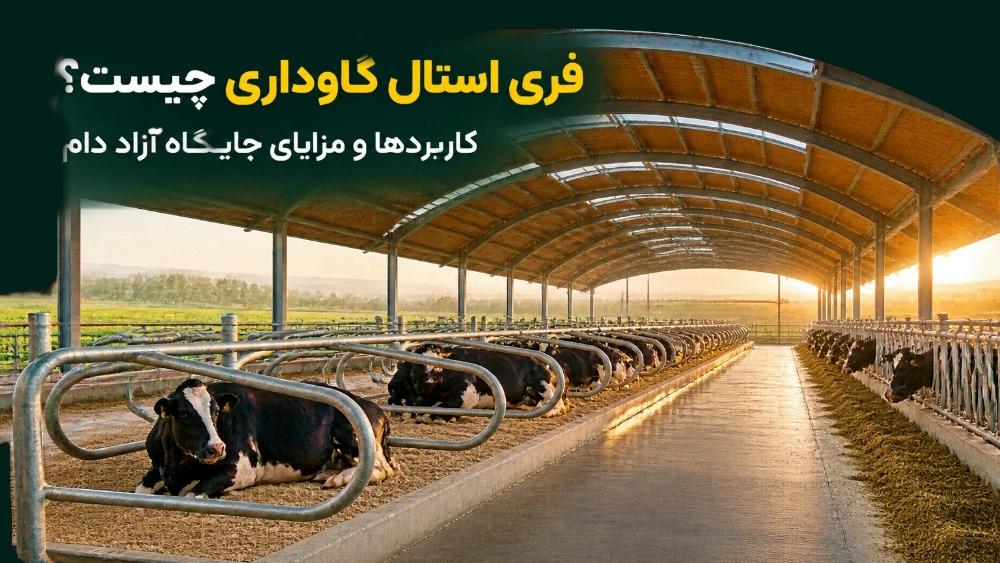

Free Stall Cattle is one of the most modern methods of designing dairy and beef cattle stalls, which is used with the aim of increasing the freedom of movement of cattle, improving the animal's comfort, reducing physical injuries and simplifying the daily management of livestock farming. In this system, unlike traditional methods in closed stalls or individual stables, cows have the possibility to move freely in certain parts of the cattle farm and have access to different parts for resting, feeding, drinking and milking.
The importance of free stall cattle breeding has increased in recent years due to the development of industrial animal husbandry, increased attention to animal welfare and the need to reduce human labor costs. The correct design of this type of place can provide more suitable conditions for cattle to rest, maintain the health of hoofs and movement organs, reduce environmental pollution, manage manure better and increase livestock productivity. Of course, the implementation of this system is not limited to the construction of a few resting places; Rather, it requires principled design, selection of appropriate equipment, compliance with standard dimensions and attention to the region's climate.
Damiar Taha Sanat Parse, by providing specialized solutions in the field of animal husbandry design and equipment, can help farmers to implement cattle free stall according to the number of animals, type of operation, weather conditions and project budget. In the following, we will get to know the structure, applications, benefits, equipment and important points of running cattle free stall.
What is cattle free stall?
Free Stall Cattle or Free Stall is a type of livestock keeping system where cows can move freely in the designed space and use special places called stalls to rest. Each stall usually has a suitable floor, separator, rest area and sometimes soft bed. In these places, the animal moves freely between the resting place, the manger, the water trough and the movement paths.
In free stall cattle, cows usually have access to rest stalls at all hours of the day and night; But they are directed to specific departments for feeding, milking, vaccination, examination and other management activities. This structure, compared to closed places, allows for the group management of livestock and allows the farmer to control a larger number of livestock with less manpower.
One of the most important features of the free stall is the relative separation of different animal activities. Sleeping and resting place, movement path, manger, water trough, waiting room and milking room should be designed with proper order and distance. If these sections are built without taking into account the natural behavior of cows, the possibility of crowding, contamination, conflict between animals and reduction of feed consumption will increase.
The main components of cattle freestal
The free stall design of the cattle farm consists of several main parts, each of which plays an important role in the health of the animals and the overall performance of the complex. Knowing these components is necessary to build a standard site.
Resting place or stall
A stall is a dedicated resting space for each animal. Stall dimensions should be determined based on animal size, breed, age and type of exploitation. A very small stall causes restriction of movement, damage to joints and reduction of the animal's sleeping time. An excessively large stall may also cause the cow to defecate in an inappropriate place and reduce litter hygiene.
Sufficient space should be considered in the design of the resting place for the animal to stand up, lie down and turn naturally. Stall dividers should be such that they separate the cattle from other cows, but do not obstruct ventilation, proper visibility and natural movement. The use of resistant and anti-rust equipment can increase the useful life of this part.
resting bed
The bedding in the cattle free stall has a direct role in the health of hoofs, knees, joints and the quality of animal sleep. The substrate can be made of sand, straw, soft soil, livestock mat or a combination of suitable materials. The choice of substrate should be done according to the cost of maintenance, access to materials, manure collection system and weather conditions.
بستر مرطوب یا آلوده میتواند زمینه رشد عوامل بیماریزا را فراهم کند و موجب افزایش مشکلات سم و عفونتهای پستانی شود. Therefore, cleaning, replacement and leveling of the substrate must be done according to a specific schedule. در دامداریهای صنعتی، استفاده از تشکهای مخصوص یا کفپوشهای استاندارد میتواند آسایش دام را افزایش دهد.
Manger and feeding place
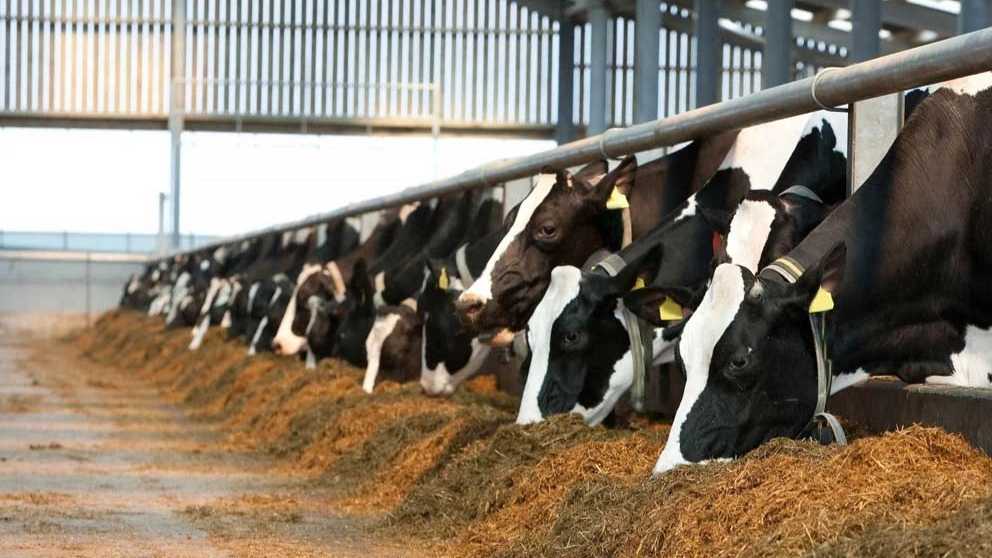
Manger in freestall cattle should be designed in such a way that all animals can have access to feed without intense competition. The height of the manger, the width of the feeding space, the material of the wall and the ease of washing are important factors in the design of the manger.
If there is little space in the manger, weaker cattle or newborn cows may not get enough time to feed. This issue can lead to weight loss, decreased milk production and increased stress. The surface of the manger should be smooth, resistant and washable and not have sharp edges.
water eater
Continuous access to clean water is one of the requirements of cattle farming. Dairy cows need a lot of water, especially during the high production period. The drinking fountain should be placed in a place where the animal can easily access it after feeding, but the water spill does not wet the bed and movement paths.
The capacity of the drinking fountain, the number of drinking fountains, the speed of filling, the possibility of emptying and daily washing must be checked at the time of design. The use of resistant drinking fountains with a safe edge prevents damage to livestock.
Movement paths
Movement paths should be designed without obstacles, slippage and blind spots. The floor of the cattle free stall is usually made of grooved concrete or resistant materials to reduce the possibility of cattle slipping. The slope of the floor should be enough to drain water and excrement well, but not make it difficult for livestock to move.
The width of the paths should allow the passage of cows at the same time. In narrow paths, livestock are stressed and the possibility of collisions, falls and injuries increases. The path between the manger and the resting place should also be short, accessible and without crowding.
The use of cattle free stall in animal husbandry
Cattle free stall has many applications in dairy, meat and semi-industrial livestock farms. The most important application of this system is to provide an organized environment for group keeping of livestock. In this method, the animals move freely and the farmer can manage different activities in a more orderly manner.
Another application of Freestall is increasing the productivity of human resources. In traditional places, controlling, feeding, cleaning and moving animals requires more time and energy. But in the free system, proper design of routes and equipment makes many activities to be done faster and at a lower cost.
In dairy farms, free stalls can help to improve the flow of cattle to the milking parlor. Designing separate routes for entry and exit prevents the accumulation of livestock and reduces waiting time. As a result, the animal's stress is reduced and the milking operation is done more quickly and hygienically.
Advantages of free stall cattle farming
Increasing animal comfort
Cows need enough time to rest to maintain their health. The correct design of the cattle free stall allows for comfortable sleeping, free movement and easy access to feed and water. Increasing animal comfort is usually associated with improved rumination, reduced stress and better performance of the herd.
Reduction of movement injuries
Suitable floor, standard stall and safe paths can reduce the possibility of slipping, hitting and damaging the feet and joints. The health of the movement organs is very important, because a cow with leg pain will visit the manger and water trough less and its production may decrease.
Improving environmental health
In freestall cattle, paddocks, resting beds and feeding areas can be better managed. The use of scraper, manure collection system and suitable waterway reduces environmental pollution. Regular cleaning is also effective in reducing infectious diseases and breast problems.
Reducing management costs
If the free stall is designed properly, the operations of cleaning, feeding, moving and controlling the livestock can be done with less manpower. Mechanized equipment can also reduce the time required to perform daily tasks. Of course, cost reduction occurs when the initial design is accurate and the equipment is selected according to the livestock capacity.
Increasing livestock capacity
Freestall allows more optimal use of livestock space. In a basic design, different parts can be placed together in an orderly manner and avoid extraneous spaces. Increasing the capacity should not be at the cost of reducing the resting space or overcrowding of animals; Because high density has a negative effect on health and production.
The difference between Freestal and the inpatient system
In the confinement system, each animal is usually placed in a specific space and its freedom of movement is more limited. Feeding, milking and animal care may be done in the same place or with manual handling. This method is used in small farms, but it is more difficult to manage a large number of animals.
In contrast, freestall cattle farming focuses on the free movement of cattle and the use of group or semi-dedicated rest areas. The farmer can divide the herd based on management needs and use more mechanized equipment. However, Freestall needs proper space, careful design, constant cleaning and proper management.
The choice between these two systems should be made based on the number of livestock, type of livestock farming, initial capital, available land, access to labor and future development plan. Consultation with animal husbandry design experts before the implementation of the project can prevent correction costs and implementation mistakes.
Important points in the design of cattle free stall
One of the most important points is to pay attention to the climate of the region. In hot areas, ventilation, shading, fan installation and cooling system are very important. In cold areas, preventing the direct flow of wind, proper insulation and providing a dry bed should be prioritized.
The height of the ceiling, the orientation of the building, the number of entrances and exits, and the amount of air circulation must be carefully calculated. Improper ventilation causes increased humidity, ammonia smell and breathing problems. Excessive ventilation can also cause thermal stress in the cold season.
In the cattle free stall, access to machinery for cleaning and repairs should be provided. The entrance route of the tractor, the feed storage area, the manure station, the milking hall and the quarantine section should be seen on the map from the beginning. Subsequent changes are usually costly and time-consuming.
The type of equipment is also very important. Metal parts must be resistant to moisture, detergents and impact. Sharp corners, protruding screws, and weak connections can injure livestock or workers. In addition to animal health, the design should also cover the safety of employees.
The role of Damiyar Taha Sanat Parse in the performance of Free Stall
Successful implementation of free stall cattle requires a combination of engineering design, appropriate equipment and understanding of animal behavior. Damiar Taha Sanat Parse can be with livestock farmers in the design and equipment of animal husbandry, from the stage of examining needs to choosing equipment and implementing operational solutions.
Focusing on the needs of different livestock farms, this collection has the possibility of providing a suitable solution for herd capacity, budget, climate, type of livestock and development goals. The use of standard equipment along with practical design allows the farmer to make the best use of the available space.
Choosing an expert supplier for cattle free stall prevents problems such as inappropriate dimensions of the stall, weak structure, difficulty in cleaning and premature failure of the equipment. Damyar Taha Sanat Parse can provide a solution by examining the project conditions to reduce maintenance and repair costs in the long term.
The cost of running a cattle free stall
The cost of building a cattle free stall depends on various factors and it is not possible to determine the same figure for all projects. The number of livestock, land area, structure type, floor material, stall model, bedding type, manure collection system, ventilation equipment and milking facilities are among the most important factors affecting the cost.
The initial cost in a basic project may be more than building a simple stand, but in the long run, it brings benefits such as reducing labor, improving animal health, reducing losses, increasing productivity, and ease of development. For this reason, the decision should be made based on the long-term cost of ownership and operation, not just the initial construction price.
For an accurate estimate, it is better to provide experts with information such as the number of livestock, type of livestock, land location, current facilities, development capacity and expected level of mechanization. Based on this information, Damyar Taha Sanat Parse can suggest a suitable route for planning and equipping the free stall.
summary
Free Stall Cattle is a modern and practical system for keeping livestock freely, which with proper design can improve the comfort of cows, environmental health, productivity of human resources and herd management. A standard resting place, a suitable bed, a safe movement path, sufficient manger and drinking water, proper ventilation and an effective manure collection system are the most important components of this place.
Using free stalls without expert design may cause congestion, increased pollution, traffic damage and additional costs. Therefore, it is very important to choose durable equipment and cooperate with a group of experts. Damiar Taha Sanat Parse, by providing specialized solutions in the field of designing and equipping livestock, is a suitable option for livestock farmers who are looking for the construction or development of a standard, hygienic and economic free stall.
