
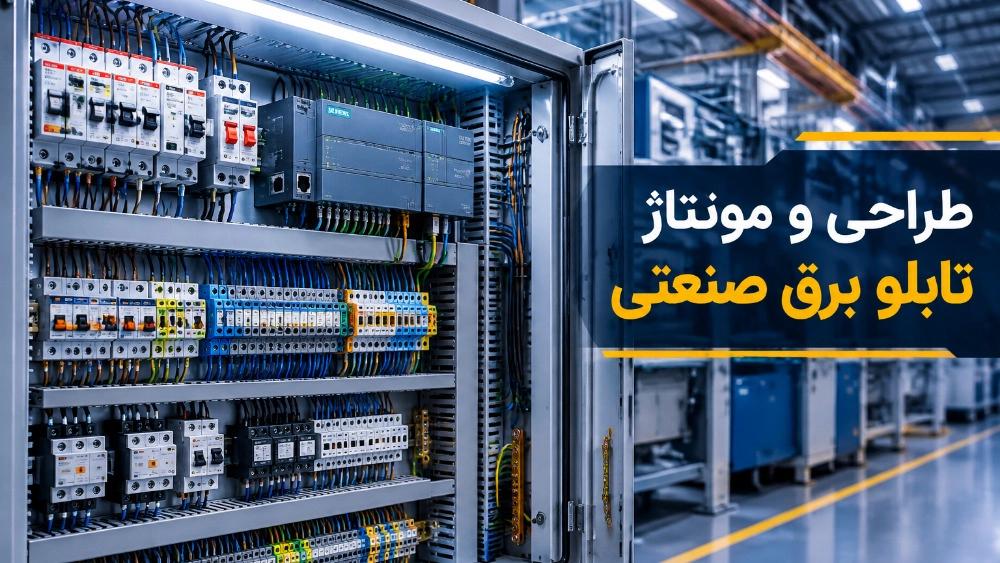


In today's world, industrial electricity is one of the most important infrastructures for the activity of factories, production workshops, assembly lines, commercial complexes and industrial units. The correct operation of electrical equipment, the safety of employees, the stability of production processes and the reduction of maintenance costs are all dependent on the quality of the power distribution and control system. Meanwhile, design and assembly of industrial switchboards plays a very important role in energy management, equipment protection and precise control of industrial processes.
Industrial electrical switchboard is a set of electrical, protection, control and measurement equipment that are installed in a suitable enclosure and are responsible for the distribution of electrical energy, control of machinery and protection of circuits. Irregular design or improper assembly of these panels can cause equipment temperature to rise, circuits to be cut unintentionally, damage to expensive devices, and even dangerous accidents.
For this reason, it is very important to choose an expert group for the design and assembly of industrial electrical panels. smart power technical and engineering group, focusing on electrical engineering solutions, basic design and implementation of industrial projects, can be considered as one of the options to be considered for businesses that are looking to build electrical panels that suit their technical and operational needs.
In this article, we will review the stages of design, equipment selection, assembly, testing, related standards, and the important points of contractor selection so that you can make a more specialized decision for your project.
What is industrial switchboard design and assembly and what is its use?
The design and assembly of an industrial switchboard is an engineering process that begins with examining the electrical and operational needs of a complex and continues until the selection of equipment, the preparation of drawings, the construction of enclosures, wiring, testing and final delivery.
The purpose of this process is not just to put some switches and contactors inside a metal box; Rather, a safe, reliable, suitable to environmental conditions and maintainable system should be created.
The most important applications of industrial switchboards
Industrial electrical panels have various uses according to the type of equipment and project needs, including:
- Power distribution: Distribution of electrical energy between consumers and different circuits.
- Control of electric motors: Starting, stopping and controlling the operation of industrial motors.
- Electrical protection: Protection of circuits and equipment against overload, short circuit and other anticipated errors.
- Industrial automation: Process control using PLC, Control relays, sensors and communication equipment.
- Energy management: Measuring electrical parameters and helping to identify unnecessary consumption.
- Controlling pumps and fans: Managing equipment performance in facilities, food industries, industrial buildings and production lines.
According to the different needs of each industry, the design and assembly of the industrial switchboard should be done based on the actual specifications of the project, not just using a fixed pattern for all applications.
Why is it necessary to comply with standards in the design and assembly of industrial electrical panels?
Technical standards provide a framework for designing, manufacturing, testing and evaluating the safety of electrical panels. Compliance with relevant requirements helps reduce electrical hazards, increase reliability and improve manufacturing quality.
In the design and assembly of industrial switchboards, choosing the right standard depends on factors such as working voltage, rated current, type of switchboard, installation environment, possible short circuit level, and equipment application.
IEC 61439 standard
The IEC 61439 standard series is an important international reference for low pressure switchboards and switch and control assemblies. This standard covers topics such as design specifications, electrical characteristics, temperature rise, short circuit endurance, insulation distances and verification requirements.
In a professional project, it should be determined which part of this standard applies to the board in question and how the related requirements are evaluated. For example, the requirements of power distribution boards and control boards may be different according to their structure and application.
IEC 60204-1 standard
The IEC 60204-1 standard is related to the safety of electrical machinery equipment. In projects where the switchboard is part of a machine or production line, it is important to pay attention to this standard along with the requirements related to the switchboard.
Things like control circuits, protection, emergency stop in related applications, wiring and electrical documentation should be checked according to the scope of application and safety requirements.
IEC 60529 standard and IP degree of protection
The degree of IP protection determines the degree of protection of the equipment enclosure against the entry of solid objects and water penetration. Choosing the right degree of protection should be done according to the installation location, the amount of dust, humidity, the possibility of splashing water, and the washing conditions of the environment.
For example, a panel installed in a clean electrical room may require a different degree of protection than a panel installed in a humid or dusty industrial environment.
Importantly, the IP rating alone does not indicate resistance to chemicals, corrosion, impact, or all environmental conditions. These factors should also be examined separately.
Other standards and technical requirements
According to the type of project, other standards and requirements may be required; including standards related to protection against electric shock, disconnecting and connecting equipment, electromagnetic compatibility and national electrical regulations.
Therefore, in the design and assembly of the industrial switchboard, the standards should be specified according to the application, the employer's requirements and the applicable regulations. Merely including the name of a standard on the map or sign plate alone does not prove the complete compliance of the product with it.
The stages of designing and assembling industrial switchboards in principle
To achieve a reliable result, the implementation of the project should be based on a specific engineering process. Each step determines the information and requirements of the next step.
1. Investigating project needs and gathering information
The first step is to know the operating conditions. Before starting the design and assembly of the industrial switchboard, the following information should be collected:
- Power grid voltage and frequency
- Consumer current and equipment power
- Number of electric motors and their starting method
- Possible short-circuit current at the installation site
- Type of electrical loads and operating conditions
- Ambient temperature, humidity and dust level
- Installation space and dimensional limitations
- Control requirements and Automation
- maintenance conditions and possible future development
The more accurate the initial information, the less chance of wrong equipment selection and costly changes in later stages.
2. Preparation of electric maps and control circuits
After collecting information, engineering drawings are prepared. These drawings are the main basis for construction and assembly and must be sufficiently accurate and understandable.
Required maps can include the following according to the complexity of the project:
- Single-line power distribution map
- Power circuit map
- Command circuit map
- Internal wiring map
- Equipment location map
- Parts list and technical specifications
- Map of terminals and external connections
In the design and assembly of industrial switchboard, coordination between power circuit map, control circuit and physical placement of equipment is essential. Any discrepancy between the plan and the actual construction can make it difficult to diagnose, repair and develop the system.
3. Calculation of nominal current and selection of protective equipment
Choosing protective equipment should be based on engineering calculations. The load flow, cable specifications, short circuit current, consumer type and operating conditions play a role in this decision.
For example, it is not enough to choose a protection key based only on the rated current of the consumer. The breaking strength of the switch should be compatible with the expected short-circuit level, and the protection coordination with other equipment should also be checked.
In panels with motors, the selection of equipment should be done according to the starting current, starting method, load conditions and motor protection requirements.
4. Housing design and equipment placement
The enclosure of the panel should be suitable for the project in terms of dimensions, strength, ventilation, degree of protection and access for repairs.
Equipment placement is very important in the design and assembly of industrial switchboards. Equipment such as main switches, contactors, relays, power supplies, PLC and terminals should be installed in a way that allows for neat wiring, proper heat dissipation and safe access.
Attention should also be paid to the proper separation of power and command circuits, the path of entry and exit of cables, the space for bending cables and the possibility of installing equipment in the future.
5. Equipment installation and mechanical assembly
After confirming the drawings and preparing the chamber, the equipment installation operation begins. Mounting rails, trays, wiring ducts, busbars and other mechanical components are implemented according to the plan.
At this stage, it is important to observe the installation distances recommended by the equipment manufacturer and use the appropriate tools. Improper installation can cause mechanical damage, decrease the quality of connections or difficulty in periodic services.
6. Wiring and numbering of circuits
Wiring should be done as per approved drawings. The cross-section of the conductors, the type of insulation, the method of passing the wires and the thermal conditions must be in harmony with the current of the circuit and the installation conditions.
Numbering wires and terminals is also a necessary measure. This allows technicians to identify the path of the circuit faster, and when an error occurs, troubleshooting can be done more accurately.
In the design and assembly of industrial electrical panels, the use of appropriate wire, standard press tools, correct connections and tightening torque recommended by the manufacturer plays an important role in the final quality.
7. Quality control and panel testing
Before delivery, the panel should be checked according to the inspection and testing program according to its design. The purpose of this step is to identify possible errors before the board enters the operating circuit.
Common checks include:
- Checking the compliance of equipment with the map and parts list
- Checking the strength of the installation and wiring quality
- Checking the protective connections and continuity of the earth circuit
- Checking the accuracy of the numbering of the wires and terminals
- Testing the operation of the control circuits
- Checking the performance of the protective equipment within the permitted test range
- Performing the necessary electrical tests according to the relevant standard
- Checking the specification plate and documents Technical
The type and scope of tests should be appropriate to the type of board, standard requirements and defined verification method. Also, a distinction should be made between design tests and routine product tests.
8. Delivery, documentation and support
After confirming the results of the tests, the panel is delivered to the employer along with the necessary technical documents. These documents may include final drawings, equipment list, operation and maintenance instructions, test results, and consumable parts information.
Proper documentation makes future repairs, component replacements, and system development faster and more accurate.
The main equipment used in industrial switchboards
The quality of industrial switchboard design and assembly depends to a large extent on the correct selection of equipment. Each part must be checked in terms of technical specifications, environmental conditions and coordination with other components.
Automatic and miniature keys
Protective switches are used to break the circuit under certain conditions such as overload or short circuit. Their selection should be based on rated current, protection characteristics, breaking power and coordination with other circuit components.
Overload contactor and relay
Contactors are used to make and break power circuits, especially in motor applications. Overload relays also play a role in protecting the motor against overload. These equipments should be selected according to the type of load and operating conditions.
Remote control drive and soft starter
The remote control drive provides the possibility to adjust the engine speed and in appropriate applications it can help to optimize the performance of the equipment. The soft starter is also used to reduce the stresses caused by starting the engine in specific applications.
Choosing each depends on the required torque, type of load, number of startups and control needs.
PLC and automation equipment
In automatic systems, PLC, input and output modules, sensors, interface relays and communication equipment can form an important part of the board. The design of this section must be in harmony with the control logic of the process and safety requirements.
Busbars, terminals and grounding equipment
Busbars and connections must have the required flow capacity and thermal and mechanical endurance. Appropriate terminals and the correct implementation of the ground connection are also effective in the safety and reliability of the system.
Factors affecting the price of industrial electrical panel design and assembly
The price of manufacturing an industrial switchboard depends on a set of technical and executive factors. For this reason, announcing the exact price without knowing the specifics of the project may be misleading.
1. Type and dimensions of the board
Simple switchboards usually differ from motor control or automation panels in terms of equipment count and complexity. Chamber dimensions, number of cells, and internal isolation requirements also affect cost.
2. Equipment brand and specifications
The brand, capacity, protection features and performance level of the equipment can determine a significant part of the final cost. The selection of equipment should be done according to technical requirements, market inventory, services and project budget.
3. The complexity of the power and steering circuit
The more inputs and outputs, control circuits, motors under control and communication equipment, the more design, assembly and testing time increases.
4. Standard requirements and testing
Requesting additional tests, extensive documentation, specific employer requirements or difficult environmental conditions may increase the cost of project implementation.
5. Installation and commissioning
The final cost may include design, fabrication, shipping, installation, cabling, commissioning, and operator training. It is better to clearly define the scope of services and responsibility of each party before entering into a contract.
To get an accurate estimate from the smart power technical and engineering group, it is suggested that information such as the type of panel, consumer power, number of motors, level of automation, installation conditions, and available maps be provided to the technical unit. A valid estimate should be prepared based on the actual needs of the project and the specifications of the equipment.
The characteristics of a professional executive for the design and assembly of industrial electrical panels
Choosing the right contractor is not limited to the price offered. Engineering quality, assembly accuracy, documentation and response after delivery are also important in the long-term performance of the panel.
When choosing a manufacturing company, check the following:
- Ability to prepare and present engineering drawings
- Familiarity with related standards and safety requirements
- Choose equipment according to project specifications
- Regular execution of wiring and circuit numbering
- Perform quality control and appropriate tests
- Provide final documents and test results
- Transparency in announcing costs and delivery time
- Ability to provide technical services and support
Why check the technical and engineering group of smart power?
For employers who intend to order the design and assembly of industrial electrical panels, cooperation with a technical group can simplify the decision-making process and project implementation. smart power technical and engineering group can be evaluated in the list of options to check the needs of the project and receive a technical proposal.
In choosing this set or any other contractor, it is better to check the examples of related projects, technical resume, quality control method, specifications of the proposed equipment, deliverables and support conditions. Also, requesting a detailed pre-invoice will help you compare the cost of equipment, design, assembly and ancillary services more clearly.
The ultimate goal should be to choose a solution that, in addition to responding to the current need, is also appropriate in terms of safety, repairability, expansion and cost of ownership in the long term.
The role of new technologies in the design and assembly of industrial switchboards
Developments in industrial automation and digitization of production processes have provided new possibilities for the design and operation of electrical panels.
Intelligent equipment monitoring
Using measuring equipment and monitoring systems, it is possible to record and analyze information such as current, voltage, power and the performance status of some equipment. If designed correctly, this data helps to identify problems and plan better maintenance.
Integration with automation systems
Tables equipped with PLC and communication equipment can communicate with industrial control and monitoring systems. This capability allows for more centralized management and collection of operational information in complex production lines.
Modular design and expandability
In projects where there is a possibility of capacity increase or process change, modular design can simplify system development. Anticipating suitable space, equipment capacity and cabling routes from the very design stage will reduce the cost of future changes.
Preventive and condition-based maintenance
A combination of proper measurements, fault recording and periodic inspections can help identify some problems early. However, no monitoring system is a substitute for principled design, proper protection, and proper implementation of safety requirements.
Checklist for ordering industrial switchboard design and assembly
Before placing an order, it is better to prepare the following information:
By preparing this information, receiving a technical proposal and comparing prices will be more accurate, and the possibility of unexpected changes in the construction process will decrease.
Frequently asked questions about industrial switchboard design and assembly
How long does it take to design and assemble an industrial switchboard?
The execution time depends on the complexity of the drawings, the number of equipment, the inventory of parts, the dimensions of the board, the test requirements and the installation conditions. After reviewing the project specifications, a more realistic schedule can be provided.
Should all industrial switchboards be manufactured according to IEC 61439?
The application of the standard depends on the type of collection, scope of the project and related regulations. For low voltage switchboards, the IEC 61439 standard set is the main reference; But the appropriate part of the standard and the requirements related to the application should be specified.
Is it possible to design a custom electrical panel?
Yes. Many projects require custom design due to differences in power consumption, number of motors, installation space or control needs. The design must be in harmony with the actual information of the project and operating conditions.
What information is required for a price inquiry?
Type of panel, voltage, current or power of consumers, number of equipment, level of automation, environmental conditions and range of required services are among the most important basic information for price estimation.
How to evaluate the quality of the manufactured electrical panel?
Checking drawings, equipment specifications, wiring quality, numbering, ground connection, related test results and final documents are the main ways of evaluation. Compliance with the standard must be verified with appropriate technical evidence.
Where to start to order an industrial switchboard?
The best starting point is to list your consumers, network specifications, and control needs. Then you can submit the information to the smart power technical and engineering group for technical review and receive a proposal, and evaluate the technical details and contract conditions before ordering.
Summary: A smart choice to build a safe and reliable industrial switchboard
The design and assembly of industrial switchboards is a specialized process that requires accurate calculations, knowledge of equipment, basic design, regular implementation and quality control. Compliance with relevant standards, correct selection of protective equipment, attention to environmental conditions, proper wiring and necessary tests play an important role in increasing the safety and reliability of the system.
On the other hand, choosing the right contractor should be based on technical quality, transparency of the proposal, documentation that can be provided and the ability to respond to the needs of the project. Comparing offers based solely on initial price may ignore future maintenance and repair costs.
smart power technical and engineering group can be one of the options that can be considered to receive advice and technical proposal in the field of industrial electrical panel design and assembly. It is recommended to specify the project needs in detail before placing an order and get clear information about the proposed equipment, applicable standards, quality tests, delivery time and post-implementation services.
If you need a switchboard suitable for operational needs for your factory, workshop or production line, preparing detailed technical specifications and expert review before construction is the first step to achieve a safe, efficient and expandable solution.