تماس با ما
Industrial blower fan is one of the important equipments in various industries, which is used to move air, provide the required air flow for devices, ventilate the environment and improve the performance of industrial systems. Choosing the right industrial blower fan can play an important role in reducing energy consumption, increasing equipment efficiency, and improving the working environment. For this reason, getting to know the types of industrial blower, applications, technical specifications and important points when purchasing it is very important for managers of factories, production workshops and operators in the field of facilities.
If you intend to buy industrial blower fan, you should check the needs of your collection properly before choosing the product. Factors such as required air volume, static pressure, environmental conditions, air temperature, type of use and energy consumption are influential in choosing the best blower fan. In this guide, we examine the types of industrial blowers and their applications and learn about Shiraz Fan's specialized services in the field of industrial ventilation equipment and fan balance.
What is an industrial blower fan and what is its use?
Industrial blower fan is a mechanical device that uses the power of the engine and the rotation of the propeller to move the air and direct it to the desired direction. Compared to many conventional fans, these equipments are designed to work in industrial conditions and provide the air volume or pressure according to the needs of the system.
Industrial blower fan is used in factories, workshops, food industry, metal industry, ventilation systems, production lines, heating and cooling equipment and many industrial environments. The correct selection of this device will ensure that the required air is supplied to the equipment with the right pressure and flow rate and the performance of the system will improve.
Among the most important applications of industrial blowers, the following can be mentioned:
- Providing fresh air for production lines and industrial environments
- Helping ventilation and air circulation in factories and workshops
- Providing combustion air for some industrial furnaces and burners
- Air transfer in drying and cooling systems
- Helping the performance of suction and dust removal systems
- Using in industrial air conditioning equipment
- Providing air flow The need for production machines and devices
Of course, it should be noted that the choice of blower fan for each application depends on the technical specifications of the system. For example, the technology used to ventilate a production hall is not necessarily suitable for transporting air in a long path with high resistance.
Types of industrial blowers
Industrial blower fans are divided into different categories based on the structure of the propeller, the way air moves, the amount of pressure produced and the type of application. Knowing these categories will help buyers to choose the right option according to their working conditions.
1. Centrifugal blower fan
Centrifugal blower fan is one of the most widely used types of industrial blower fan that moves air using centrifugal force. In this type of fan, the air usually enters from the central part of the propeller and after receiving energy, it is directed in the radial direction towards the outlet.
One of the important advantages of the centrifugal blower fan is the possibility of designing it for different pressure and air flow conditions. For this reason, this equipment is used in many production lines, industrial ventilation systems, suction equipment and air transfer devices.
The applications of the centrifugal fan are:
- Industrial and workshop ventilation systems
- Air suction and discharge equipment
- Factory production lines
- Furnaces and some heating equipment
- Air transmission systems in paths with pressure drop
- Wood, metal and food industries
When buying a centrifugal blower, you should pay attention to the type of impeller, diameter of the impeller, engine speed, required pressure, aeration volume and environmental conditions. Also, the exact balance of the propeller is very important; Because imbalance can cause vibration, increased noise and premature wear of parts.
2. Axial blower fan
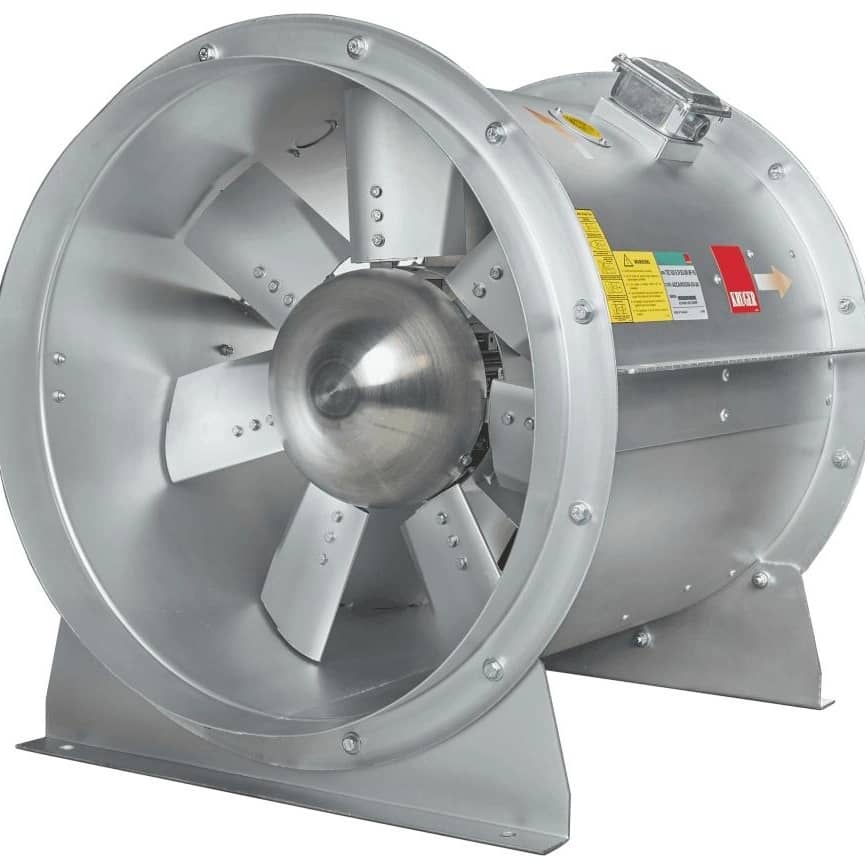
The axial or axial blower fan moves the air almost along the axis of rotation of the propeller. This type of fan is considered a practical option for applications that need to move a suitable volume of air in a straight path.
The axial blower fan is used in many ventilation systems of halls, warehouses, workshops and industrial environments. Of course, the amount of pressure that can be provided depends on the design of the fan and its working conditions, and all axial models are not suitable for paths with high resistance.
Among the advantages of this type of industrial blower fan can be mentioned a relatively simple structure, easy installation in some applications and the possibility of moving a large volume of air.
Before buying an axial blower fan, you should check that the device is designed for wall installation, channel or use in special equipment. Also, the sound level, impeller diameter and installation conditions are important factors in choosing it.
3. High pressure blower fan
The high pressure blower fan is designed for applications where the system requires more air pressure than many conventional ventilation fans. In this equipment, the design of propeller, body and engine should be done according to the working pressure and resistance of the track.
High pressure blower fan is used in some industrial furnaces, combustion equipment, air transmission systems, industrial devices and production lines. This type of fan can be a suitable choice in situations where air must pass through resistant paths or equipment with pressure drop.
However, more pressure does not always mean better performance. If the industrial blower fan does not fit the actual system needs, energy consumption may increase or the device may work outside of its proper performance range.
To choose a high pressure blower fan, it is necessary to check the fan performance curve, static pressure, required flow rate and motor power.
4. Two-way blower fan and special industrial blowers
Some industrial applications require blowing equipment with special structures. In this situation, the type of air inlet, propeller design, power transmission and installation conditions become important in choosing the device.
Fans with two-way inlet are used in some centrifuge designs to increase the aeration capacity. This structure must be compatible with the system and installation space requirements.
Also, in some applications, the industrial blower fan must have the ability to work at a certain temperature, dusty environments or special working conditions. In such cases, the material of the body, the type of bearing, the design of sealing and the specifications of the engine should be carefully checked.
What is the difference between an industrial blower fan and a suction fan?
Blower fan and suction fan help to move air in terms of overall performance, but the purpose of using them in the system may be different.
A blower fan is usually used to provide air and direct it to an environment or device. On the other hand, the suction fan is used to remove air, collect pollutants or transfer polluted air from one point to another.
For example, in a production line, a blower fan may supply the required air to the device, and a suction fan simultaneously removes polluted air or dust from the environment.
The important point is that the type of fan alone does not determine the final application. Many centrifugal fans can be used in blow or suction systems, depending on the design and installation method. Therefore, when buying an industrial blower fan, you should consider the required performance of the entire system.
The most important points when buying an industrial blower fan
Choosing an industrial blower fan based only on the price or appearance of the device is not the right decision. To achieve proper performance, a set of technical specifications and working conditions must be checked.
1. Determining the required aeration volume
Aeration volume or air flow determines how much air the fan moves per unit of time. This parameter is usually expressed in units such as cubic meters per hour or cubic meters per second.
If the capacity of the blower fan is less than the system requirement, not enough air will reach the device. On the other hand, choosing a fan that is too big can increase the purchase cost and energy consumption.
For this reason, first the required air volume of the system should be determined and then the appropriate fan should be selected.
2. Check static pressure
Static pressure is one of the most important parameters in choosing an industrial blower fan. The path of channels, filters, elbows, valves and other components of the system can create resistance against air movement.
In such a situation, the fan must have the ability to provide the required flow in the working pressure of the system. Comparing the nominal pressure of fans regardless of their performance curve may lead to incorrect selection.
For complex industrial applications, it is very important to calculate the path pressure drop before buying a blower fan.
3. Choose the right engine
The motor is one of the main components of the industrial blower and must be compatible with the working conditions of the device. Engine power, rotation speed, efficiency, start-up method and electrical conditions of the installation site are among the things that should be checked.
Choosing a motor with an inappropriate power may increase power consumption or poor performance of the device. Also, in continuous applications, the quality of the engine and the ability to work in the specified conditions are very important.
In some systems, the use of a remote control drive can provide the possibility of adjusting the air flow rate and optimizing energy consumption; Of course, this issue depends on the compatibility of the engine, fan and working conditions.
4. Attention to the material of the body and propeller
The material of the body and propeller should be selected according to the environmental conditions. For example, the presence of humidity, high temperature, abrasive particles or corrosive substances can affect the life of parts.
In industrial environments where the air contains dust or various particles, the type of propeller and the resistance of parts against working conditions should be carefully checked. Also, if you need to move air with high temperature, it is necessary to choose the right material and design.
As a result, when buying an industrial blower fan, in addition to the capacity of the device, the actual conditions of the installation environment should also be considered.
5. Sound and vibration check
Abnormal noise and excessive vibration can be a sign of problems such as propeller imbalance, bearing failure, shaft misalignment or improper installation.
An industrial blower fan with proper balance usually has more stable performance and less vibration. For this reason, manufacturing quality, assembly accuracy, and repair and balance services are considered important criteria in choosing an industrial equipment supplier.
Collections that are active in the field of balancing rotating equipment can play an effective role in maintaining the fans properly and reducing problems caused by vibration.
6. Checking the cost of purchase and maintenance
The price of an industrial blower fan depends on various factors such as the type of fan, ventilation capacity, working pressure, engine power, components and quality of construction. For this reason, it is not possible to consider a fixed price for all models.
When buying, in addition to the initial cost, you should also check energy consumption, access to spare parts, repair costs, and the possibility of periodic service.
Sometimes buying an industrial blower fan with good manufacturing quality will result in lower maintenance costs in the long run than a cheaper option but not suitable for working conditions.
Application of industrial blower fan in different industries
Industrial blower fan is used in various fields and its correct selection can affect the quality of equipment performance.
Manufacturing industries and factories
In factories, blower fans are used for ventilation, air supply for production processes, cooling and air transfer. The type of fan should be determined based on the conditions of the production line and the amount of air required.
Wood industries and carpentry workshops
In the wood industry, air flow is important for environment ventilation and in some systems for transporting particles and dust. In these applications, the right fan should be selected with the suction system, filters and dust conditions.
Metal industries and furnaces
In some thermal processes and industrial furnaces, the blower fan is responsible for providing the required air. In these applications, working pressure, ambient temperature and compatibility of equipment with operating conditions are particularly important.
Industrial ventilation systems
In industrial buildings, production halls and warehouses, the blower fan can be used to provide fresh air and air circulation. Correct choice of fan capacity helps to improve ventilation and reduce energy loss.
Why is propeller balance important in industrial blower fan performance?
The propeller is one of the main components of the industrial blower fan, and any mass imbalance in it can cause vibration force when rotating. This vibration may put pressure on the bearings, axis, joints and other components of the device.
Among the signs that require a technical inspection of the blower fan, the following can be mentioned:
- Abnormal vibration of the body or fan bases
- Increasing the noise of the device during operation
- Frequent failure of the bearings
- Loose connections due to vibration
- Decreasing the stability of the device operation
Of course, any vibration is not necessarily caused by the lack of propeller balance. Bearing failure, shaft misalignment, foundation problems, and other mechanical issues can also cause vibration; Therefore, accurate diagnosis of the cause is necessary before carrying out repairs.
Shiraz Fan; Accompanying industries in the field of balance and industrial ventilation equipment
Shiraz Fan is an active group in the field of dynamic and static balancing of rotating equipment, which provides services related to fan blades, rotors, shafts and other industrial parts. Choosing an expert group to check and balance the equipment can help reduce vibration and increase the stability of the operation of industrial devices.
If you use an industrial blower fan, centrifugal fan or ventilation equipment in your collection, pay attention to the state of the impeller and rotating parts in the device maintenance program. Timely handling of mechanical problems can reduce the possibility of unwanted stoppage of the production line and repair costs.
To choose an industrial blower fan, it is better to first determine the required working conditions, flow and pressure, and then choose the appropriate option according to the technical characteristics of the equipment. Getting to know the specifications of the fan and paying attention to related technical services helps to make a more accurate decision.
To get more information about industrial balance services and related equipment, you can visit the Shiraz Fan website at https://shirazfanbalance.com/ and check the required specialized information according to the needs of your collection.
summary
Industrial blower fan is one of the important equipment in ventilation systems and production processes, which is used to supply air, create proper flow and support the operation of industrial devices. Centrifugal, axial, and high pressure fans are common types of these equipments, and each of them has a different application according to the design and working conditions.
To buy an industrial blower fan, you should check factors such as aeration volume, static pressure, motor power, impeller material, environmental conditions, vibration level and maintenance cost. Choosing the right fan can help improve system performance and manage energy consumption.
It is also important to pay attention to periodic service and propeller balance to increase the stability of rotating equipment. By providing dynamic and static balance services for industrial parts, Shiraz Fan can be one of the options to consider for collections that need specialized balance services. Before making the final choice, carefully evaluate the technical specifications of the device and the real needs of your system in order to get the best result from buying an industrial blower fan.