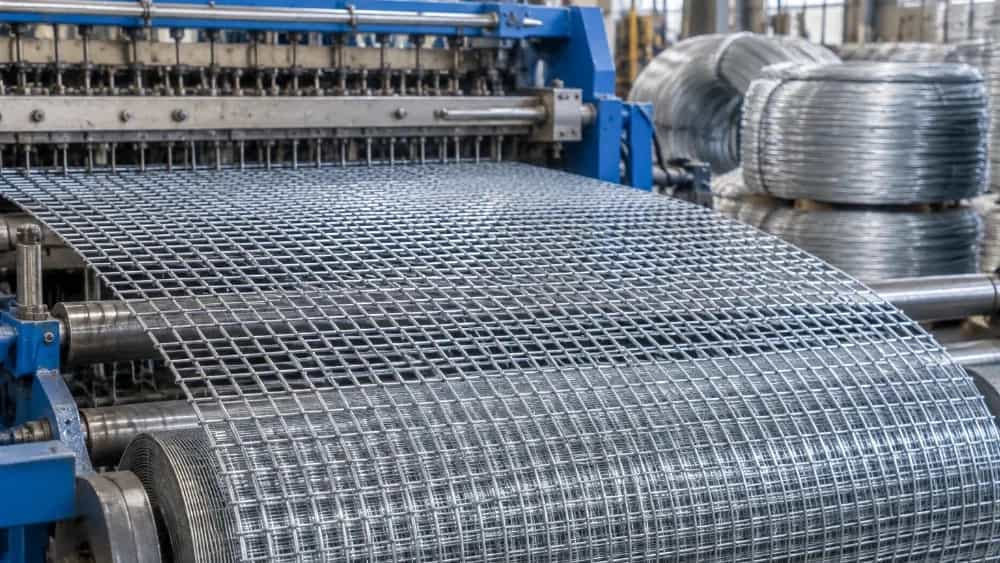

Production of galvanized mesh and resistant wire in Tehran requires precise stretching of steel rebar, continuous acid washing and hot galvanizing with a minimum zinc coating weight of 240 grams per square meter. Ektatori delivers these products based on high tensile strength of 450 to 650 megapascals in the form of rolls and sheets to manufacturing industries. This engineering structure prevents rusting, deformation due to heavy workshop vibrations and corrosion caused by soil moisture and acid gases.
In construction projects and facilities located in the industrial towns of Tehran province, such as Shamsabad and Abbasabad, many purchasing managers report that non-standard nets in less than 18 months suffer from deep rusting and fracture of springs due to weak electrogalvanized coating. Our field experience shows that the difference in the initial price of cheap raw materials becomes completely ineffective as the costs of periodic replacement and stopping of safety lines increase.
Technical criteria for measuring the quality of industrial resistant wire
Hard and standard cable must have two characteristics of proper elasticity and high yield strength at the same time. The wire warping test or so-called axial twisting shows whether the base rebar has obtained a homogeneous crystal structure after the annealing process or whether it is crushed in sudden loading. A wire whose carbon percentage is not accurately measured will crack in the texture of the fine mesh springs or fence mesh knots.
Another key factor is the uniformity of the hot dip galvanized coating along the length of the coil. In factories with traditional methods, the freezing slope of the molten zinc bath leads to the uneven thickness of the surface layer. In industrial workshops equipped with a nitrogen blowing system and continuous mechanical cleaning, the protective layer is uniformly stabilized to increase the resistance against salt spray in salt spray tests to more than 700 hours.
Types of industrial nets produced in Tehran and their use
Each industrial environment requires a specific pattern of the texture and dimensions of the spring to ensure ventilation flow, mechanical shock tolerance or particle filtration.
Fence netting with thick wire and heavy zinc coating
Heavy fence netting is mainly used to enclose the premises of chemical factories, petrochemicals and open raw material storage. This model is irradiated with a wire diameter of 3 to 4 mm and springs of 5 to 7 cm. The use of hot galvanized wire with strong end knots prevents the strands from breaking under the lateral pressure of strong winds in the southern plains of Tehran.
Anti-abrasion wavy press lace
In the sand mines and granulation silos around the capital, the screen has a critical role in the screening process. The continuous vibrations of the wires cause a strong vibration to the wire. The sinusoidal shaping before the weave causes the knots to lock together and reduces the friction wear between the strands to zero. This structure absorbs and depreciates continuous dynamic loads without the need for welding.
Welded mesh netting with standard shear resistance
Prefabricated rebar mesh is used as floor reinforcement in heavy production halls, storage lines with high-tonnage forklifts, and industrial pools. The point-to-point resistance welding process in Ektatori guarantees that the connection between the longitudinal and transverse wires against the tensile shears of concrete is higher than the standards of the ninth subject of the National Building Regulations.
Challenges of Tehran iron market and direct supply of factories
Continuous supply of raw materials with specific grades such as RST34 and 1006 is one of the most complex issues of the capital's industrial workshops. The quality fluctuations of the tensile wires in the Shadabad market and the mechanical iron market often make the major buyers face the dimensional heterogeneity. A fluctuation of one-tenth of a millimeter in the caliber of the wire disturbs the settings of the punching and automatic weaving machines and causes a severe variation in tonnage.
Iktatori maintains the wire diameter tolerance within the standard range by establishing the input quality control system from the rolling origin and using the hard metal dozing process. Direct sending of orders based on accurate technical needs assessment and without the involvement of various brokers, reduces the financial burden and ensures the receipt of uniform alloy for the units located in Khavaran, Chahardangeh and Nasirabad industrial towns.
Guide to inspection and quality testing of galvanized mesh before purchase
Purchasing managers must perform three simple but decisive tests as a workshop acceptance test before delivering the goods. First, coating thickness measurement test through calibrated electromagnetic portable devices that record the amount of zinc microns. Any coating value less than 40 microns indicates cold galvanizing or a poor quality process.
The second test is to investigate the behavior of the wire under a bending angle of 180 degrees on a nut of the same diameter as the wire. If the zinc layer peels off from the steel base surface, the intermetallic bonding of the zinc-iron alloy will not occur at the proper temperature and the mesh will be vulnerable to impact. Finally, the geometric symmetry of the springs and the longitudinal tension of the rolls is tested, which prevents distortion during the installation of the structure.