
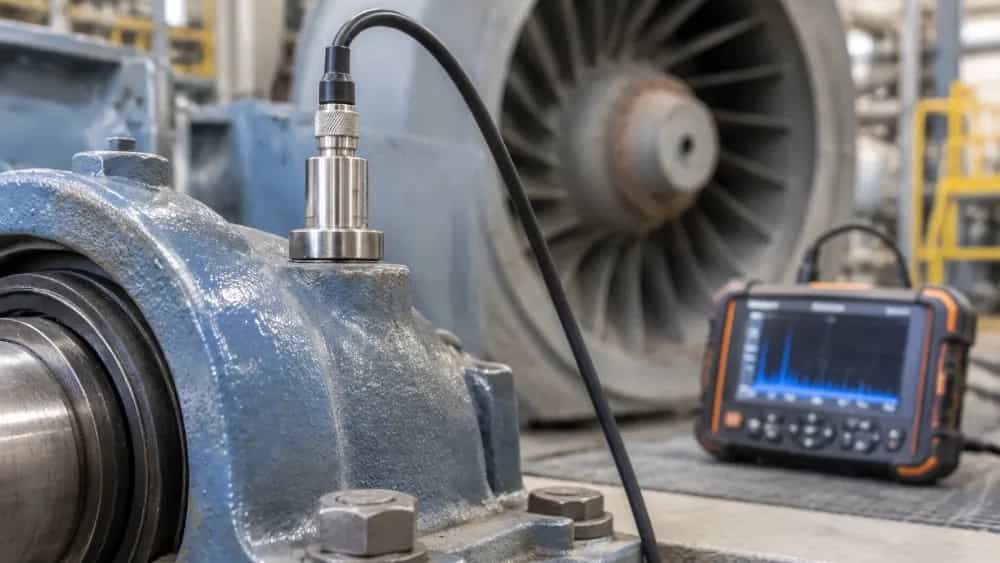

Balancing the fan in place without disassembling and opening the propeller is a method based on condition monitoring and vibration analysis, in which the mass imbalance of the rotor is corrected at the rated operating speed and without the need to transfer the impeller to the turning workshop. In this process, by connecting piezoelectric sensors and optical tachometer to the system, the experts measure the vibration amplitude and displacement phase angle with micron accuracy and install accurate balance weights on the propeller. This technique reduces the stoppage of the production line in factories and industrial workshops in Tehran from a few days to less than a few hours and prevents damage to the bearings, shaft and spiral of the fan.
The cost of opening a centrifugal impeller with a diameter of more than one meter, the rent of a crane in the shed, the risk of the shaft warping during the transfer and the freight fee to the lathe workshops in the south of Tehran, are often several times the cost of the vibration level operation itself. On the other hand, when the propeller on the factory balancer (turning) reaches the so-called zero balance, after re-installation on the factory shaft and coupling with a belt or coupling, due to alignment errors, shaft run-out and aerodynamic effects of the channel, it experiences severe vibration again; A problem that can only be solved by dynamic balance in real operating conditions.
Why is it necessary to balance the fan without opening the impeller in the production line?
In the field visits we had to active factories in Khavaran Road, Shamsabad and Hashtgerd industrial estates, the main reason for premature destruction of bearings and belt burst is not the poor quality of the parts, but the vibration caused by the disturbance of the mass balance of the propeller in working conditions. With the passage of time, factors such as deposition of fatty materials or cement dust, wear caused by abrasive particles and even thermal stress of hot gases change the mass symmetry of the fan.
In the old ways, the fan had to be turned off, the housing cut or opened, the pulleys and belts pulled, and the propeller painstakingly pulled out of line. In addition to the waste of work shifts, the disassembly process imposes asymmetric mechanical stress on the motor shaft and bearings. On the other hand, the implementation of in-situ work allows all the real variables of the system, including the foundation, the bearing base, the chassis and even the resistance of the inlet and outlet air network to be included in the vector calculations.
Operational advantages of portable balance compared to traditional turning method
- Keeping the complete health of the housing and without the need to dismantle the channels or money
- Measuring the vibration behavior of the system at the actual nominal speed and operating temperature
- Zeroing the errors caused by displacement, shaft lagging and reassembly error
- Significant savings in manpower costs, moving equipment rental and production stop
- Simultaneous adjustment of the vibration state In accordance with the requirements of the international standard ISO 1940 and ISO 10816
Technical steps of measuring and correcting vibration in one and two pages
In practice, it has been observed that the mistake of many people in trying to reduce vibration is to close the blind weights and guess which exposes the mechanical structure to fatigue failure. Engineer Khalili's centrifugal fan balance group advances this process based on a standard four-step methodology:
First step: measurement of initial vibration and phase reading
Before any action, accelerometer sensors are magnetically installed on the critical points of bearing housings (horizontal, vertical and axial directions). Simultaneously, an optical or laser sensor reads the reference angular speed (RPM) and phase angle by targeting the reflective label on the shaft. The primary frequency data is recorded and the spectrum diagram or FFT is checked to ensure that the existing vibration is caused exactly by unbalance (1X frequency) and that issues such as mechanical slack, bearing failure or structural resonance are not the cause of the vibration.
Second stage: Implementation of the trial weight test (Trial Weight)
After registering the initial range and phase, the system is turned off and a weight with a certain mass and dimensions is attached to a certain point of the propeller angle. The fan is turned on again and the changes in the vibration vector (the amount of angular displacement and the change in millimeters per second of effective speed or RMS) are recorded. The response of the system to this test weight determines the response rate and vibration coupling matrix for the algorithm.
The third step: calculating the equilibrium mass vector
The fourth stage: final correction and issuance of the vibration certificate
After connecting the weight and collecting the sensors, the system restarts. The final test should show that the overall vibration of the system is within the permissible standard range (often below 2.8 to 1.8 mm/s depending on the fan class in ISO 10816). After the final approval, the vibration data sheet and the technical status report will be issued for the archive of the net unit (maintenance and repairs).
Tehran industrial market challenges and engineering solutions in special projects
Tehran's industrial towns and satellite cities such as Siman Ray, Shoorabad, Simindasht and Chahardangeh impose special conditions on industrial ventilation equipment. In metal recycling and foundry industries, gases with a temperature above 300 degrees Celsius cause the longitudinal expansion of the shaft and structural inhomogeneity of the impeller. The balance of this equipment will be ineffective regardless of the thermal condition of the line, and the fan will vibrate again as soon as it reaches the operating temperature.
Another challenge is irregular wear and sedimentation in the suction systems of carpentry workshops, cardboard production lines and brick kilns. Our workshop investigations show that if the expert team does not scale the riser and clean the fins before installing the weight, the vibration will not be stable. Khalili's centrifugal fan balance, equipped with advanced diagnostic tools, implements on-site balance services for all models of backward, forward, radial blade, utility fans and high pressure exhausters without any structural destruction at the factory site.
