
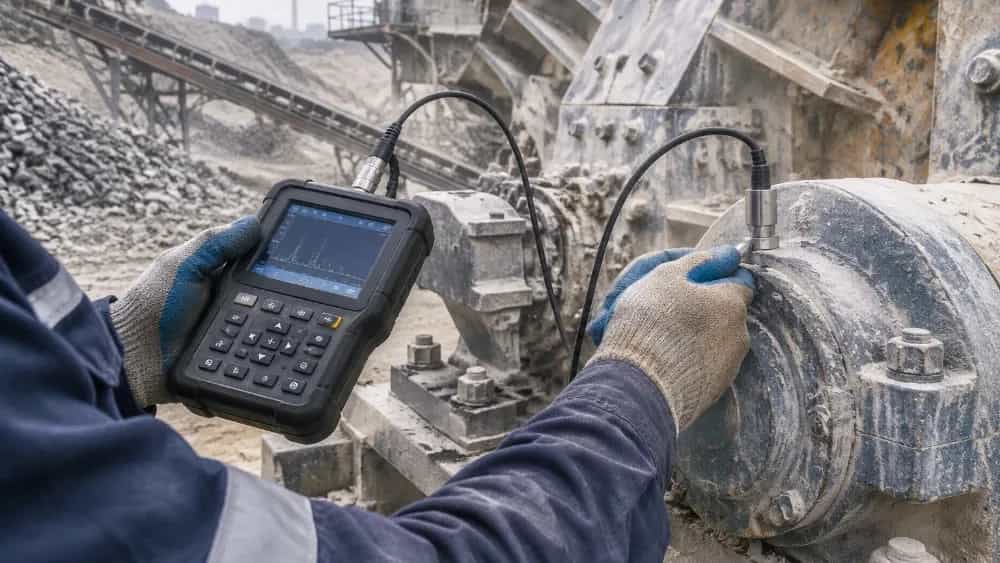

The cost of stone crusher balancing services in mines and asphalt factories in Tehran is calculated based on variables such as the type of stone crusher (Cubit, Hydrocon or Faki), rotor weight, initial vibration level and the need for on-site balancing (without disassembly) or workshop balancing. In the field evaluations, the access factor to the equipment at the mining site and the asymmetric wear rate of the hammers directly affect the number of massing times and the final time of the project. Receiving the specialized services of on-site balance prevents the risks of shaft failure and early bearing burnout and reduces the final cost by 70% compared to stopping the production line for several days.
Fundamental factors in determining the tariff of dynamic balance of stone crushers
Calculation of the final figure of vibration measurement and industrial balance projects is a function of mechanical complexities. In heavy stone crushing machinery, it is not possible to set a fixed default figure, because the wear of impact parts is always random in nature.
Capacity, tonnage and rotational speed of the rotor
The weight and dimensions of the shaft and rotor directly determine the required balance class according to the ISO 1940 standard. Crushers with a higher rated speed or heavy processing tonnage need more precise sensing and higher accuracy in the milligram range. The weight of the rotating part causes an increase in the inertial stress in the working cycles and prolongs the process of curbing the initial imbalance.
The type of material and the rate of erosion of hammers and anvils
In the asphalt factories and sand mines of Tehran province, limestone or passing silica causes uneven wear on the internal surfaces of the rotor. If a part of the body is geometrically corroded due to wear, the technician must stabilize the basic correction mass before the final balance, which changes the time of the work and thus the technical salary.
Economic comparison of on-site balance against complete disassembly
Deciding between portable balancing at the factory or sending the shaft to a lathe and balance shop is the main issue in determining the total cost of the operation. The technical experience in the production lines shows that sending several tons of stone crusher to the workshop, in addition to the high costs of the crane and trolley, brings the risk of the shaft being deformed during transportation.
Eliminating the long-term stoppage of the granulation and asphalt curing line
The cost of stopping a shift of an asphalt plant or a mine in the suburbs of Tehran is far beyond the salary of a vibration technician. In-situ balance using advanced portable equipment has the advantage that without opening the shaft and bearings, the device is tested in real working conditions and returns to the permissible vibration range in less than a few hours.
Measuring vibrations with frequency spectrometer analyzers
In the field process, the frequency spectrum (FFT Spectrum) is first recorded with magnetic accelerometers to distinguish between mass imbalance, mechanical slack, misalignment or bearing failure. Carrying out balance on equipment whose root problem is misalignment or weak concrete foundation is a waste of budget, and initial troubleshooting prevents additional costs from being imposed on technical managers of mines.
Environmental conditions of Tehran mines and its effect on the complexity of operations
Active units in areas such as Shahryar, Quds, Pakdasht, Ray and Abali Road are struggling with special maintenance challenges due to the high concentration of fine dust and severe thermal fluctuations in summer and winter. The penetration of asphalt filler dust into the bearing chamber and the adhesion of bitumen or wet particles on the rotating parts change the dynamic structure of the crusher.
In order to adjust the dynamic behavior, the technician must first remove the unwanted masses attached to the shaft and create stable thermal conditions so that the welded counterweights are not torn due to alternating line stresses. The durability of the balance weights against the impact load of the crushing parts requires different expertise, which is included in the implementation cost.
Return on investment with timely vibration control
Paying for basic balance services is actually a preventive measure to preserve machinery capital. The vibration outside the crusher standard is directly transferred to the metal chassis, concrete foundations, expensive bearings, and driving electric motor, causing chain failures. The implementation of the status monitoring protocol and rotational balance adjustment reduces the electricity consumption of the electric motor by about 10% and significantly increases the useful life of the bearings.
