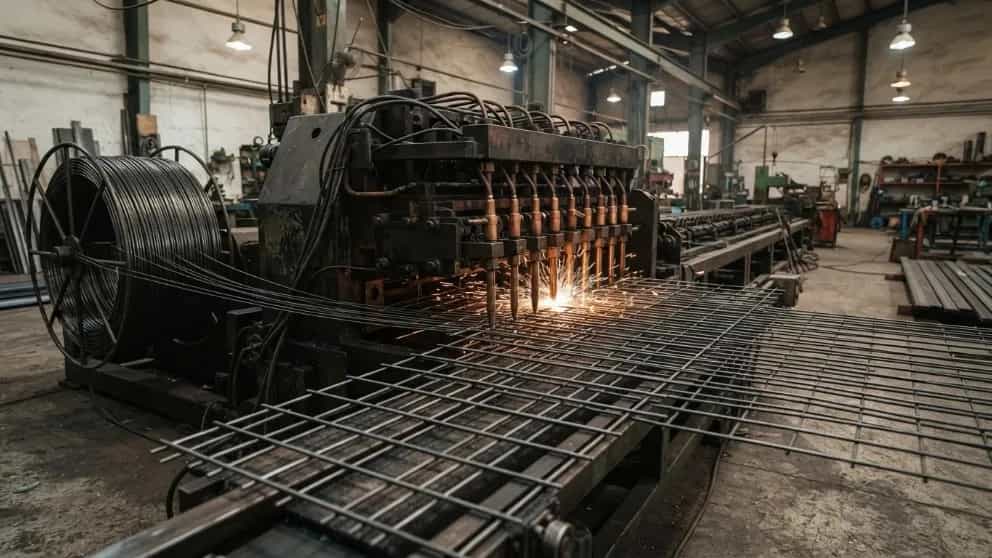
Minai Machinery in Karaj is a direct designer and manufacturer of fully automatic and semi-automatic mesh weaving machines for the production of light and heavy construction mesh nets. The production lines of this collection, using the medium frequency resistance welding system, advanced PLC switchboards and precise servo motor tensioning mechanism, provide the possibility of weaving rebar networks from 2 to 10 mm in diameter with an error of less than half a millimeter. The quick access of industrial factories and buyers to the production unit and construction workshop in Alborz province reduces the risk of supplying parts and stopping the line to zero.
Engineering of mesh netting production line in Karaj industrial workshop
Production of engineering mesh netting requires a strong structure that neutralizes continuous shocks and vibrations caused by the resistance welding process and roll tension in long work shifts. In the design of the chassis of the devices made by Minai Machining, de-stressed heavy industrial profiles are used so that they do not undergo geometric twisting over time.
The experience of manufacturing and operating these machines in the Karaj industrial hub has shown that most buyers face the problem of changing the pitch of the mesh spring at high speeds. To solve this weakness, the transverse and longitudinal rebar feeding system is equipped with a step motor mechanism or servomotors. This allows the distance between the rebars to be maintained in standard dimensions such as 10x10, 15x15 or 20x20 cm with the lowest possible tolerance.
The electrode welding system is designed based on copper-chromium-zirconium alloy metallurgy, which has high thermal resistance and low wear. The perfect coordination between the flow discharge time, the pneumatic pressure of the jacks and the closed water cooling system ensures the strength of the welding point based on the national standard shear tests.
Operational differences of hydraulic and pneumatic mesh weaving machine
Choosing the mechanism for applying pressure on welding electrodes is the most important technical decision in ordering a mesh production line. Pneumatic systems operate with compressed air and have a very high stroke rate per minute, while hydraulic systems are more efficient for thick rebar networks and heavy projects.
Evaluation of the experimental performance of these two mechanisms in high-pressure workshop production lines:
- Pneumatic systems:Very high welding speed up to about 60 strokes per minute, suitable for 2 to 6 mm coiled rods, lower mechanical wear and easier maintenance without oil contamination in the workshop environment.
- Hydraulic systems: Ability to apply high concentrated force to branch rods with a diameter of 8 and 10 mm, regularly eliminating the risk of welding pressure drop during power outage hours, requiring monitoring Hydraulic system and oil unit.
Enamel machinery engineers implement the special design of combined or all-pneumatic jaws with precise proportioning valves according to the production volume and the variety of wire size input of the customers.
Optimization of energy and material consumption in rebar mesh
The cost of industrial electricity and wire waste are the two main challenges of mesh weaving workshops. The welding of traditional single-phase transformers usually imposes heavy demand penalties on the employer due to unbalancing the plant power phases. The use of resistance welding transformers with medium frequency inverter has solved this defect.
With the precise control of the welding time in terms of milliseconds, the phenomenon of molten splashing and burning of the rebar section is eliminated. This not only preserves the tensile strength of the production mesh at the joints according to the requirements of the concrete regulations, but also minimizes the loss of material caused by cutting and narrowing of the wire due to excess heat.
Furthermore, in the enamel designed systems, the dedicated control software has the ability to set the automatic cutting program so that no longitudinal rebar waste is left at the end of the roll or mesh sheet.
The benefits of providing devices and after-sales services from Karaj
Purchasing industrial equipment from a manufacturer that has close geographical access to the country's industrial highways is a permanent operational advantage. Workshops and construction projects in Tehran, Alborz, Qazvin and neighboring provinces can benefit from on-site technical and installation services as soon as possible.
Imported machines or machines made by manufacturers without a dedicated machining workshop stop the production line for months when welding jaws wear out, transformers burn out or traction gears fail. Minai Machinery Manufacturing, relying on the warehouse of spare parts, manufacturing all chassis components in Karaj and providing 0-100 training to the operator at the factory, guarantees the continuity of production lines.
Field testing of the device with the customer's real coil of wire is done before the final delivery so that all the tolerances expected by the buyer are checked and documented on the test table.
Guide to economic efficiency and production capacity of mesh weaving workshop
Economical justification of setting up a mesh weaving line depends on the continuous operation factor of the machine and the output tonnage in each work shift. Lines that require frequent stops to change the size of the spring due to unnecessary complications, greatly reduce the profitability of the factory.
In the devices of this series, the dimensions of the mesh network can be changed using the touch panel in a few minutes, and there is no need to completely open the jaws and readjust the holding screws. The production capacity of the machine varies from 2 to 6 tons per shift, depending on the diameter of the rebar and the distance between the springs. This flexibility allows small and large manufacturers to cover different orders in the fields of foundation, composite roof, water supply channels and precast concrete parts with a single line.
Technical specifications of mesh weaving machines for enameling
Technical parameter | Light mesh knitting machine (coil) | Heavy mesh knitting machine (branch) |
Rebar diameter range | 2.5 to 6 mm | 6 to 10 mm (plain and ribbed) |
Useful working width | 100 to 250 cm | 120 to 300 cm |
Standard spring step | 5x5 to 20x20 cm | 10x10 to 30x30 cm |
welding mechanism | pneumatic short stroke Resistance | Heavy pneumatic / hydraulic |
Dimensional control system | PLC with HMI touch screen | Industrial PLC with servo traction Multiaxial |
Cooling system | Circuit of water and chiller circulation | Continuous radiator circuit |
Longitudinal rebar feeding | Automatic unwinder equipped with tensioner | Automatic branch sorting and loading |