

 https://psbolt.ir

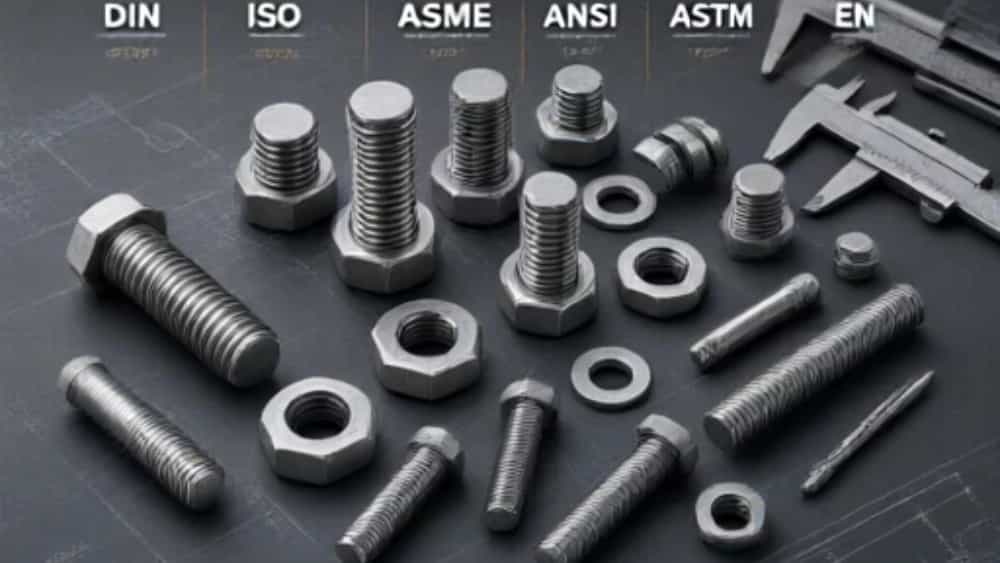
Choosing standard bolts and nuts is one of the most important steps in designing, manufacturing and implementing industrial connections. In different industries such as oil and gas, petrochemical, construction, automobile and machine building, bolts and nuts are produced according to different standards. The most important of these standards are DIN, ISO, ASME, ANSI, ASTM and EN.
One of the challenges of engineers and activists in the field of buying and selling industrial fittings is to recognize the equivalence of bolt and nut standards and convert different standards into each other. For example, an industrial drawing may use a DIN 931 screw, while the supplier offers a product with the ISO 4014 standard.
In such a situation, it is very important to be familiar with the conversion table of industrial bolt and nut standards. In this article, we review the widely used standards of screws, nuts and washers and present their common equivalents in the form of practical tables.
What is the standard of industrial bolts and nuts and what is its application?
A bolt standard is a set of technical requirements that determine the various characteristics of a connection. These specifications can include geometric dimensions, thread type, raw materials, resistance class, surface coating, production tolerance and testing methods.
Using valid standards makes parts produced by different factories comparable in terms of required specifications.
The most important standard applications of bolts and nuts are:
- Determining the exact size and dimensions of bolts and nuts
- Determining the type and pitch of the thread
- Determining tensile and mechanical resistance
- Quality control and checking the properties of raw materials
- Choosing suitable connections for industrial projects
- Preventing incompatibility of parts during assembly
What is the difference between DIN, ISO, ASME, ANSI, ASTM and EN standards?
Each of the industrial standards have been developed with a specific purpose and they cannot all be considered equivalent to each other.
Standard name | Full title | Main scope | Use in bolts and nuts |
|---|---|---|---|
DIN | Deutsches Institut für Normung | Germany | Connection dimensions and specifications |
ISO | International Organization for Standardization | International | Dimensions, threads and mechanical properties |
ASME | American Society of Mechanical Engineers | America | Dimensions and Requirements of Connection Engineering |
ANSI | American National Standards Institute | America | Standardization System |
ASTM | ASTM International | International | Materials, Mechanical Properties and Testing |
EN | European Norm | Europe | European Standards and Technical Requirements |
The important point is that DIN and ISO are more known for determining the dimensional specifications of metric fittings, while ASTM is used in many projects to determine the material and mechanical properties of bolts and nuts. ASME standards also include dimensional specifications and engineering requirements for fittings.
DIN to ISO standard conversion table
DIN and ISO standards are among the most widely used standards in the industrial bolt and nut market. Many old DIN standards have been replaced by ISO standards; However, replacement does not always mean the exact same dimensions.
DIN standard | Equivalent or close ISO standard | Product type |
|---|---|---|
DIN 931 | ISO 4014 | Half-thread hexagon screw |
DIN 933 | ISO 4017 | Hex head screw |
DIN 934 | ISO 4032 | Nut Hexagon |
DIN 125 | ISO 7089 / ISO 7090 | Flat washer |
DIN 127 | ISO 7090 is not a direct replacement | Spring washer |
DIN 912 | ISO 4762 | Cylindrical Allen screw |
DIN 7991 | ISO 10642 | Allen screw |
DIN 985 | ISO 10511 | lock nut with ring Non-metallic |
DIN 7985 | ISO 7045 | Slotted or square head screw with cylindrical head |
Note that dimensions, product class, thread type and standard revision should be checked for exact replacement. Especially in the case of washers and nuts, the similarity of the standard name does not mean a perfect match.
ANSI and ASME American Bolt Standard Table
In American industrial projects, ASME standards and ANSI/ASME thread standards are widely used. These systems are mostly known with inch dimensions and UNC and UNF threads.
Standard | Product Type | Application |
|---|---|---|
ASME B18.2.1 | Hex Bolts | Inch Fittings |
ASME B18.2.2 | Hex Nuts | Industrial nuts |
ASME B1.1 | Unified thread | UNC and UNF thread |
ASME B18.3 | Allen Bolts | Inch Allen Fittings |
ASME B18.21.1 | Flat Washer | Standard Washers |
ASME B18.22.1 | inch flat washer | general connections |
In American standards, UNC thread means coarse thread and UNF means fine thread. Therefore, when converting inch screws to metric, only the diameter conversion is not enough and the thread pitch must also be checked.
ASTM standard table of industrial bolts and nuts
ASTM is one of the most important references for standardization of materials and mechanical properties of bolts and nuts in the oil, gas, petrochemical and industrial structures industries.
ASTM standard | Type of screw or piece | Application |
|---|---|---|
ASTM A193 | Alloy and stainless steel bolts and studs | Connections under high pressure and temperature |
ASTM A194 | Steel nuts and Alloy | Use with industrial screws |
ASTM A307 | Carbon steel screws and studs | Connections General |
ASTM A325 | High strength structural bolt; Old Name | Structural Fasteners |
ASTM F3125 | High Strength Structural Bolts | Steel structures |
ASTM A490 | Strong structural bolt; Old Name | Structural Connections |
ASTM F436 | Hardened Washer | Connections Structural |
ASTM A453 | Temperature Resistant Studs and Bolts | High Temperature Applications |
Important note: Today, ASTM A325 and ASTM A490 are included in the ASTM F3125 standard family, and the corresponding grade must also be specified when purchasing.
EN European standard table for bolts and nuts
EN standard | Product type | Application |
|---|---|---|
EN ISO 4014 | Half thread hexagon screw | Industrial connections |
EN ISO 4017 | Full thread hexagon screw | General connections |
EN ISO 4032 | Hex nut | Metric connections |
EN ISO 4762 | Cylindrical Allen screws | Industrial machinery |
EN 14399 | High strength structural bolt and nut set | Preloaded steel structures |
EN 15048 | Non-preloaded structural bolt assembly | Structural connections |
EN ISO 898-1 | Bolt mechanical properties and steel stud bolts | Strength class |
EN ISO 898-2 | Mechanical properties of steel nuts | Nut resistance class |
Metric to inch bolt and nut size conversion table
One of the common questions when buying industrial bolts and nuts is converting metric to inch size. In the table below, some common metric sizes and their closest inch sizes are given.
Metric size | Diameter in millimeters | Nearest inch size |
|---|---|---|
M6 | 6 | 1/4 inch |
M8 | 8 | 5/16 inch |
M10 | 10 | 3/8 inch |
M12 | 12 | 1/2 inch |
M14 | 14 | 9/16 inch |
M16 | 16 | 5/8 inch |
M18 | 18 | 3/4 inch |
M20 | 20 | 3/4 inch |
M22 | 22 | 7/8 inch |
M24 | 24 | 1 Inch |
M27 | 27 | 1 and 1/16 inch |
M30 | 30 | 1 and 1/8 inch |
Note that the inch sizes in the table are only the nearest nominal diameter and are not equivalent to straight threads. To use inch screw instead of metric, diameter, thread pitch, thread type and tolerance should be checked.
What is the difference between DIN 931 and DIN 933 screws?
DIN 931 and DIN 933 screws are both hex screws, but their main difference is the length of the threaded part.
In newer standards, ISO 4014 is known as a close standard for DIN 931 and ISO 4017 for DIN 933.
What is the difference between metric and inch screws?
Metric screws are produced and measured based on the millimeter measurement system; But the inch screw is determined based on the inch measurement system.
The most important differences between them are:
Feature | Metric screw | Inch screw |
|---|---|---|
Unit of measurement | mm | inches |
designation | M8, M10, M12 | 1/4, 3/8, 1/2 |
Thread System | Metric | UNC, UNF |
Pitch determination | mm | Number of threads in inches |
Application | Metric industries | American industries and some imported equipment |
How to choose the right standard for industrial bolts and nuts?
To choose the right bolt and nut, it is not enough to just know the name of the standard. The technical specifications of the part must match the working conditions of the project.
The most important things to check when choosing are:
- Standard Type: Specify whether the part is required according to DIN, ISO, ASTM or ASME.
- Diameter and Length: The nominal diameter and length of the bolt must be in accordance with the technical drawing.
- Thread Pitch: Check the metric or inch thread type and its pitch.
- Bolt material: Choose carbon steel, alloy steel or stainless steel according to environmental conditions.
- Surface coating: Choose hot-dip galvanized, electric galvanized or other coatings according to corrosion conditions.
- Quality certificate: In sensitive projects, check the material certificate and mechanical test results.
Frequently asked questions about industrial bolting standards
Can DIN screws be replaced with ISO screws?
In some cases, yes; But the replacement should be done by checking the diameter, length, thread pitch, screw head dimensions, resistance class and standard version.
What does the EN standard mean in bolts and nuts?
EN stands for European Standard. These standards determine the technical requirements and specifications of various products, including industrial and structural bolts.
summary
Familiarity with the conversion table of DIN, ISO, ASME, ANSI, ASTM and EN industrial bolting standards will help engineers and industry operators to choose the right fittings more accurately.
Each standard has a specific application; For example, DIN and ISO are mostly used in the field of dimensions and specifications of metric fittings, ASTM in the field of materials and mechanical properties, and ASME in the field of engineering and dimensional requirements of fittings.
The important point is that no standard should be considered equivalent to another standard based solely on the similarity of the product's name or appearance. For accurate replacement, it is necessary to review technical specifications, drawings, material certificates and standard revisions.
تماس و مشاوره
پیچ و مهره صنعتی
تماس و مشاوره
پیچ و مهره صنعتی
Company catalog
Download file