
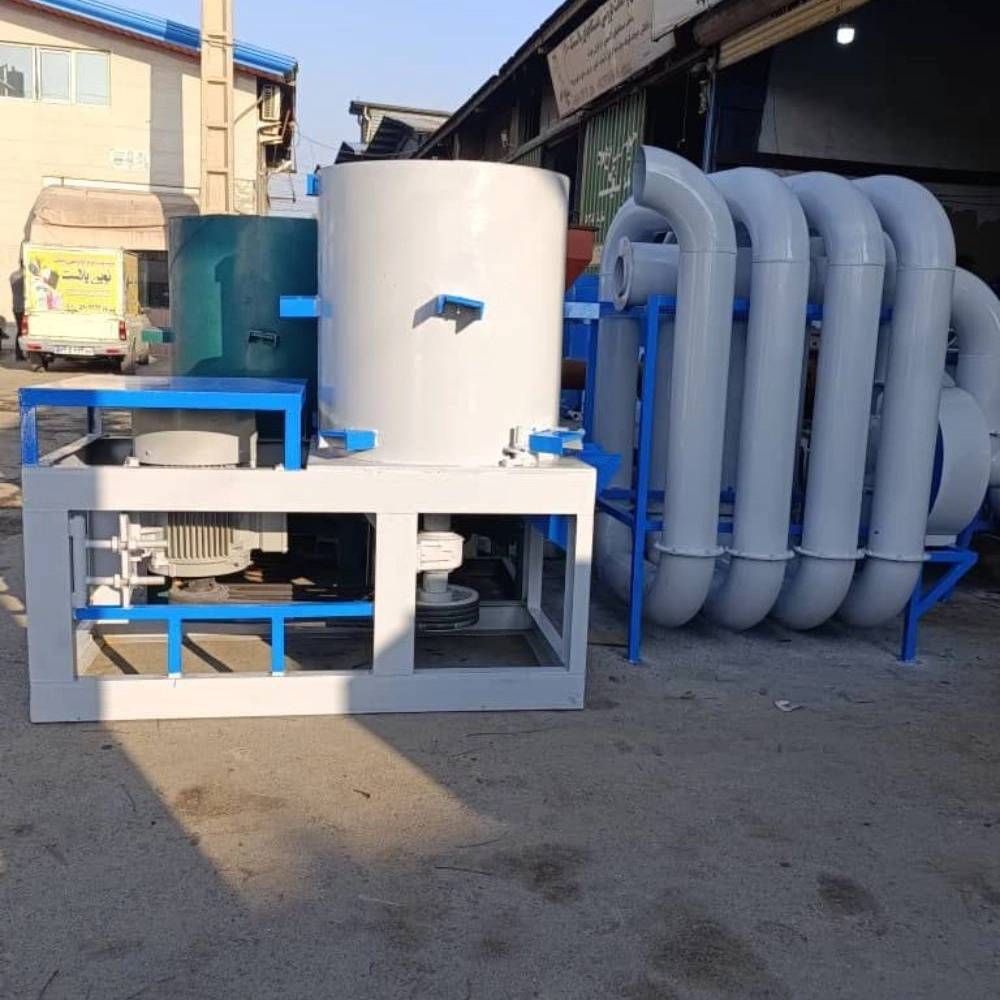

Condor Milling Machine for Nylon and Nylex is made to crush and recycle plastic waste (especially types of Nylon, Nylex, Cellophane, and light and heavy polyethylene). Its performance is based on the friction and impact of the blades at high speed. These blades break the waste into smaller pieces ready for melting, granulation or reuse.
Its function can be explained in several parts:
Incoming materials: Nylon or Nylex wastes are poured into the mill tank from the entrance.
Grinding: the electric motor rotates the shaft and blades at high speed; The collision of fixed and moving blades causes the plastic to be powdered or fragmented.
Output of fine material: the crushed material passes through a net or sieve under the machine (usually a net with an adjustable hole size to control the output size).
Collection: The ground material is collected by the suction system or manually and transferred to the next stage (granulation, washing, drying, etc.)
Engine power: between 15 and 75 horsepower, depending on the capacity of the machine (from 300 to 1000 kg per hour).
Material of blades: anti-wear steel or spring steel with the possibility of resharpening.
Grinding tank: thick steel to prevent vibration and breakage.
Cooling system: in some models to prevent melting of materials during work.
Blade type: 4 to 6 moving blades and 2 fixed blades (depending on the model).
3. Strengths and weaknesses
Advantages
High power in crushing soft and semi-hard materials.
Relatively low wear and blade durability.
Compatibility with all kinds of light plastics (nylon, nylon, cellophane).
Easy repair and service in Iranian models.
Disadvantages
For very hard or thick materials, a stronger grinder should be used.
Lots of noise in models without sound insulation.
May require cooling or periodic shutdown if operated continuously.