
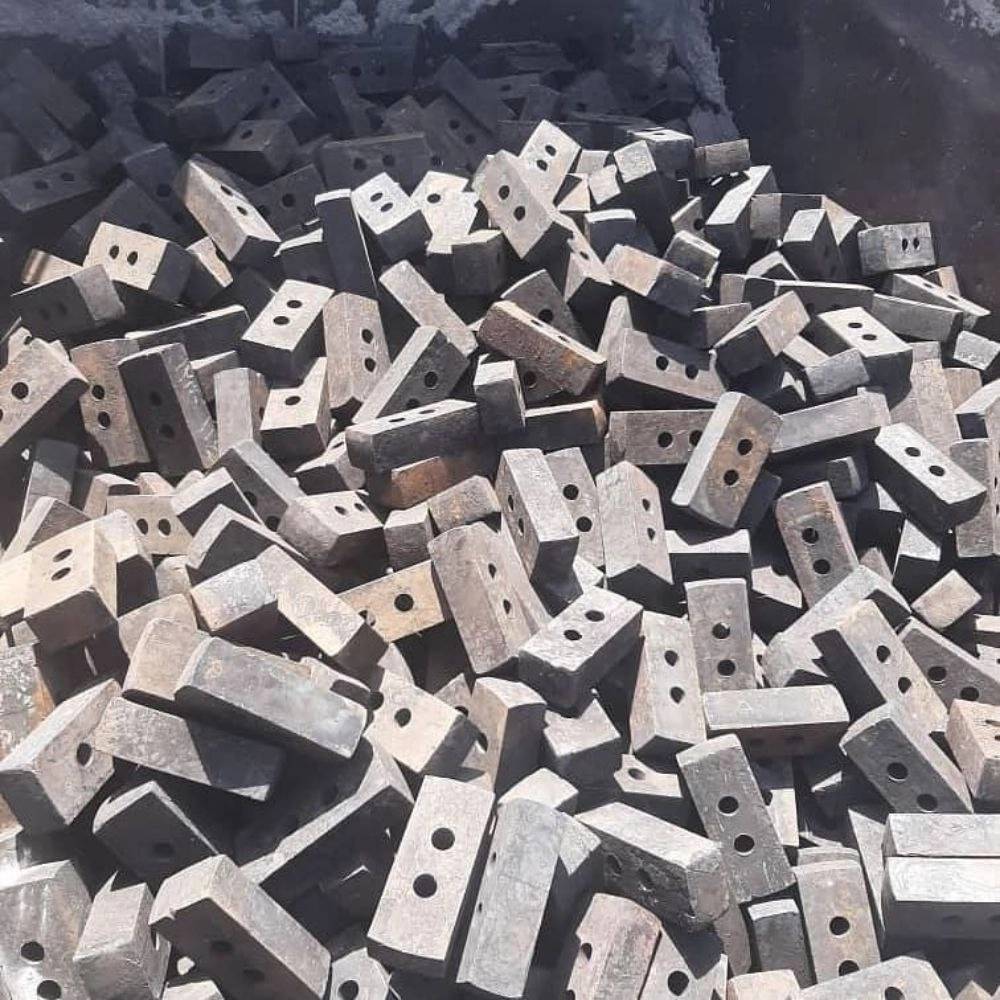

Structure and design of hammer mill
Hammers are usually designed as rectangular, square or hexagonal and are mounted freely (hanging) or fixed on the axis (rotor).
Free hammers (hanging): They are the most common type. These hammers are connected to the bars using steel pins and are tilted outwards by centrifugal force during rotation. This design allows the hammer to rotate on its axis so that its sharp and healthy edge is always engaged in cutting.
Face: The part of the hammer that contacts the material. This surface should have maximum wear resistance.
Holes: The holes through which the pin goes and connects the hammer to the rotor.
Hardness: usually measured in terms of Brinell (HBW). Depending on the material, the hardness can vary from 300 HBW (manganese steel) to more than 600 HBW (high chromium cast iron).
Weight: The weight of the hammer is directly related to the impact energy. In a certain mill, the weight of the hammer determines the amount of crushing energy.
Size and shape: The size of the hammer should be proportional to the size of the mill chamber (Rotor Clearance) and the size of the input material, so that it has the greatest contact surface with the material.
Periodic replacement: Hammers should be checked and replaced regularly due to wear.
Adjusting the direction of rotation: In many hammer mills, the direction of rotation of the rotor is periodically reversed so that all the faces of the hammer are worn evenly and its useful life is increased.
Final product size: In a hammer mill, the final product size is controlled by the rotor speed and the size of the exit mesh holes, not directly by the hammer.