

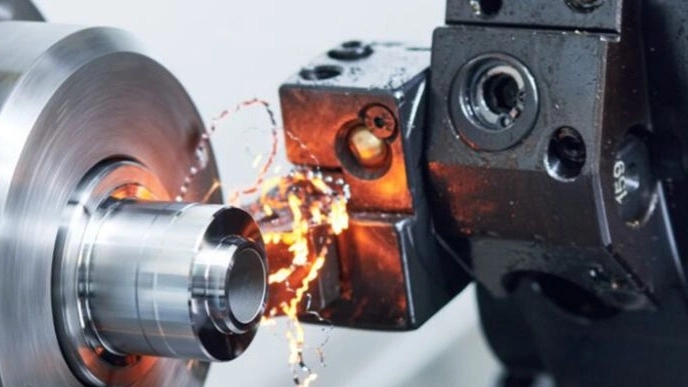
All turning processes from the past until now are performed by the turning machine, which includes four types of conical turning, cylindrical turning, weld inspection and external groove. Single-point cutting tools are used in turning.
All turning processes can produce different shapes of materials such as cylinders, cones, curves or grooves. Turning parts have circular sections, such as simple and non-simple rods, bolted rods, flakes, bushings, and the like, which form the main parts of machines, devices, and technical devices. Also, many tools such as milling cutters, drills, screwdrivers, and drills have round sections. Based on the type of consumption and use that turning parts should have, they are made of various materials such as steel, cast iron, bronze, brass, copper, light metals, wood, or synthetic materials and their analogues.
Among the types of lathes, we can include CNC lathes, special wood lathes, automatic lathes, special lathes, CNC lathes, tool lathes, birdcage lathes, forehead lathes, vertical lathes, Let's mention ordinary lathe and lathe with high working diameter.
Types of turning process
Rotaching
Rotaching is one of the most important and basic machining processes in which the part to be turned rotates and cutting tools such as diamond turning are single-point, parallel to the axis of rotation. they do. Resection can be performed on the internal and external surface of the body.
Conical turning
Conical turning by means of compound slide and by using a hydraulic copy attachment by CNC machine, cutting of amateur lathes is used.
Face grinding
Face grinding uses a single-point grinding tool and by moving in the radius of the work piece, it grinds the face of the work piece until the outer surface of the desired piece is smooth. to be The depth of forehead cutting is less than other turning processes. (Forehead is the beginning or end of the work piece.)
Groove turning
In this turning process, the cutting groove pen penetrates slowly in line with the radius of the piece, and a groove equal to the width of the pen is made on the outer surface of the cylindrical piece. It creates.
Screw turning
For this type of turning process, screw cutters are used using a lathe. Screw cutters, which are part of the form cutters, must have the shape of their cutting edge completely parallel and match the shape of the groove of the screw tooth. Then, by using a special tool and using a conductor rod and using the methods of turning the piece or using a screwdriver, the desired screw is cut.
Treading
Treading is the creation of regular grooves with different shapes along the length of the piece, which is one of the most widely used turning processes
Drilling A drill is inserted axially from the end of the part and cuts the threads inside the hole. It should be noted that the drill bit used must be the same diameter as the drill that made the hole. Boring operations A boring tool is included in this turning operation. The work piece is cut along the axis of the created hole. It is a single-point boring tool that can be used to change the diameter of the created hole by using its adjustable head. Boring operations are used after drilling to enlarge part of the hole or to reach more accurate dimensions.