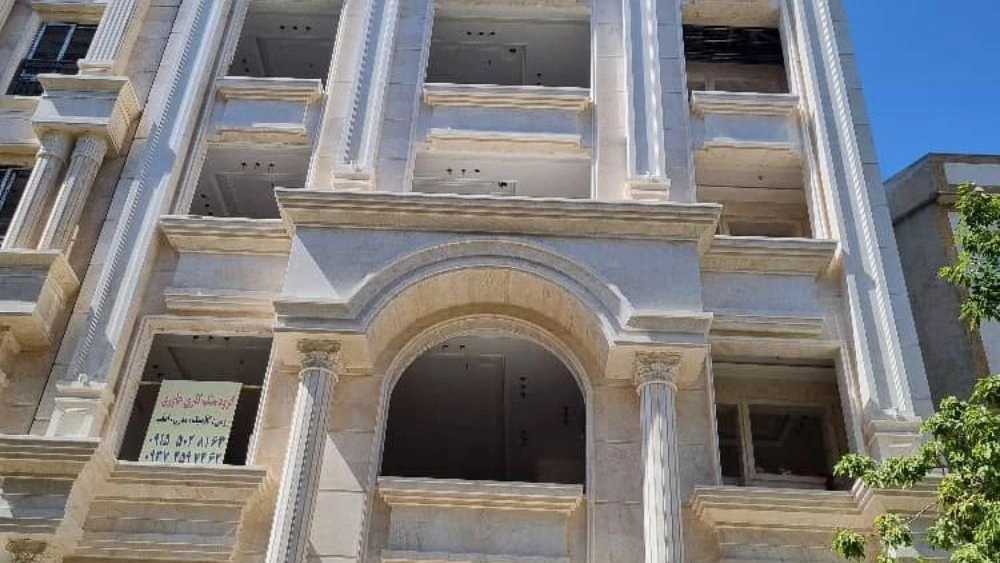
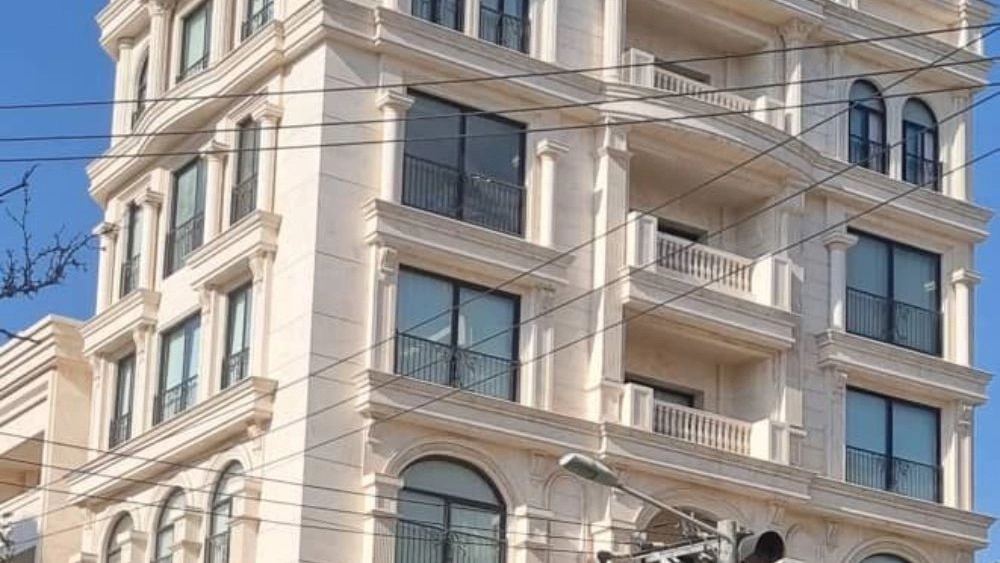
When talking about luxurious and eye-catching architecture in big cities like Mashhad, the facade of the building is the first and most important part that attracts the attention of every viewer. In recent years, the taste of builders and property buyers in the luxury areas of Mashhad has been inclined towards classical and neoclassical designs. In the meantime, the Roman facade with stone slabs in Mashhad is known as a symbol of wealth, power and eternal beauty. The use of monolithic and large stones (slabs) in the implementation of the complex details of the Roman facade is a challenge that only skilled craftsmen can handle. In this article, we are going to examine this architectural style in detail, the advantages of using stone slabs, and introduce Khavari stonework group as one of the pioneers of implementing these special facades in Razavi Khorasan.
Why is the Roman facade so popular in Mashhad?
As the second largest metropolis of Iran and the spiritual capital of the country, Mashhad has always been a platform for huge constructions and luxurious hotels. Roman facade with stone slabs in Mashhad has many fans because of the grandeur it gives to the building. This style, which has its roots in ancient Roman and Greek architecture, is known for elements such as tall columns, carved capitals, inscriptions, large arches and symmetry.
But why has this style become such a trend in Mashhad?
- Sense of luxury and luxury: Apartment buyers in privileged areas of Mashhad, such as Sajjad, Ahmedabad, Hashemiyeh and Malekabad, are looking for buildings that are different and special even from the exterior.
- Durability and durability: Use of stone in the facade, especially travertine stones, which are the main material of the Roman facade, high resistance to changes in Mashhad's climate (dry cold and extreme heat). It has.
- Dazzling lighting: Due to its many protrusions and depressions, the Roman facade acquires a dreamy effect at night with a basic lighting that makes the city of Mashhad more beautiful.
The difference between slab stones and longitudinal stones and tiles
To better understand the importance of a Roman facade with stone slabs in Mashhad, we must first know what stone slabs are. In the traditional method, stones were cut with small widths (for example, 40 cm). But stone slabs are very large pieces of stone that are cut into large sheets. The dimensions of these stones sometimes reach 2 x 3 meters or more.
Using slabs in the Roman facade has countless advantages, which Eastern Stonework Group has special emphasis on:
- Visual integration: In slab stones, the straps are minimized. This means that the facade of your building will look like a uniform painting.
- Stone pattern display: The real beauty of natural stones lies in its veins and waves. In small stones, these designs are cut, but in slabs, the stone design is completely revealed.
- Book Match and Four Match: Using slabs, you can create stunning parallel designs (like the opening of a book) on the facade walls, which create a masterpiece in the classic view.
The challenges of implementing a Roman facade with stone slabs in Mashhad
Executing a Roman facade with stone slabs in Mashhad is not for everyone. Unlike small stones, which are relatively easier to install, installing heavy slabs at a height, with complex Roman style details (such as columns and tools), requires high technical knowledge and advanced equipment.
1. Heavy weight and basic restraint
Slabs are very heavy. If their installation is not done properly, there is a risk of stone falling, which can be catastrophic. Eastern Stonework Group guarantees 100% safety of the facade by using the latest scoping methods and powerful metal chassis. In the city of Mashhad, which sometimes experiences strong winds and mild earthquakes, the safety of the facade is the first priority.
2. Accurate cutting of materials
Slab stone is expensive. In the Roman facade, which is full of arches and geometric shapes, the cutting work should be done with millimeter precision to minimize the small size of the stone. The expert team of Eastern stone work group designs the cutting plan with precise engineering calculations before starting the work in such a way that you have the least wastage of stone and the cost of the employer is saved.
3. Infrastructure and chassis
To install slabs in the Roman facade, you cannot rely on mortar alone. Dry or combined installation methods are often used. The metal substructure must be so precise that the final surface is completely level and perpendicular. The smallest unevenness in slab installation, due to its wide surface, is immediately visible and calls the quality of the work into question.
The best stones for Roman Slab facade
In projects of Roman facade with stone slabs in Mashhad, choosing the type of stone is very important. Usually, the following stones are used the most:
- Travertine: The most popular stone for Roman facades. The bright travertines (white and cream) of Abbas Abad, Haji Abad and Ateshkoh have a unique splendor in slab dimensions. Due to proper porosity, these stones have excellent adhesion with mortar and are very resistant to the cold winter of Mashhad. However, the first proposal of Eastern Stonework Group for the exterior in Mashhad is high-quality travertine.
The stages of project implementation by Sangkari Khavari group
When you entrust the project Roman facade with stone slabs in Mashhad to a professional team, the work steps should proceed systematically. Eastern stone work group manages the execution process as follows:
- Free visit and consultation: The experts of the group first visit the project and suggest the best design and type of stone according to your location, budget and taste.
- Three-dimensional (3D) design: Before buying even a piece of stone, the facade of your building will be designed in three dimensions so that you know exactly what the final result will be. The slabs available in the Mashhad stone market or the country's quarries will help you get a healthy, crack-free and well-shaped stone.
- Chassis and ironwork: A team of skilled welders executes the facade metal infrastructure based on calculation plans.
- Precise installation: Master stoneworkers carefully install the slabs in place using lifting and crane equipment and Roman tools (columns, capitals).
The cost of implementing a Roman facade with stone slabs in Mashhad
One of the frequently asked questions of employers is the final price. The fact is that the Roman facade with stone slabs in Mashhad is considered one of the expensive and luxurious facades. The factors affecting the price are:
- Slab stone type and quality: Super and export stones have a higher price.
- Design complexity: The more columns, statues and stone tools, the higher the execution fee.
- Building height: Working at height requires special scaffolding and more safety equipment.
- Execution quality: The price difference is often in the quality of the infrastructure and the elegance of the installation. It lies.
However, Eastern stone work group is committed to providing the fairest price with the highest possible quality to the citizens of Mashhad by properly managing resources and reducing material waste. Investing in the facade of the building directly multiplies the value of your property.
Why is the Eastern stone work group the best choice?
In the crowded construction market of Mashhad, it is difficult to find a contractor who has both technical expertise and is committed to time and quality. Khavari stone work group is a familiar name in Khorasan construction industry with years of brilliant experience in implementing luxury projects.
Distinctive features of the Eastern stonework group are:
- Expert and trained team: All personnel, from design engineers to craftsmen and workers, have received specialized training in working with slabs.
- Advanced tools: Use of precision cutting devices and modern installation tools to prevent damage to the stone.
- Strong resume: Implementation of dozens of successful projects Roman facade with stone slabs in Mashhad which can be visited
- Execution guarantee: We are confident in the quality of our work and we guarantee all the services performed.
- Speed in execution: Project delivery on time is one of the ethical principles of Khavari Group.
The effect of Mashhad climate on the choice of installation method
The climate of Mashhad has many temperature fluctuations. Hot and dry summers and cold and frosty winters can be killers of stone facades if principles are not used. Slab stone has more expansion and contraction due to its large surface. If the expansion joint is not observed in the installation or the mortar behind the stone is not suitable, the stone will crack or become loose.
Khaori stone work group fully aware of Mashhad's climate, uses concrete additives and special adhesives in mortar or uses dry installation methods (Dry Fix) to control these temperature stresses. These are the details that determine the difference between an ordinary work and an engineering masterpiece.
The combination of materials in the Roman facade
Although travertine stone is the main material, in more modern classic designs, sometimes the combination of slab stone with other materials is also seen. For example, the use of gold or bronze metalwork in fences and window frames doubles the glory of the Roman facade with stone slabs in Mashhad. By mastering the harmony of color and texture, the designers of Khavari Group offer you the best combinations to have a distinctive building in your neighborhood.
Maintenance of the Roman slab view
After implementing the facade, it is also important to maintain it. Air pollution and dust can reduce the luster of the stone over time. The polished surface of slab stones absorbs less dirt and is easier to clean than ax or wind stones. However, Eastern Stonework Group suggests that every few years you restore the first-day shine to the building by using nano-wash and flooring services. Our post-implementation services also include advice for proper maintenance.
conclusion
Execution of a Roman facade with stone slabs in Mashhad is a combination of art, engineering and experience. This facade style not only gives a great visual beauty to the city, but is also a smart investment to increase the added value of your property. But this beauty and value is realized only when the performance is done by a professional team that knows the subtleties of working with large slab stones.
Eastern stone work group is ready to turn your dream of having a luxurious and magnificent building into reality, relying on technical knowledge, high operational experience and commitment to customer satisfaction. If you are looking for quality, precision and beauty, contact us today and get a free consultation. Let the facade of your building be the signature of your credibility in the city of Mashhad.